



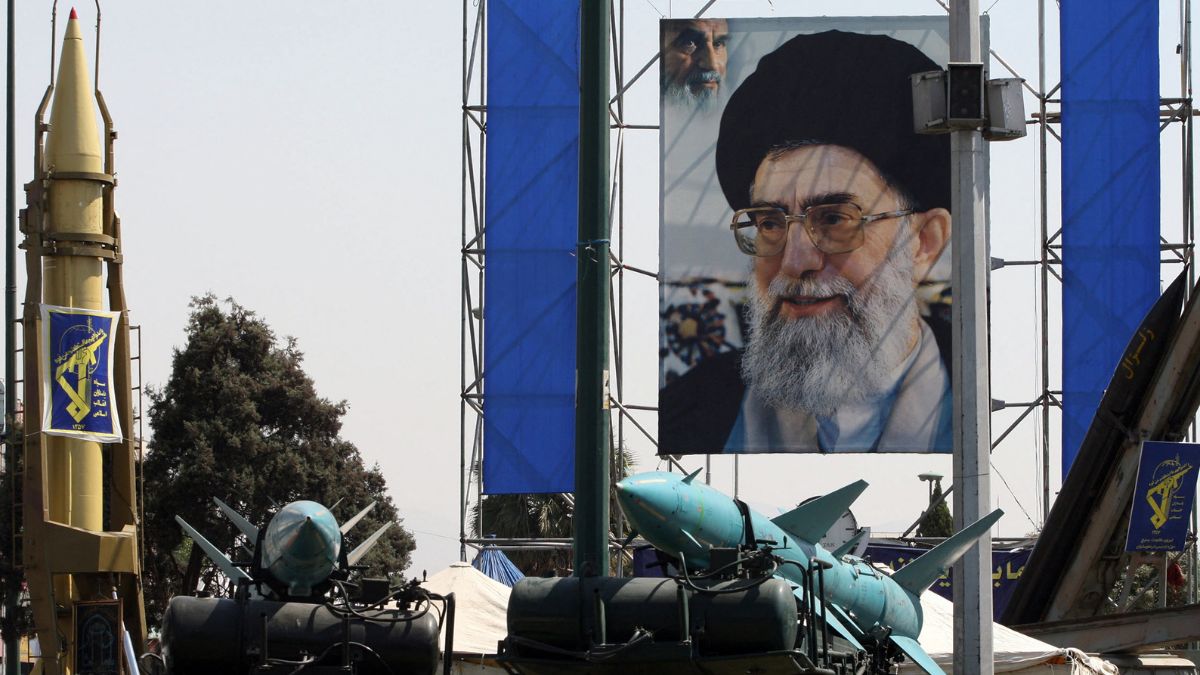
As the United States and Israel intensify their military campaign against Iran, Tehran’s primary response has been a barrage of ballistic missiles and drones aimed not only at Israeli territory but at American bases and allied infrastructure across the region. The first wave, launched on Saturday morning, was directed at Israel. Within hours, Iranian retaliation expanded to target US military installations in Bahrain, Qatar, the United Arab Emirates, Kuwait, Jordan and Saudi Arabia. Latest reports indicate the targets in the Gulf states have spread to hotels, resorts, airports and embassies. Ships passing through the Hormuz Straits are also not spared.
Dismantling Iran’s ballistic missile system presents an extraordinary military challenge for the US and Israel, largely because of how the arsenal is housed and managed. Iran has worked really hard to fortify its ballistic missile capabilities against Western/Israeli attacks. It has built sophisticated underground “missile cities”, carved deep into mountain ranges. Some of them go deep up to 500 metres below ground, and are spread across provinces such as Kermanshah and Semnan and even coastal areas near the Gulf.
Their depth and hardened design render conventional airstrikes largely ineffective. Penetrating such sites requires specialised bunker-busting munitions delivered by stealth aircraft. In recent operations, the United States has deployed B-2 bombers armed with heavy precision-guided bombs designed to punch through reinforced rock and concrete before detonating. Even then, complete destruction is far from guaranteed. Collapsing entrances may seal a facility temporarily, but vast internal networks can remain intact.
Aerial bombardment alone cannot erase the engineering expertise or reliably destroy every component of missile production. Damage assessment from the air is uncertain, especially when facilities lie hundreds of metres underground. Military analysts note that verifying total destruction could eventually require special operations forces on the ground, a step that would risk major escalation.
Another major challenge is that most of the missile force is mounted on mobile truck platforms, which are kept hidden in tunnels. They emerge quickly, launch within minutes and retreat to safety before counterstrikes arrive. Iranian engineers disperse manufacturing components across multiple sites to prevent a single strike from crippling the system. They are also good at breaking ballistic missiles into smaller, concealable components which can be transported discreetly and reassembled elsewhere.
Iran has also been able to bounce back from setbacks rather quickly. Following last June’s American and Israeli strikes against the ballistic missile arsenal, production was back online quickly, producing dozens of missiles per month.
The scale of Iran’s programme makes it the largest and most diverse missile arsenal in the Middle East. Lacking a modern air force and still relying in part on ageing aircraft such as the MiG-29 and the F-14 Tomcat, Tehran has invested in ballistic missiles as its primary long-range deterrent. Before last June’s conflict, estimates placed its inventory at around 3,000 ballistic missiles. Although sustained strikes have degraded this stockpile, assessments suggest numbers may still stand near 2,500, with ambitions to expand significantly in the coming years.
Key systems such as the Sejil, Khorramshahr and Kheibar are believed to possess ranges of 2,000 to 2,500 kilometres, placing Israel and American bases across the region within reach. Iran has also invested in lighter composite materials to extend range. There are also reports about hypersonic variants capable of hitting speeds of more than five times the speed of sound. Complementing these high-end weapons are mass-produced Shahed-136 loitering munitions, inexpensive drones designed to saturate air defences and exhaust interceptor stocks.
For Western and Israeli defence planners, this missile complex now represents the principal strategic threat. Iran’s nuclear programme, heavily damaged in earlier strikes, appears contained for the moment. The immediate danger lies instead in the volume and diversity of conventional missiles capable of overwhelming sophisticated defence systems such as Iron Dome and US regional interceptors.
The conflict has thus evolved into a grinding war of attrition. The United States and Israel seek to methodically dismantle launchers, storage depots and production hubs in order to delay Iran’s rebuilding efforts by years. Tehran, in turn, aims to absorb the blows while unleashing repeated waves of missiles and drones against military and economic targets across the region.
