



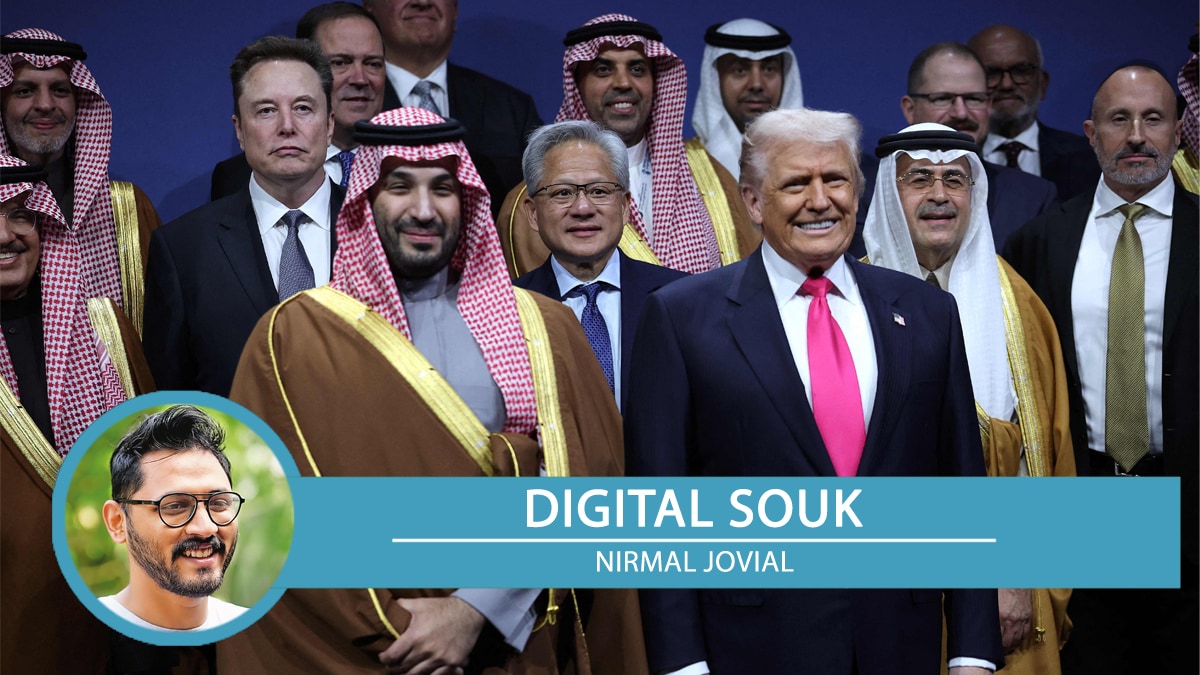
Recently, when US President Donald Trump hosted a high-profile black-tie dinner for Saudi Crown Prince Mohammed bin Salman at the White House, even Elon Musk attended, despite having avoided public visits to the White House since his feud with Trump earlier this summer and his removal from DOGE’s leadership.
That alone signalled how the US government, along with some of the most influential figures in tech, especially in AI, now sees Saudi Arabia as integral to their plans.
Soon after the dinner, the Wall Street Journal reported that the US had authorised the export of advanced AI chips—the equivalent of up to 35,000 Nvidia Blackwell units—to the Saudi-government-backed AI venture Humain. Humain and Musk’s xAI also plan to jointly develop data centres in Saudi Arabia, including a 500-megawatt facility.
With these moves, Washington expects Saudi “sovereign AI” to become dependent on US hardware and software, giving it long-term leverage.
The US decision is driven by a mix of economic, geopolitical, and strategic interests—not charity. Saudi Arabia faced severe criticism in the West after the 2018 Khashoggi murder and the Yemen war, but under Trump, realpolitik and the race for AI dominance have eclipsed human-rights rhetoric. Similarly, the US is supplying AI chips to the UAE’s state-backed sovereign AI company—the same firm in which Microsoft has invested $1.5 billion for an equity stake and a board seat.
Saudi Arabia and the UAE had previously hedged with Chinese tech, and the current US measures aim to prevent Gulf oil wealth from accelerating China’s AI rise. Riyadh has now committed roughly $600 billion to over $1 trillion in U.S.-linked deals, including AI data centres on American soil, tech partnerships, and broader investments. Beyond collaborating with xAI, Humain is planning joint projects with Nvidia, AMD, and other major players. This redirection of oil capital into US-aligned AI infrastructure is exactly what Washington wants.
Like the UAE, Saudi Arabia is also strategically positioned, with abundant energy, rapid infrastructure development, and strong connectivity across the Middle East and Global South—qualities that make it especially attractive to the US American tech giants have also pushed for loosening restrictions, arguing that the Gulf offers cheap land for hyperscale data centers—something the US lacks at scale—along with vast, reliable energy.
With Saudi Arabia becoming a major non-NATO ally in the Gulf and receiving full US export licenses for cutting-edge AI chips, Washington is pulling Riyadh further from Beijing in the US–China tech rivalry. The goal is a US-aligned AI hub in the Gulf, countering China’s ambitions in the region.
Chinese companies such as Huawei, Alibaba, and Tencent had expanded aggressively in the Gulf before 2025, offering unrestricted access to their AI chips. Now, with US hardware flowing into the region’s most powerful economies, Washington can ensure that Middle Eastern data centres run on Nvidia or AMD chips and rely on Microsoft Azure, AWS, or other US-aligned software stacks—making any future switch to Chinese systems costly and difficult.
As Saudi Arabia’s Humain and the UAE’s G42 become major players in the US AI arena, India remains constrained by stricter, quantity-capped licensing rules. This underscores a tiered US approach to AI technology diffusion. India may be a talent hub, but the recent moves show that Washington is prioritising countries capable of delivering massive reciprocal investments and clear strategic alignment against China.
At the same time, Saudi Arabia and the UAE’s full alignment with the US AI ecosystem has the potential to create a mixed but ultimately positive dynamic, accelerating the emerging India-Gulf innovation corridor, where Gulf capital and US technology meet Indian talent.
