



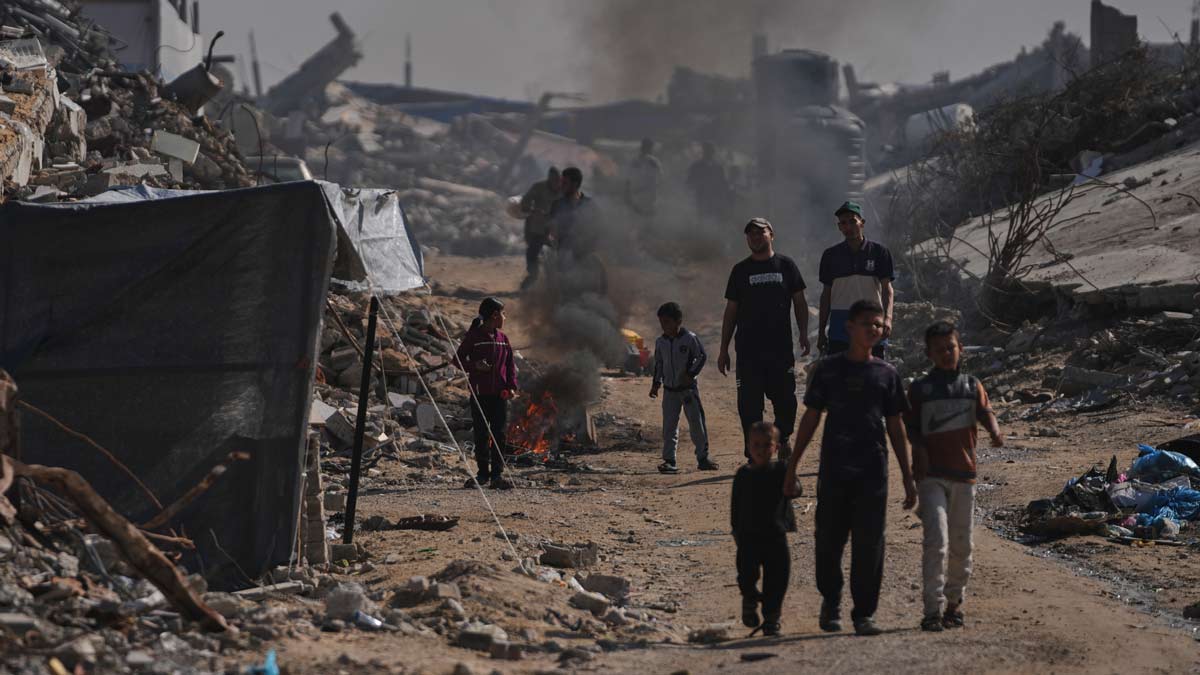
Israeli forces killed five Hamas operatives on Friday after they emerged from tunnels in eastern Rafah, in southern Gaza, an area currently under Israeli control. According to the Israel Defense Forces, about 15 operatives came out through two tunnel exits situated east of the Yellow Line, the boundary separating IDF-held territory from areas still under Hamas control. Once identified near the ceasefire demarcation point, they were targeted by the Israeli Air Force using information passed on by troops on the ground. Six operatives were killed, while five others surrendered to soldiers of the Nahal Brigade and were subsequently taken for interrogation by the Shin Bet security agency.
IDF sources described the gunmen as posing an immediate threat to forces deployed in southern Gaza. Army Radio reported that the operatives belonged to a dwindling group of around 200 fighters trapped inside what the military calls a “terror pocket” — a section of Hamas’s tunnel network in eastern Rafah that remains behind Israeli lines after months of operations. The area near the Jenina neighbourhood, where yesterday’s incident took place, is believed to be the centre of this isolated underground enclave. As the IDF continues to destroy tunnel routes and seal off remaining exits, more Hamas operatives are compelled to emerge in recent weeks; many have been intercepted or killed as they attempt to flee. Earlier this month, Israeli troops shot four operatives who crossed the Yellow Line during tunnel-clearing operations, killing three.
Senior commanders, including Major General Yaniv Asor of the Southern Command and Brigadier General Barak Hiram of the Gaza Division, conducted an on-site assessment following Friday’s events and approved follow-up operational plans. Two IDF brigades continue to maintain control of the area while conducting extensive searches for remaining operatives. Despite an October ceasefire agreement, this week has seen an uptick in violence, with mediators such as Qatar warning that renewed clashes risk destabilising the already fragile truce.
The IDF recently uncovered what it described as one of the most significant Hamas tunnel systems found to date. The underground complex, discovered in Rafah beneath a densely populated neighbourhood, was identified as the place where the body of Lieutenant Hadar Goldin had been held since he was killed during an ambush in the 2014 Gaza war. Earlier this month, Israel recovered his remains. The tunnel, which is more than seven kilometres long and descending 25 metres underground, contained some 80 rooms used by Hamas commanders for prolonged stays, the storage of weapons and the planning of operations. Parts of the network extended beneath a UNRWA compound as well as mosques, clinics and nursery schools.
The IDF said the Yahalom combat engineering unit, working with the Shayetet 13 naval commando force, uncovered rooms functioning as command posts for senior Hamas leaders, including Muhammad Shabana, who was killed in May along with Mohammed Sinwar. The military also reported the arrest of Marwan al-Hams, who was allegedly involved in determining Goldin’s death and who played a role within Hamas’s operational infrastructure.
Further north in the Gaza Strip, Israeli airstrikes this week killed Abdallah Abu Shamala, the chief of Hamas’s naval forces, and Fadi Abu Mustafa, an operative involved both in holding Israeli hostages and in tunnel construction for Hamas’s Khan Younis Brigade. Their deaths were announced jointly by the IDF and the Shin Bet following a series of strikes launched in response to gunfire directed at Israeli troops stationed in the Khan Younis area. While no Israeli soldiers were injured in the initial attack, the military said the subsequent aerial response targeted Hamas infrastructure and operatives responsible for recent assaults. Five additional casualties were reported in those strikes.
The IDF described Abu Shamala as a senior commander with decades of involvement in Hamas’s naval operations, including the group’s maritime infiltration at Zikim during the 2014 war and its preparations for the large-scale assault of October 7, 2023. Abu Mustafa was identified as both a captor of Israeli hostages and an expert in tunnel construction.
Amid these developments, Israel’s security cabinet voted yesterday to form a ministerial team tasked with overseeing the second stage of the ceasefire agreement. The group will include Foreign Minister Gideon Sa’ar, Justice Minister Yariv Levin, Finance Minister Bezalel Smotrich and National Security Minister Itamar Ben Gvir, though Smotrich and Ben Gvir opposed the deal in the initial vote. The next phase of the agreement is intended to begin once all living hostages have been released; Hamas continues to hold the bodies of three deceased captives.
While no timeline has yet been set for the plan’s implementation, the United States is working with regional partners to assemble an international security force made up of troops from Arab and Muslim states.
