


In India, ‘Benegal’ has always been a name to reckon with, belonging to such illustrious personalities as the Benegal brothers (Sanjiva Rao, Sir Narsing Rau, Sir Rama Rau and Shiva Rao), Air Commodore Ramesh Benegal and filmmaker Shyam Benegal. But there was a family of Benegals from Calcutta—Balkrishna, Sudarshan and Arvind, fine artists all—who, though they were famous within the city, were virtually unknown outside. It is time they were brought out from the shadows.
It all started with the B.B. Benegal Studio, founded in a nondescript two-room flat in Calcutta in 1930 by Balkrishna Bhawanishankar Benegal, a Konkani-speaking Mangalorean Saraswat. He was born in Udupi in 1905 and won his first gold medal for painting at his Mangalore school. Rabindranath Tagore’s visit to Mangalore in 1922 inspired the young Balkrishna to move to Calcutta after school to join the Government School of Art and Craft. Seeing his sample work, the English principal Percy Brown admitted him to the third year straight-away, and he completed his five-year degree in fine art in just three, by the end of which he had won several gold medals.
Noted publisher and printer Chintamani Ghosh, whose Indian Press in Allahabad had first printed Rabindranath’s works, including the Nobel-winning Gitanjali, spotted Balkrishna’s work early at an exhibition at the GSA. As soon as he passed out of art school, Chintamani invited him to Allahabad to work as resident chief illustrator with the Indian Press.
Chintamani died in 1928, and two years later, Balkrishna left Allahabad for Mangalore, where he got married and returned to Calcutta. He found work as a poster artist for Hindi movies, which brought him into close contact with the celebrities of the time like Begum Akhtar, Devika Rani, Sabita Devi, V. Shantaram and K.L. Saigal. His work was soon in demand. He shifted to a two-room flat on Dharamtalla Street in central Calcutta and set up his studio in one of the rooms.
Around 1939, his nephew Sudarshan Benegal (eldest of a brood of ten which included filmmaker Shyam Benegal) came from Hyderabad, also to study fine art at the GSA. An extraordinary artist himself, he too sailed through the course in just three years and joined the B.B. Benegal Studio as its manager and poster artist, becoming an integral part of the studio and the family. Thanks to him, the studio’s business began to boom.
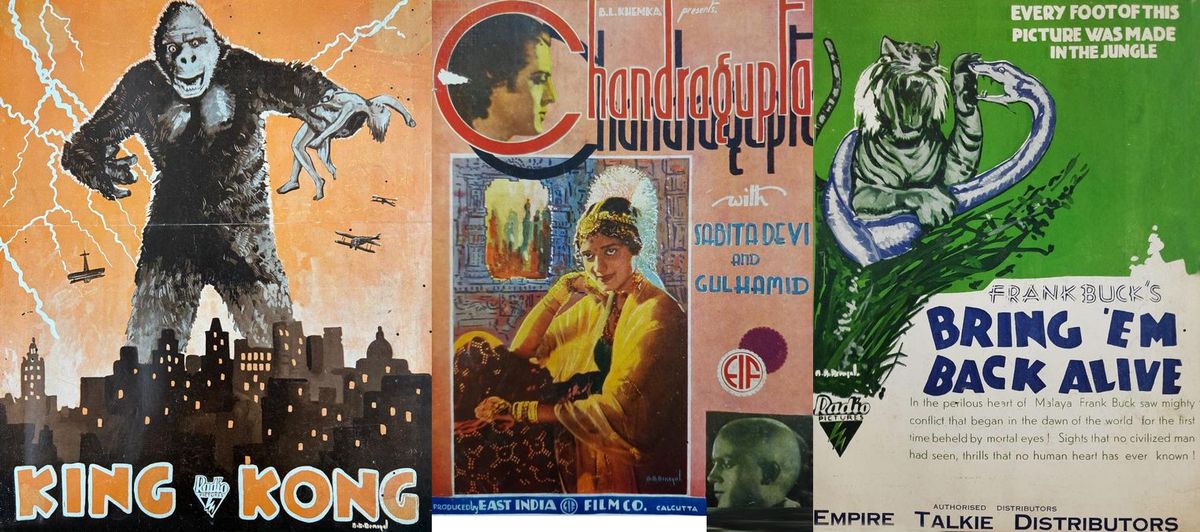 Art & craft: Film posters produced by the B.B. Benegal Studio
Sometime in the early 1940s, Balkrishna moved his studio and family (he had four children by then) to a bigger rented place further down the road, next to the recently built Jyoti Cinema. After the city was evacuated following the Japanese bombing during World War II, accommodation became cheap. Balkrishna rented two flats: one to live in and another above it for his studio.
He found that Hindi film distributors were tardy paymasters and gradually began working only for foreign movies, where assignments were regular and well-paid. The B.B. Benegal Studio was emerging as a name to reckon with. “As one of the first Indian print designers to embrace the emergent new art deco style, Balkrishna’s work uniquely bridged American influences with Indian themes, crafting a distinct visual language for film promotion,” says Rajesh Devraj, author of The Art of Bollywood, a book on publicity design in Indian cinema.
Balkrishna was closely associated with the erstwhile Lighthouse and New Empire, two premium theatres in Calcutta, as well as the Globe, Elite and Minerva. All of them primarily screened foreign movies. New Empire had a unique movie hall which could be converted into a modern stage when required. Celebrated performers there included dancer Uday Shankar and his younger brother, sitar player Ravi Shankar; celebrated dancers Shantha Rao, Balasaraswati, Indrani Rahman and Yamini Krishnamurthy; violinist Yehudi Menuhin and music conductor Zubin Mehta; P.C. Sorcar the magician and even the Westminster Choir. The B.B. Benegal Studio painted posters for all of them. Uday and Ravi, who were new at the time, would plead with Balkrishna for a hefty discount. Having struggled in life himself, he would readily agree. Ravi never forgot the favour.
In his early years, Guru Dutt, another nephew of Balkrishna, was keen to be a dancer. Balkrishna filmed his self-composed snake dance, (inspired by one of Balkrishna’s paintings) and showed it to Uday who enrolled him in his India Culture Centre at Almora in Uttarakhand. However, a disillusioned Guru Dutt soon returned to Calcutta. By now he had begun to dream of becoming an actor.
Balkrishna painted for himself, too—large oils, mostly with poetic or patriotic themes, using pet symbols like the lotus (for peace and love), flames (for violence and anguish), and eyes (for the ever-watchful universe). However, for some reason, despite repeated requests from galleries and collectors, he neither exhibited nor sold his paintings. Two years ago, his oil paintings were found vandalised in his studio. Neither the culprit nor the motive was discovered.
Balkrishna’s studio went on to produce enormous posters and mammoth cutouts for the Lighthouse for blockbusters like King Kong, The Ten Commandments, Ulysses, and Samson and Delilah. Massive life-like images of Moses, King Kong or the Cyclops of Ulysses loomed over an awestruck public from the iconic mast outside the Lighthouse. The lobby of the theatre would turn into a snow-covered Vermont for Danny Kaye’s White Christmas or a sultry Egyptian landscape for The Ten Commandments.
Those were the halcyon days of the studio. In 1974, Balkrishna’s youngest son Arvind Benegal also joined the studio. He was a similarly prodigious talent who, a year after joining the GSA, was given membership of the Academy of Fine Arts, normally reserved for established artists. By then, the government had replaced out-of-turn promotions with scholarships. True to tradition, Arvind won the scholarship and effortlessly breezed through the course. Initially, he set up his own studio in his house with a partner, but this did not work out and he moved to Bombay to work with Guru Dutt’s brother Atma Ram. This also was a failure and in 1974, he returned to Calcutta to join his father’s studio.
However, by then the import of foreign movies had begun to shrink, and with it, the studio’s chief source of income. They were now compelled to work for Hindi movies, which was not as lucrative. The studio limped on painfully. Paying the staff was becoming increasingly difficult. One by one, they left. They had worked with Balkrishna for more than 30 years and were heart-broken.
Balkrishna died on January 25, 1987, but his legacy lives on. “His work embodied a rare blend of artistic depth and commercial appeal, transforming film publicity into an artform in its own right,” says Aparna Subramanian, a Fulbright Fellow and audio-visual archiving expert. “His creations reflected precision, imagination, and a deep respect for his craft.”
Sudarshan retired in 1993. Arvind tried hard to keep the studio running, but by 2000, thanks to the advent of cheap, digitally printed high-resolution posters, work further dwindled. The B.B. Benegal Studio officially closed in 2002, foreshadowing the end of the era of hand-painted posters in India.
Asha Gangoli is an author and daughter of B.B. Benegal