



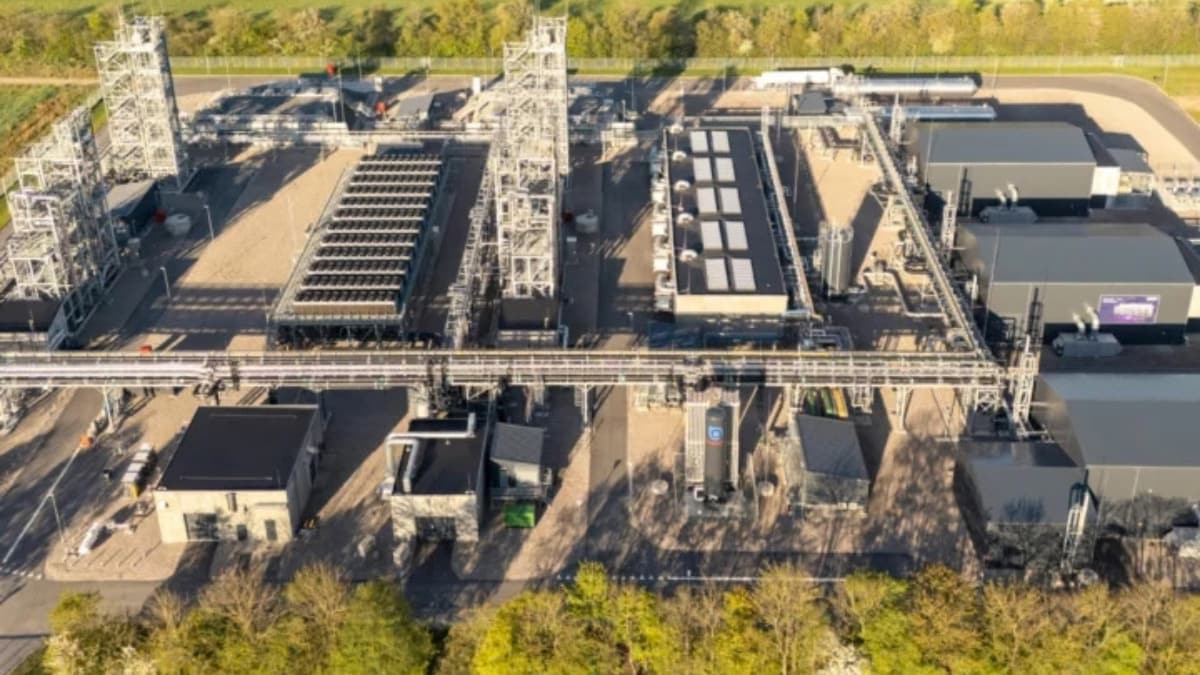
In a major push for maritime trade and sustainable development sectors, the foundation stone for a ₹2,300-crore e-methanol plant was laid on Saturday at the Deendayal Port in Gujarat's Kandla.
The upcoming plant, which will be the first port-based facility of its kind in India, will have a capacity of 150 metric tonnes (MT) per day, and will use renewable power, water, and biogenic CO2 for production.
However, the production of e-methanol as part of the country's green shipping push is not the only outcome.
This is because the Deendayal Port's strategic location on India's western coast—as well as the quantity of e-methanol that has been targeted for production—has placed the plant squarely at the centre of plans to supply this green fuel to vessels plying on the Asia-Europe International Trade Corridor, and to export it as well.
With the e-methanol produce expected to cost $750 per metric tonne as compared to the global rate of $1,300 per metric tonne, the country aims to become a global leader in the production and supply of green fuel.
The e-methanol plant was also briefly discussed by Nilabhra Dasgupta, Deputy Chairperson at the Deendayal Port Authority (DPA), at THE WEEK Maritime Conclave 2026, as a part of a larger conversation about the Kandla-based port's green push, during a session on how ports are contributing to the nation's prosperity.
Dasgupta had also described how plans were underway to increase the capacity of India's first megawatt-scale green hydrogen plant by another 5MW—just a year after its construction at Kandla.
This is significant for the Deendayal Port, which is already one of just three designated Green Hydrogen Hubs in the country, with the other two being the Paradip Port in Odisha and the V.O. Chidambaranar Port in Tuticorin.
The ₹2,300-crore plant is a joint initiative of the DPA and the Namrup-based Assam Petro-Chemicals Ltd (APCL), and will be installed in phases, as scalable modules.
Phase I of the project will help the plant reach a daily capacity of 50MT at an investment of ₹1,200 crore, which will be completed by January 2027. Phase II will add the remaining daily capacity of 100MT per day at an investment of ₹1,100 crore, which will be completed by March 2027.
The capital contribution between the two partners stands at a ratio of 76:24 between DPA and APCL, with the port authority's contribution including equity capital of ₹567.32 crore, 75 acres of land, desalinated water, and renewable energy in the form of green hydrogen.
This is another reason why the Gujarat-based port being a Green Hydrogen Hub is significant: increasing the production of green hydrogen at the port makes more available for e-methanol production, among other uses.
"In the years ahead, Kandla will become a green-fuel hub on the Singapore-Rotterdam route, and this plant is a model for every major port in the country," said Union Minister for Ports, Shipping and Waterways (MoPSW), Sarbananda Sonowal, at the foundation stone laying event, which also saw the Chief Ministers of Gujarat and Assam in attendance.
The upcoming facility is also poised to be one of the largest e-methanol production facilities in India, which is expected to create more than 3,500 direct and indirect jobs.
