



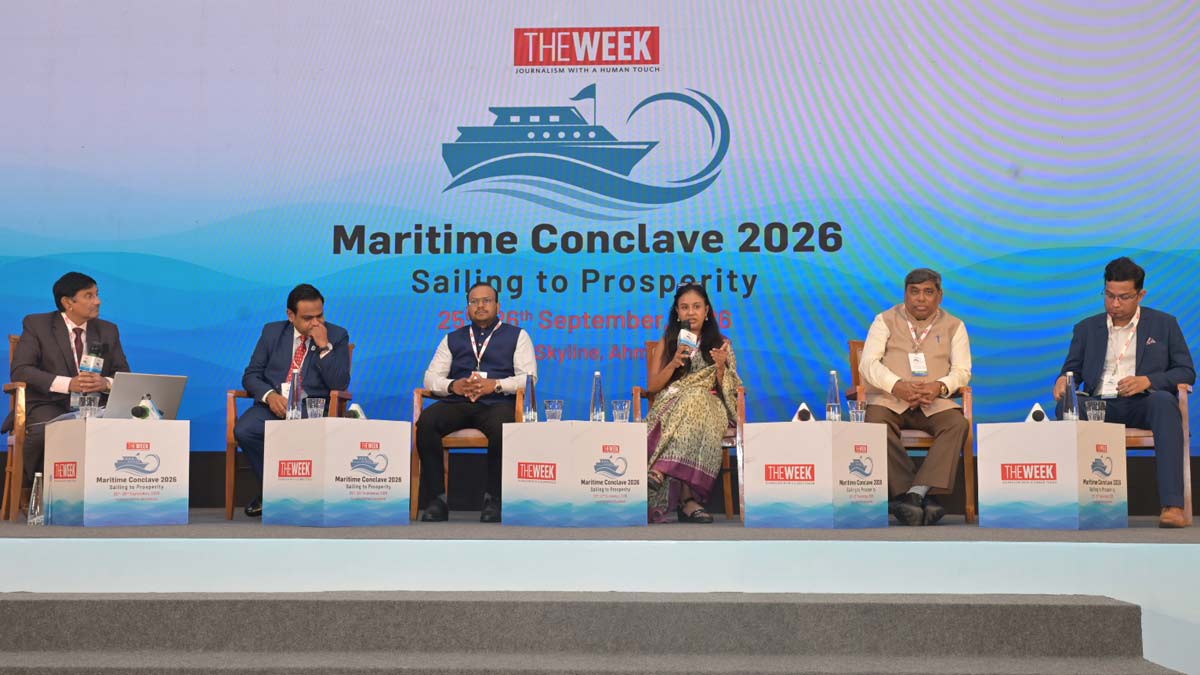
Gone are the days of maritime worker safety in India being restricted to a few “incident reports” only to be forgotten in file cabinets. The world leader in ship recycling has now turned to rigorous analytical monitoring and continuous worker skilling in the sector, as India looks to lift occupational safety from basic statutory compliance into a predictive, ecosystem-wide safety culture.
Pallavi Mansingh, National Project Coordinator at the International Labour Organization (ILO), stressed that long-term safety hinges on tracking near-misses and evaluating operational patterns.
Mansingh, during a discussion at THE WEEK Maritime Conclave 2026 in Ahmedabad, said: “While compliance creates the initial push, a genuine safety culture is taking root on the ground.”
“What becomes extremely critical for us also is to move beyond set formats of reporting and get into an analytical mode,” she added.
The ILO National Project Coordinator further prophesied that skilling and monitoring must encompass the entire industrial cluster, including seasonal labourers who transition between yard cutting and downstream processing.
Effective safety, Mansingh noted, relied on evaluating how thoroughly workers absorb training and apply safety-oriented behaviours in high-risk environments.
Other experts at the event backed this human-centric shift.

Vidyadhar Vasudeo Rane, General Secretary of the Alang Sosiya Ship Recycling and General Workers Association, spoke about the historical reforms, noting that “workers are no longer disposable day-labourers; they are certified industrial professionals.”
Focus on women worker safety
At the conclave, Mansingh highlighted a vital but frequently overlooked dimension of industrial health—the distinct occupational safety and healthcare needs of female workers operating across secondary recycling markets.
“While women are rarely employed in primary ship-cutting on the beach, significant numbers of women work in downstream secondary processing—sorting scrap, handling heavy anchor ropes, and managing re-rolling shop inventories,” Mansingh said.
She doubled down on the fact that providing female workers with formal occupational safety training, ergonomic tools, and healthcare coverage under the Employees' State Insurance Corporation (ESIC) was critical for an inclusive safety framework.
Other industry leaders and technical experts also spoke about the economic and environmental angles that affect recycling.
Mansingh and Rane were joined by Buoyancy CEO Prasad Sawant, Sustainable Ship and Offshore Recycling Programme Dr Anand Hiremath, and Bansal Shipbreakers COO Rohit Agarwal in the first panel of day two of THE WEEK Maritime Conclave 2026. The discussion on ship repairing was chaired by Indian Maritime Centre CEO Tushar Pradhan.
