



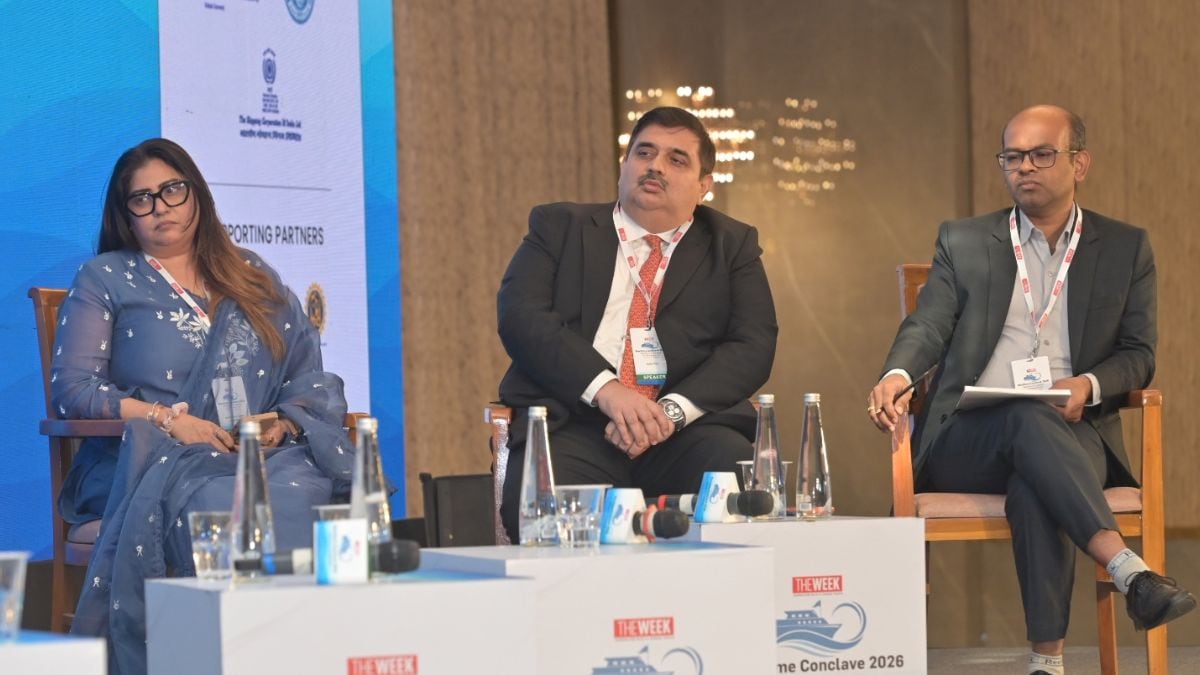
THE WEEK Maritime Conclave 2026 already explored a lot of exciting questions in its first day—how India can safeguard its strategic energy corridors against corrosive geopolitics, how ports are contributing to the country’s prosperity, and how to scale up domestic commercial shipbuilding.
Yet, as Cmde R.S. Vasan (Retd), Regional Director at the National Maritime Foundation—and the moderator for the final panel of day one—rightfully pointed out, size, speed, and scale in steel, software, and shipping lanes mean nothing without the human skills behind them.
This was the key focus of the final panel of day one of THE WEEK Maritime Conclave 2026: transforming the scale and skill of India’s maritime training ecosystem ‘from lame to legendary’, as Cmde Vasan’s presentation said.

Prof. Jitesh J. Thakkar, Dean at Gati Shakti Vishwavidyalaya (GSV)—India’s first Central University dedicated to transportation and logistics—answered this challenge by outlining the GSV’s tier-oriented modes of skilling those meant for the maritime sector of the future.
“Ports and waterways are growing faster than the workforce; skills are now the binding constraint,” he explained, detailing how workers, supervisors, and executives have been supported by means of nearly 60 strategic MOUs it signed with industry stakeholders, naval firms, port authorities, and the academic world.
Amit Oza, CEO, Astramar Shipping & Trading Services, widened the discussion and highlighted a crucial commercial skill gap: that while Indian seafarers rank second globally, overseas maritime hubs have become facilities “manned by Indians, funded by Indians, and servicing the Indian cargo from a foreign jurisdiction”.
Bridging this divide, he argued, requires establishing industry-sponsored talent pipelines and asset-based financing expertise, for which global models like Singapore’s MaritimeONE initiative, which has disbursed over S$20 million, are a great reference point.
Prof. Giriraj Tejra, Principal, Ganpat University’s Faculty of Maritime Studies, as well as Dr Chirag Patel, Registrar at Gujarat Maritime University, again zoomed in on specific educational initiatives at their universities dedicated to actually effecting a transformation in maritime education over the years.
“To keep pace with decarbonisation, we partnered directly with shipping lines to design specialised dual-fuel propulsion modules,” explained Prof Tejra, adding that these collaborations were in line with a four-pillar framework centred on skilling, reskilling, upskilling, and life skilling.
“Through our ₹28 lakh Virtual Reality laboratory at our transit campus at GNLU … (our students) virtually observe how commercial vessels and engine rooms operate, how port control rooms and shipyards function, how terminal logistics take place, and how mock arbitration moot courtrooms are conducted," noted Dr Patel.
Adding a critical personal dimension to mariner welfare, Aishwarya Gupta Pilankar, Director, Nautical Marine Management Services, clarified that financial resilience for a mariner is more about being prepared for the future that the sector brings, rather than being able to earn in foreign currency and spend in Indian rupees.
"Before you sign on, what are you signing? Please read it carefully for all the new students here … Read each and every paragraph and each and every line. Know what is covered? What is excluded?" she advised the young mariners in the crowd, focusing on the women among them, who have seen the industry call for more diversity over the years.
Ultimately, the panel’s deliberations circled back to the start after taking the scenic route around topics associated with future-proofing the future of the maritime sector, bringing day one of THE WEEK Maritime Conclave 2026 to a very interesting close.
