



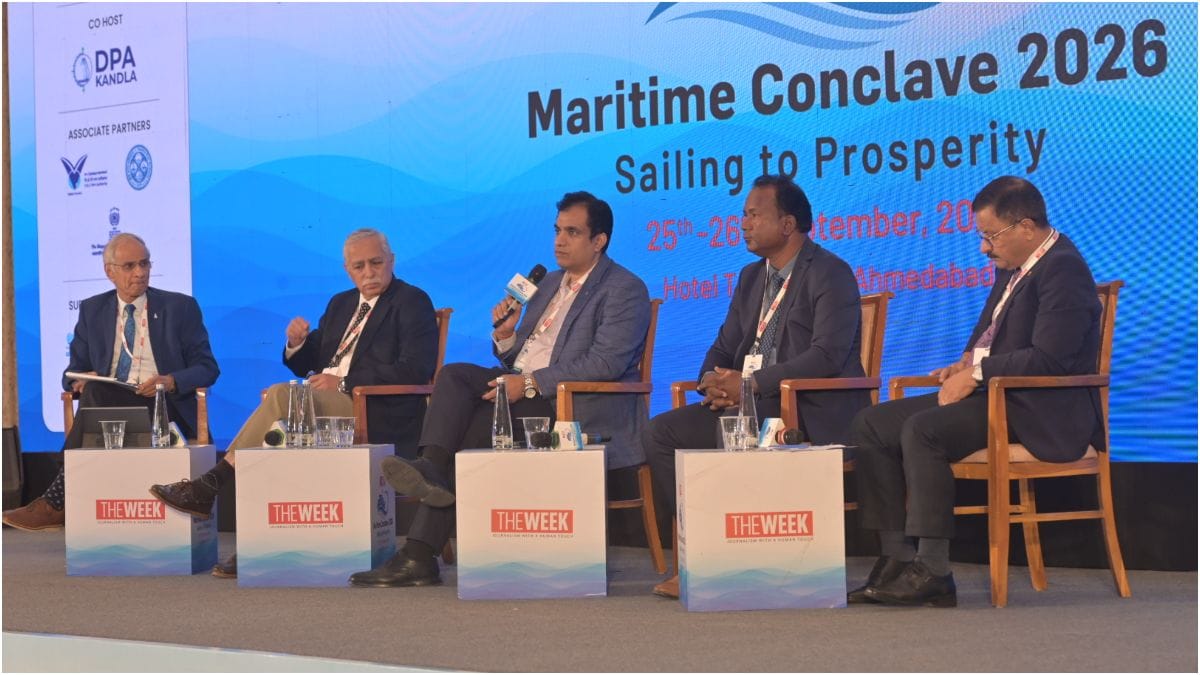
The first panel at THE WEEK Maritime Conclave 2026 in Ahmedabad brought together veteran military leaders, financial regulators, and maritime administrators to address how national economic ambitions are going head-to-head with escalating geopolitical volatility.
Moderating the session on Maritime Strategy & Security, former Chief of the Naval Staff Admiral Karambir Singh (Retd) put forward the central challenge: “How do we align our maritime security policies to enable and achieve these growth ambitions in the face of what I would term today’s ‘corrosive geopolitics’?”
While India envisions massive port expansion and a $30 trillion economy by 2047, maritime security must receive equal priority, he stressed. “There is a vital difference between energy security and the security of energy”.
Vice Admiral R.B. Pandit (Retd), former Commander-in-Chief of Strategic Forces Command, expanded on the global security environment. He warned that modern warfare increasingly targets critical trade routes and civilian infrastructure.
Pandit remarked, “To the traditional DIME framework of national power—Diplomatic, Information, Military, and Economic—I would add an ‘R’: the Resilience of our population and infrastructure.”
The discussion then moved to commercial vulnerabilities, where Captain Ashutosh Sharma, Chief General Manager at IFSCA, GIFT City, doubled down on flagging India's heavy reliance on external shipping fleets. “Over 95 per cent of India’s EXIM trade is carried on foreign-flagged, foreign-owned vessels,” Sharma noted.
True sovereignty requires domestic ship leasing and ownership because “whoever controls the financial plumbing controls the world today”, he added.
And all of this requires human security. Here is where Captain Ajit Sunil Topno, Nautical Surveyor-cum-Deputy Director General (Tech.) of Shipping at the MoPSW, elaborated on the risks facing seafarers, including arbitrary detention and abandonment.
He reminded the audience that the human crew remains irreplaceable. “Autonomous vessels are not replacing merchant mariners anytime soon,” Topno stated, urging stronger legal protections because “protecting the human element is fundamental to maritime security”.
Then, Addl. DG A.K. Harbola (Retd), Former Coast Guard Commander (Western Seaboard), spoke about the operational challenges of protecting India’s maritime zones against non-military threats and risks.
Harbola argued that “prosperous trade cannot take place without security,” adding that “maritime security, coastal security, and maritime law enforcement... form a single, integrated continuum”.
He also said that implementation of coastal security measures and law enforcement is as important as any other measures towards overall maritime security.
“All the links in the ecosystem of security should be strengthened,” Harbola stressed.
The panel went on to conclude that securing India’s maritime future requires a whole-of-government strategy uniting naval power, financial infrastructure, legal safeguards, and coastal vigilance.
THE WEEK Maritime Conclave in Ahmedabad, co-hosted by Deendayal Port Authority, is a two-day summit flagged off by Union Minister of Ports, Shipping and Waterways Sarbananda Sonowal with an electrifying address to key maritime stakeholders and keen students in the sector.
