



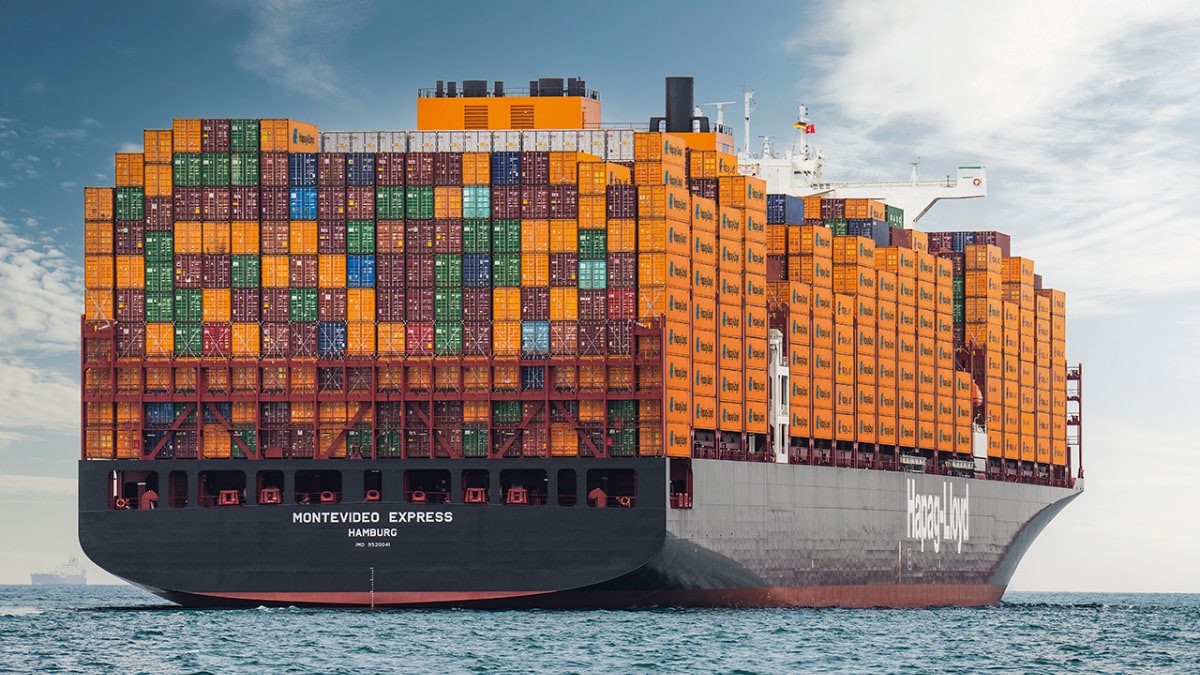
Measuring somewhere between 380-400m (or nearly four football pitches) long, Megamax container ships have long remained the absolute peak that ultra-large container vessels (ULCVs) can aspire to.
However, a new report from Alphaliner, a research and data platform for the liner shipping industry, claims that a new class of ULCVs may become a reality by 2030, spurred by a set of factors in today's maritime industry.
Meet the Gigamax, a new class of 27,500 TEU container ships about 414m long and 63.3m wide—that it says most major carriers could "theoretically" deploy at least one 'full set' of—by 2030.
Alphaliner adds that the reason for this is not just increased cost pressure to do so amid the rapid expansion of global container capacity: from about 23,200 TEUs to about 34,100 TEUs in the years since the COVID-19 pandemic, or a growth of about 47 per cent.
"Factors like the increasing price of fuel and the introduction of carbon emissions taxes will give bigger ships a competitive edge in the long run," it said, especially in the case of East-West trade routes.
What could such ships look like?
The report brings back the theoretical design it had made for such a ship back in 2021, and explains that such a ship would carry containers 25 rows across, pushing capacity past the 27,000-TEU mark using an extra bay on the forecastle (the front part of a ship's upper deck).
Limiting its speed to 18 knots and using LNG dual-fuel propulsion would be two key factors that would bring its fuel consumption down to almost that of Megamax ships, in line with the global push for decarbonisation.

Another crucial factor that may help it service ports across the world faster than say, an absolute abomination that did not fit at any port, is the fact that the size difference could be easily absorbed at many terminals due to the existing margins of port equipment, such as berths and cranes, as per estimates in the report.
What this means is that Gigamax ships could even call at Indian ports that have housed Megamax ships, such as the Vizhinjam Port, as long as their equipment have such margins.
The port had berthed the MSC Irina—one of the world's largest container ships—back in June 2025.
Who could make the first move?
Alphaliner notes that Danish carrier Maersk could lead the Gigamax charge, given that such vessels could give it the biggest benefits as compared to other possible carriers such as the Swiss carrier MSC and Chinese carrier COSCO.
This is because Maersk had held out on buying ships for a while amid uncertainty over decarbonisation in the maritime sector.
However, this situation has since changed, and with the carrier needing an upgrade from its ageing Emma-class vessels of 2006-08, Gigamax ships may just be its best bet.
The report also notes that the growth of the Gemini Cooperation—a hub-and-spoke maritime partnership between Maersk and German carrier Hapag-Lloyd that services the East-West trade routes—also calls for the use of ULCVs due to economies of scale, becoming yet another reason why the world's first Gigamax ship may emerge as blue as the skies above it.
