



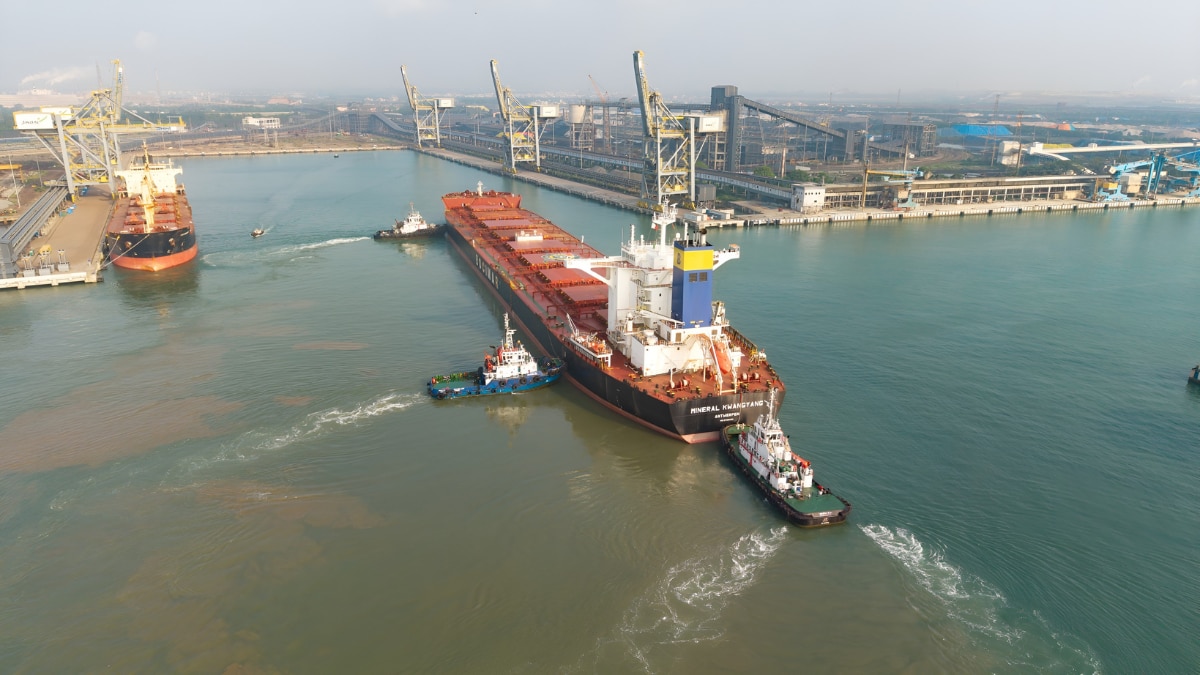
The Paradip Port Authority (PPA) on Sunday berthed its first-ever Capesize vessel at Western Dock-1 (WD-1), marking a significant boost in its ability to handle larger vessels that need deeper drafts.
This was the bulk carrier Mineral Kwangyang (IMO: 9722429), which had been carrying 152,702 metric tonnes (MT) of coking coal from the Port of Hay Point in Australia—one of the largest coal export ports in the world.
Measuring 292m in length and 45m wide, the 2016-built Belgium-flagged vessel has a capacity of 180,513 dwt, and arrived at the Paradip Port on Saturday, after which it was berthed at WD-1 in the early hours of Sunday morning.
This is a major milestone for the Odisha-based port, which opens the door for more such vessels to call in.
This, in turn, would improve cargo throughput at India's second busiest major port after the Deendayal Port—it had registered 156.45 million metric tonnes for FY 2025-26, as compared to 160.11 MMT by the Gujarat-based port.
This also comes after the PPA's overall plans to increase draft depth to 18.5m, which would allow the port to berth fully-laden Capesize vessels—allowing vessels like the Mineral Kwangyang to bring in more of its cargo when they call at the port.
Capital dredging for this purpose amounted to ₹352 crore of the ₹427.80 crore package anounced by Union Minister for Ports, Shipping and Waterways (MoPSW), Sarbananda Sonowal, during his August visit to the port just weeks ago.
Other projects within this package were focused on easing congestion and boosting key port infrastructure.
Sonowal's visit also saw three concession agreements worth ₹1,580.36 crore signed with the PPA for berth mechanisation, on a build-operate-transfer (BOT) basis.
This is part of its plan to achieve 100 per cent berth mechanisation by 2030, as compared to the current 80 per cent, which will help boost turnaround times.
