



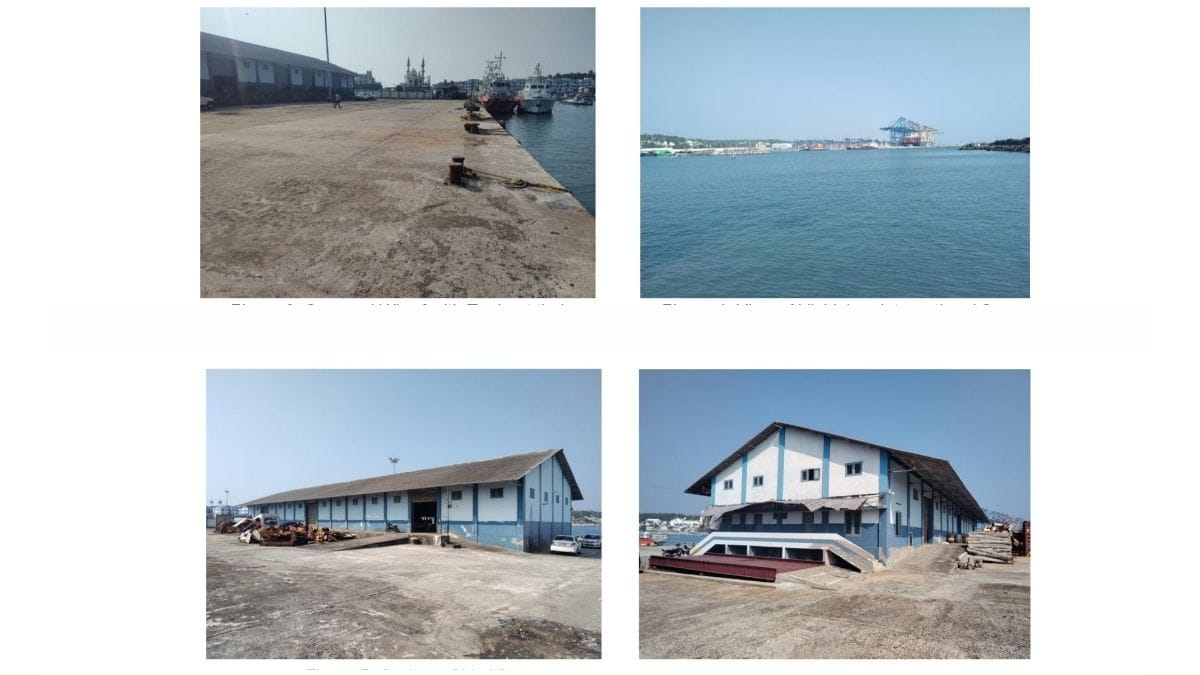
Vizhinjam is now well known for the international transhipment port. But this Thiruvananthapuram suburb also houses another small port—a government asset with a wharf, a warehouse, a crane, a weighbridge, and a tugboat. The Kerala Maritime Board (KMB), which owns and manages the facility, has not had that much luck generating substantial revenue from it, even as, just a few hundred metres away, one of the world's most talked-about new seaports has been smashing records month after month.
That is now set to change as the KMB has thrown open the doors of its godown, which is a transit shed spanning roughly 750 square metres, for private businesses to lease and operate. The bid deadline is 4 PM on July 25, 2026, and the minimum monthly rent starts at ₹1 lakh.
Why Now?
The Vizhinjam International Seaport, operated by Adani Ports, has become a phenomenon. In just 18 months since beginning operations, it crossed the two-million TEU (Twenty-foot Equivalent Unit) milestone, making it the fastest Indian port ever to hit both one million and two million TEUs. The Thiruvananthapuram port has handled over 970 vessels, including some of the world's largest container ships.
Gateway cargo, i.e., goods actually coming into or going out of India, not just passing through, has also started flowing, creating fresh demand for warehousing and logistics space in the immediate vicinity of the port.
According to KMB Chairman N.S. Pillai, they hope to capitalise on "the business opportunity created by the success of the Adani-operated Vizhinjam port". KMB hopes that the cargo could be ferried from the minor port to the international port through barges or small ships once it becomes operational.
More than a warehouse tender
This godown lease is, in the KMB's own words, only an interim measure. The board's larger ambition is to develop the entire Vizhinjam minor port under a Public-Private Partnership (PPP) model, one that would fully integrate the minor port's facilities with the adjacent international seaport, effectively creating a unified cargo logistics ecosystem.
That PPP proposal has already been submitted to the Kerala government and is awaiting approval, but the board expects it to take close to a year to materialise. The warehouse lease is designed to generate revenue in the meantime, while also signalling to investors that the minor port is open for business.
Several private companies have already knocked on KMB's door.
Who can bid?
The tender, dated June 10, is open to both private companies and government entities. Private firms need to show an average annual turnover of at least ₹60 lakh over the last three financial years and must have at least three years of experience in maritime-related fields, be it port operations, logistics, warehousing, oil and gas, or marine tourism.
The lease starts at three years and can be extended on a year-to-year basis, up to a maximum of five years in total. Rent escalates at 5 per cent annually.
Joint ventures and sub-leasing are permitted. Bidders must register and submit their proposals online at Kerala's e-tender portal (etenders.kerala.gov.in) and pay a refundable Earnest Money Deposit of ₹50,000. A pre-bid meeting for prospective bidders is scheduled for June 24, 2026.
What the successful bidder gets access to, beyond the warehouse itself, is a customs-notified, ISPS Level 1-certified port, a 85-metre wharf, a 60-tonne weigh bridge, a crane, and a tug boat, all located barely 10 nautical miles off the world's busiest east-west shipping lane, and well connected by road and rail.
