



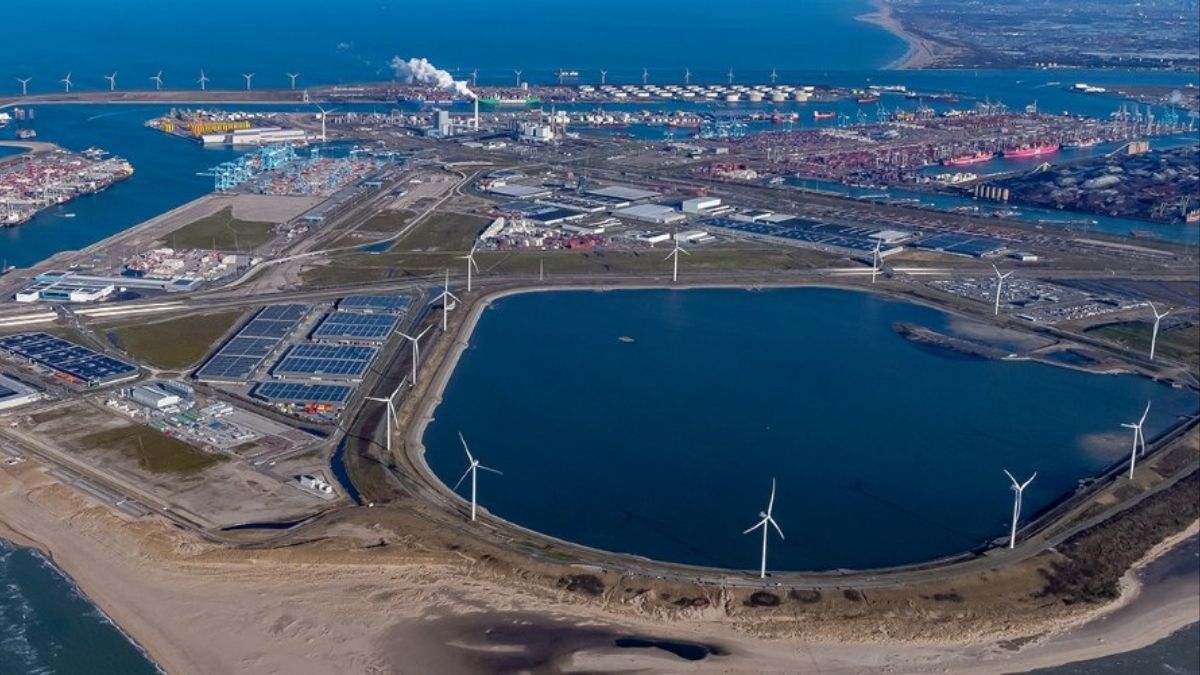
Walking through the Maasvlakte II terminals in Rotterdam is an eerie experience for any traditional maritime professional. In a facility that moves millions of containers a year, you see almost no people. Massive, driverless Autonomous Guided Vehicles (AGVs) glide silently between the quay and the stacks. Automated Stacking Cranes (ASCs) shuffle boxes with mathematical precision in the middle of the night. The only "activity" is the hum of electric motors and the rhythmic blinking of sensors.
As India prepares to break ground on the Vadhavan Port—a ₹76,220 crore ($9 billion) greenfield mega-port in Maharashtra—the question isn't whether we can build such a terminal, but whether we should and how.

The Rotterdam benchmark: Why Maasvlakte II?
Rotterdam's success isn't just about big cranes; it's about decoupling. In a manual terminal, the productivity of a ship-to-shore (STS) crane is tethered to the availability of a human truck driver. If the driver is on a break or stuck in traffic, the crane stops.
In Rotterdam's fully automated terminals (like RWG or APMT), the system is decoupled. The STS crane, often remotely controlled, drops a container onto an AGV. The AGV, guided by a grid of thousands of magnets embedded in the tarmac and 5G positioning, carries it to the stack. There, an ASC picks it up. Every move is orchestrated by a Terminal Operating System (TOS) that functions like a grand conductor.
The result? Consistency. An automated terminal doesn't get tired at 3 AM, it doesn't struggle with visibility in the fog, and its safety record is near-perfect because humans are physically removed from the "active" zone.
Vadhavan: The greenfield advantage
India has struggled to automate existing terminals like JNPT or Mundra because "retrofitting" automation is like performing heart surgery while the patient is running a marathon. You have to deal with legacy pavement, old power grids, and established labour unions.
Vadhavan is different. Because it is being built from reclaimed land in the sea, it is a blank canvas.
Draft and scale: With a natural draft of 20 meters, Vadhavan will host the world's largest "Mega-Max" vessels. These ships carry 24,000+ containers. You cannot unload these ships efficiently using manual processes; the sheer volume of data and movement requires an automated "Ghost Port" approach.
Digital first: Unlike older ports that added IT later, Vadhavan can bake its Digital Twin into the foundation. Every AGV path and crane rail can be simulated before the first container arrives.
India-specific challenge: Labour vs efficiency
The biggest hurdle for Indian automation isn't technology; it's socio-economics. In Europe, automation was driven by the high cost of labour. In India, labour is relatively inexpensive, but land and time are incredibly expensive.
Automation in the Indian context isn't about replacing people; it's about increasing density. Automated stacks can be packed much tighter and higher than manual ones. For a port like Vadhavan, which must handle 300 million tonnes of cargo annually to be viable, automation is the only way to achieve the required "velocity" of cargo.
To achieve a Rotterdam-level of automation, Vadhavan must solve the "Inter-modal" puzzle. Automation shouldn't stop at the port gate. The vision for Vadhavan includes a dedicated rail corridor where automated systems load containers directly onto trains.
If Vadhavan succeeds, it will serve as the "Amrit Kaal Anchor", proving that India can move from being a labour-intensive maritime nation to a technology-leading global hub.
