



For years, India’s Inland waterways remained an under-explored mode of transportation despite the country possessing one of the largest river networks in the world. With nearly 34,000 kilometres of navigable waterways and a coastline of over 11,000 kilometres, India has always had the geographical advantage to build a strong Inland water transport ecosystem. However, it is only in the last decade that this potential has started translating into serious policy initiatives and infrastructure development.
A major turning point came in 2016 with the enactment of the National Waterways Act, under which 111 waterways were declared as National Waterways. The larger vision behind this initiative was not limited to transportation alone. It aims to reduce logistics costs, improve connectivity, introduce multimodal transport, reduce dependence on road transport, and create a cleaner and more sustainable transport ecosystem.
At the same time, the global maritime industry was going through its own transformation. Across Europe and other developed maritime nations, Electric and Hybrid ferries were becoming increasingly common as countries pushed towards decarbonisation and low-emission transportation systems. Naturally, similar questions started emerging in India—could such technologies work effectively on Indian rivers?
The answer was not straightforward.
The design problem

Unlike the relatively calmer, ambient temperature and more sedate waterways of Europe, Indian rivers present a far more demanding operational environment. Variable depths, strong tidal effects, crowded traffic movement, tropical weather and continuous passenger operations make vessel design significantly more challenging and even bespoke, sometimes. Any electric propulsion system for Indian waterways would therefore need to be adapted to the local operational realities rather than simply be imported as a ready-made solution.
This became particularly relevant in West Bengal, where Inland waterways passenger movement through ferries continues to play a vital role in daily transportation. Nearly 78 per cent of India’s inland waterway passenger movement is concentrated in West Bengal alone, with lakhs of passengers depending on ferries every year for daily commuting across the Hooghly River and nearby riverine regions, including the Sundarbans.
The Hooghly, however, is not an easy river to operate on.
Strong currents, tidal variations, dense vessel movement and demanding operating schedules make it one of the toughest Inland waterways for passenger ferry operations in the country. Designing a next-generation green ferry for this river, therefore, meant much more than developing an environmentally friendly vessel—it required creating a practical, reliable, and commercially workable transportation solution.
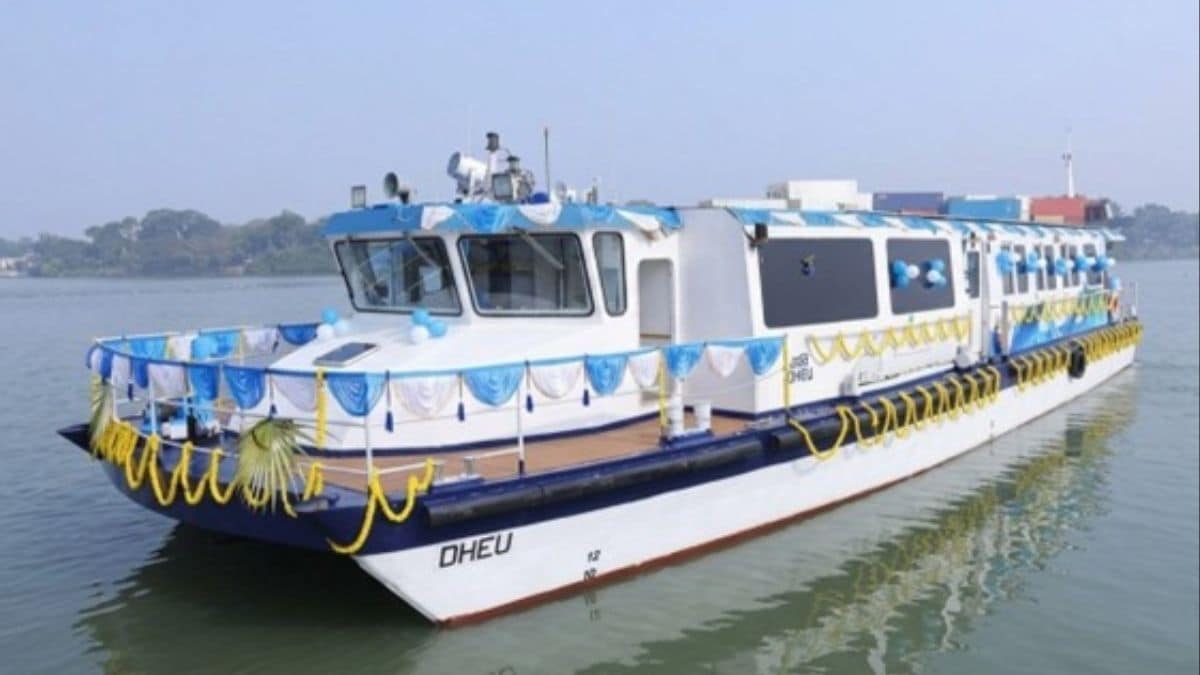
With this objective, Garden Reach Shipbuilders & Engineers Ltd. undertook the development of a prototype 150-passenger fully electric ferry as part of an R&D initiative in collaboration with IIT Kharagpur. It is the largest fully electric ferry designed and built to date. The vessel was aptly named DHEU—meaning “wave,” in Bengali. The name alludes not only to the riverine identity of Bengal, but also to the beginning of a new technological wave in India’s inland waterways sector.
Right from the concept stage, the design philosophy behind DHEU focused on efficiency, safety, operational practicality and passenger comfort.
To achieve better stability and manoeuvrability while accommodating 150 passengers, a catamaran hull configuration was selected. The wave-piercing catamaran hull was further optimised using CFD analysis and validated through model testing at IIT Kharagpur. Since weight directly affects battery endurance and vessel performance, lightweight construction became another critical design consideration. Aluminium was selected for the hull structure, while FRP was used for the superstructure and several outfitting elements.
DHEU was designed for a service speed of around 8 knots with a maximum speed close to 10 knots. The operational requirement was particularly demanding—continuous operation for nearly four hours with multiple crossings every day on the Hooghly River. Achieving this, using only battery-based propulsion, required careful integration of hull efficiency, propulsion sizing, battery capacity, and onboard power management systems.
The vessel operates using a liquid-cooled lithium battery-based Energy Storage System integrated with a DC grid architecture. Twin propulsion motors drive fixed-pitch propellers through efficient shaft arrangements, while solar panels supplement auxiliary loads onboard. An emergency diesel generator has also been incorporated as a backup arrangement for operational safety and redundancy.
However, the true success of any new technology lies not in design calculations or presentations, but in actual field operations. The operational trials conducted on the Hooghly River became the defining moment for DHEU.
The vessel’s performance during river trials validated the design estimates for speed, endurance, manoeuvrability, and stability. But beyond the technical parameters, one observation stood out prominently—the silence of operations. Unlike conventional diesel ferries, DHEU operated with minimal vibration, almost no noise, and negligible propeller wake. For many observers standing along the riverbank, the ferry appeared to glide silently across the Hooghly, almost in quiet reverence to the river itself.
‘Dheu’ on the Hooghly: Making waves
This successful deployment demonstrated that electric ferries are not merely experimental concepts for Indian waterways but practical solutions capable of operating under demanding river conditions.
The strongest validation, however, came soon after.
Following the successful prototype deployment and satisfactory operational performance of DHEU, GRSE secured an additional order for 13 Hybrid-Electric ferries from the Government of West Bengal. This transition from prototype development to fleet-level induction marks a significant milestone for India’s inland water transport sector.
It signals the beginning of a broader shift where sustainability, technology, and indigenous innovation are coming together to redefine inland transportation. India’s Inland waterways renaissance is no longer limited to panel discussions in glitzy conferences but a reality, now visible on the rivers themselves.
In many ways, DHEU represents more than just an electric ferry. It symbolises a new direction for Indian shipbuilding and inland mobility—one where global green technology is adapted for Indian rivers, engineered by Indian minds, and proven under Indian conditions.
The writer is a naval architect and Deputy Manager (Design) in the Forward Design Group at Garden Reach Shipbuilders and Engineers Limited (GRSE), Kolkata
The opinions expressed in this article are those of the author and do not purport to reflect the opinions or views of THE WEEK.
