



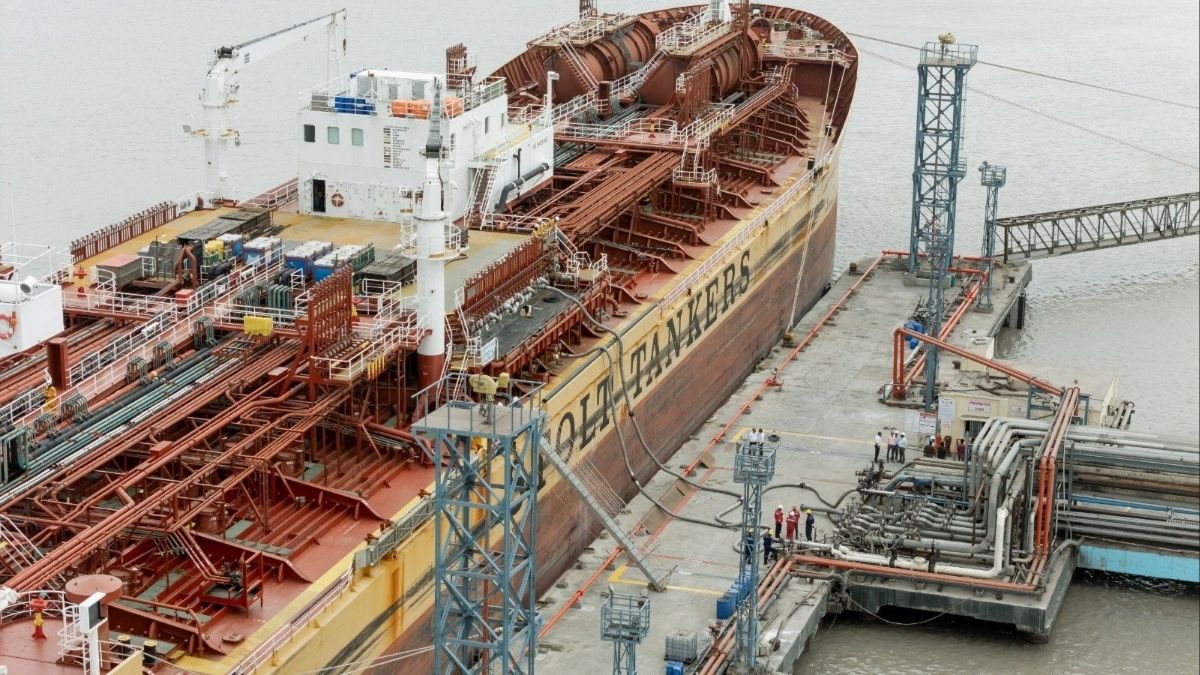
Earlier this month, a routine-looking fuel transfer on the Gujarat coast turned into a historic moment for Indian shipping. Deendayal Port Authority (DPA), Kandla, India's single largest port by cargo volume, completed the country's first-ever shore-to-ship methanol bunkering trial, pumping methanol directly from shore tanks into a vessel in a demonstration.
According to maritime experts, this is a critical early step in cleaning up the world's dirtiest-emitting industry. Think of methanol bunkering the same way you'd think of filling up your car, except the "car" is a 300-metre deep-sea cargo ship, the "petrol station" is an entire port terminal, and the fuel being pumped produces dramatically fewer emissions than the conventional heavy fuel oil that ships have burned since the 19th century.
Methanol emits roughly 10–15 per cent less CO₂ and virtually no sulphur oxides compared to traditional bunker fuel, and when it's the "e-methanol" variety made from renewable energy and captured CO₂, the emissions are even cleaner.
The trial was conducted in collaboration with Stolt Tankers, J M Baxi, Aegis Vopak and Indian Oil Corporation Ltd (IOCL), and was independently verified on-site by DNV Maritime Advisory Services, one of the world's top maritime classification bodies.
DNV's assessment found Kandla to be at Level 6 on the IAPH Port Readiness Level (PRL) scale, which, on a 1-to-9 scale (where 1–3 is analysis, 4–6 is development, and 7–9 is implementation), puts Kandla solidly in the advanced development category, with verified infrastructure ready to support commercial methanol bunkering.
And Kandla's ambitions don't stop at a trial. The port is targeting availability of around 500,000 tonnes per annum of RFNBO-compliant e-methanol by 2028–29, targeting a competitive price of $700–$750 per metric tonne, aimed at dual-fuel vessels plying the busy Asia–Europe trade corridor, one of the world's most important shipping lanes.
DPA has also initiated site work for India's first 150-tonnes-per-day e-methanol plant in partnership with Assam Petrochemicals and Thermax, and has issued tenders for a port-integrated biomethanol production facility. The next phase will involve ship-to-ship methanol bunkering at high seas.
Maersk, the world's second-largest shipping company, has already ordered 25 methanol-powered vessels and is sourcing 500,000 tonnes/year of green methanol. The IMO wants net-zero shipping emissions by 2050. Kandla, sitting right on the Rotterdam–Singapore green shipping corridor, is positioning India to be the fill-up stop of choice for the next generation of clean ships.
