



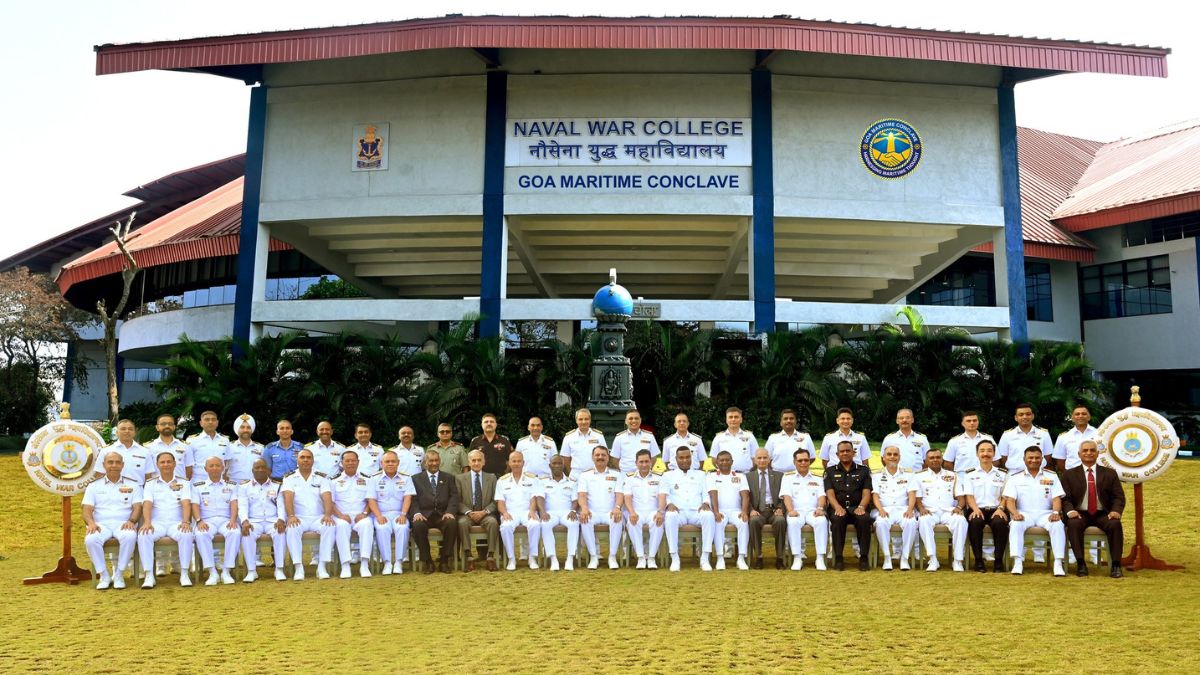
The 5th edition of the Goa Maritime Conclave (GMC-26) was held on Saturday at the Naval War College in Verem, situated in the northern part of the state.
The event brought together Chiefs of Navies and senior maritime leaders from 15 Indian Ocean Region (IOR) nations with the intent of boosting cooperation in the handling of maritime security challenges.
Organised by the Indian Navy under the theme, 'Common Maritime Security Challenges in the IOR - Progressing Lines of Efforts (LsOE) to Mitigate Dynamic Threats', the GMC-26 reinforced India's (and its naval forces') important role within the maritime security conversation.
The GMC-26's roadmap for advancing the IOR's maritime security framework is also in line with the Prime Minister's MAHASAGAR (Mutual and Holistic Advancement for Security and Growth Across Regions) Vision, the Ministry of Defence said in a statement.
In his keynote address, Admiral Arun Prakash (Retd), former Chief of Naval Staff, highlighted that the need of the hour in the case of maritime security was synchronised regional responses anchored in real-time information exchanges, institutionalised coordination mechanisms, and sustained capacity development.
He stressed that doing so would help address challenges such as Illegal, Unreported and Unregulated (IUU) fishing, trafficking networks, and other transnational maritime crimes, which require IOR nations to share responsibilities.
The first session, moderated by Vice Admiral G. Ashok Kumar (Retd), a former National Maritime Security Coordinator, built on the keynote address and discussed best practices to enhance real-time flow of maritime information and operational coordination, in order to counter IUU fishing, drug trafficking, and other illegal maritime activities.
The speakers in this session were Rear Admiral T.V.N. Prasanna of the Indian Navy and Colonel Amanulla Ahmed Rasheed from the Maldives.
This session also saw discussions on other issues of trans-national significance, such as strengthening maritime domain awareness networks, the interoperability of information-sharing systems, and developing structured institutional links for rapid, coordinated responses across jurisdictions.
The second session, moderated by Admiral Karambir Singh (Retd), former Chief of Naval Staff and Chairman of the National Maritime Foundation, focused more on capacity building and capability enhancement among IOR maritime agencies.
The speakers in this session were both from the Indian Navy: Rear Admiral Srinivas Maddula, and Captain Ranendra S Sawan, a Senior Fellow at the National Maritime Foundation.
This session also saw discussions on pooling regional training resources, expanding professional exchange programmes, and strengthening institutional frameworks to reinforce long-term maritime resilience.
Various Chiefs of Navies and Heads of Delegations also added their insights to round off the GMC-26.
In his closing address, Chief of Naval Staff and IONS Chair Admiral Dinesh K. Tripathi conveyed his sincere appreciation to all partner nations, emphasising that in an era of adaptive maritime threats, the goal was to keep moving—from shared awareness to coordinated action by leveraging technology, information sharing, and focused operations under the MAHASAGAR vision.
