



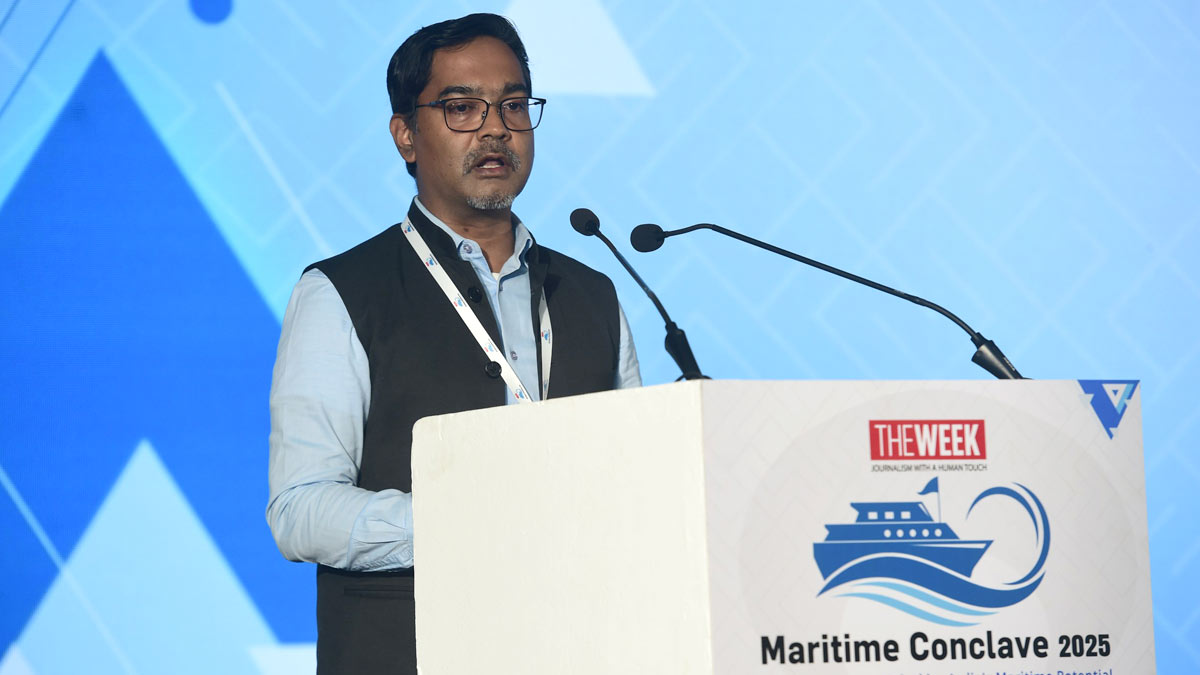
“India needs to build mega ports, and to build them fast. But, ports alone are not enough. Connectivity is equally vital,” said Pradeep Jayaraman, CEO, Adani Vizhinjam Port Private Limited, at THE WEEK Maritime Conclave 2025 held at Crowne Plaza in Kochi. Jayaraman observed that the Maritime Mission, released in 2021, highlighted a key concern: nearly 75–80 per cent of India’s shipping capacity is flagged outside India. This leads to losses of over USD 200–220 million annually—an older estimate, with current numbers likely much higher. This is foreign exchange leaving the country and adds costs for exporters, reducing their competitiveness.
Jayaraman noted that the Vizhinjam International Seaport in Thiruvananthapuram, which became operational last year, has already demonstrated its potential by crossing the one million TEU threshold in under 12 months. “In simple terms, we are already running at over 100 per cent capacity. This clearly signals the urgent need for more infrastructure,” he said.
Jayaraman noted that currently, only two Indian ports feature in the world’s top 30 and that India handled just over 22 million TEUs last year—less than half of what a single Chinese port achieved at 51 million. “This starkly shows the infrastructure gap we face,” he said.
Jayaraman added that while India competes in manufacturing and services with strategies like “China Plus One” without matching infrastructure, the country cannot attract the capital or create the business success required.
He noted that Vizhinjam has been built as a port to match world-class standards, but without adequate connectivity, its potential is limited. “Infrastructure planning must be holistic—bringing together multiple ministries and ensuring integration across sectors.
Such infrastructure also has a multiplier effect on jobs—whether in skilled, semi-skilled, or unskilled categories. Unlike services, which generate narrower employment bands, manufacturing and port-linked industries provide opportunities across the socioeconomic spectrum, reducing inequality,” he said.
However, Jayaraman noted that India has made some progress in areas like automation, and optimisation. On the digital side, too, we are making progress. “Earlier, critical systems like Vessel Traffic and Management were imported. Today, in collaboration with IIT Madras, we have developed homegrown digital twins and VTMS systems under the Make in India initiative, which are already being deployed across major ports,” said Jayaraman. He added that the more we digitise and automate, the more essential it becomes to rely on indigenous technologies and equipment. “Encouragingly, government policies are now focusing on shipbuilding, vessel registration reforms, and infrastructure development,” he said.
Jayaraman noted that the Vizhinjam project, built with the support of the Kerala government and the Union government, is a classic example of effective public-private partnership in action, setting a precedent for future projects.
“It is not only about the private sector—it is also about the state, the Centre, and private players coming together and shaking hands. This collaborative model is critical, and the challenge before us is how to replicate it across other states,” he said.
Citing the example of Vizhinjam—the first fully automated port in India—Jayaraman added that automation may seem like it reduces employment opportunities. But, in the long term, it creates far greater value—by boosting productivity, enabling industries to flourish, and ultimately creating new types of jobs. “Since the start of our operations, productivity has been consistently rising, and consistency itself has become our competitive advantage. Customers value certainty: when a vessel arrives with a set number of moves, they know the turnaround time will be met,” he said.
According to Jayaraman, it is a myth that automation is prohibitively expensive. “The reality is that the cost gap between manual operations and automation is narrowing rapidly. At the same time, automation enhances safety—a critical concern in our industry, where accidents can be devastating. A safe, efficient workplace that also upholds the dignity of labour is driven by adopting the right technologies,” he said.
