


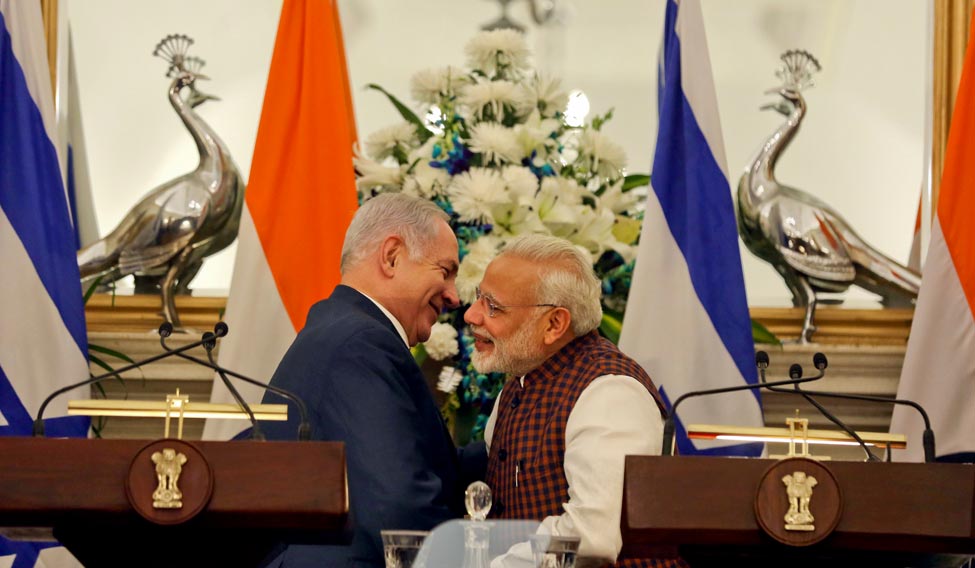
Mixing business with pleasure, Israeli Prime Minister Benjamin Netanyahu on his first visit to India ticked all the right boxes. Posing with his wife Sara at the Taj Mahal to taking selfies with Bollywood stars to spinning charkha, the couple revelled in the Indian hospitality. Prime Minister Narendra Modi, in his characteristic style, hugged Israeli counterpart several times to signify personal warmth.
The optics of the visit is likely to help Netanyahu back home as he battles political vulnerability. For Modi, hosting his “personal friend” sends a larger political message to the larger Hindu right-wing family, which wants India to be like this West Asian nation.
In the past, India had collaborated with Israel on getting advanced agriculture know-how and buying defence equipment. The current engagement saw relation expanded to include areas of cybersecurity, and petroleum and natural gas, films, and space.
Beyond the bonhomie between the two leaders, what 'Bibi' Netanyahu came looking to was to revive the $500 million Spike Anti-Tank Guided Missile (ATGM) deal, canceled by the South Block on multiple grounds. Given the security issues, both leaders discussed the deal and Palestine issue behind closed doors. “Am not at liberty to say what transpired,” Vijay Gokhale, MEA secretary said about the deal.
As Natenyahu pushed hard for the deal, the biggest hint came from the Israelis itself. Israeli media reported that Netanyahu had said the deal was on track.
Government sources here claimed that both countries were now working on a formula to strike the ATGM deal under the direct government to government agreement to meet the Indian army's requirement.
Israel has been one of the largest suppliers of military equipment to India in the recent past. Foreign policy experts believe that Israel may even overtake Russia to become chief supplier along with USA. “Given the nature of relationship over security issues, both sides will keep it under wrap the nature of their talks,” informed sources said.
The ministry of defence had cancelled the ATGM deal to make way for missile systems produced indigenously by the DRDO in order to reduce India's dependence on defence imports. This was in line with PM Modi's Make in India theme. This was to be the first private missile subsystems unit in India, as the Israeli firm Rafael had signed a joint venture with Indian Kalyani Group and set up a missile subsystems facility in Hyderabad in August 2017. Now, DRDO has been given four years time to develop the Man-Portable Anti-Tank Guided Missile (MPATGM) to meet the Indian Army's requirement. Insiders claim that expensive transfer of technology by the Israeli firm was one of the key reasons for derailment of the negotiations.
Besides ATGM, both countries are hopeful of a key acquisition programme to procure Israeli Heron TP armed drones which are capable of hitting targets with air to ground missiles after tracking it down.
PM Modi, during his July visit to Tel Aviv, had shaped the project and things seem to be moving at a good pace. The project, code named ‘Cheetah’, to acquire 10 weaponised drones from Israel for $400 million dollar was expected to get a push during Netanyahu's visit. After the US denied to sell its Predator armed drones to India, Israel came forward to give new heights to strategic partnership to both countries under the Modi government regime.
“Both Prime Ministers noted the readiness of Israeli companies to enter into joint ventures with Indian companies in the defence sector under the Make in India initiative. They call on the defence ministries to hold discussions in 2018 with active involvement of the public and private sectors, for long term cooperation in the defence industry,” the joint statement by both PMs said.
Modi had first visited Israel in 2006 as Gujarat Chief Minister and became the first PM to visit that country in July last year. This was a major step in de-hyphenating Israel from Palestine, whom India has always supported. What was interesting in Netanyahu's visit was that he spent more time outside Delhi, visiting three BJP-ruled states—Uttar Pradesh, Gujarat and Maharashtra.
“The bilateral relations have been decentralised by couple of decades. This visit institutionalised it. The focus is no longer Delhi, but the states. That's where real action in bilateral relations is taking place. Earlier, the focus was on security, defence, counter-terrorism. Now, the Israelis talk more about non-political, economic agenda,” says veteran Isreali expert and professor at JNU's school of International studies, P.R. Kumaraswamy. He explains that issues like agriculture, water management, desalination, healthcare are pertinent to state governments just like security, defence and foreign policy are to the Centre.
If the warmth was at display between Modi and Netanyahu, Kumaraswamy adds that Modi has made a break from past. “Modi has started openly dealing with Israel, earlier it was wishy-washy. But here also he is meeting the Israeli PM as any other foreign leader, like he met several leaders in the Arab world. It is no longer special in the negative sense of the word.”
As Netanyahu landed in India, some protests were held to oppose his visit. Many concerns were expressed that it would displease the Muslim world, especially the West Asian or Arab countries. But India had voted against US administration’s decision to recognise Jerusalem as Israel’s capital during a resolution put to vote in UN, last month. Under Modi, New Delhi had become far more vocal about reaching out to Israelis. But at the same time, Modi will be undertaking his maiden trip to Palestine on February 10.
“Our side made its stand clear on the issues of Palestine and Jerusalem but our relations are much larger than single issues,” Vijay Gokhale, secretary (economic relations) said. Gokhale will be the next Foreign Secretary.
Experts say the relationship is no longer in black and white. “There is a deep schism between the West Asian countries, Saudi Arabia is opposed to Iran, religious communities Shias and Sunnis are divided. This means many such countries are now not opposed to Israel. Its an open secret, Saudi Arabia wants to engage with Israel to contain Iran. This all has given elbow room for India to develop relations with Israel without upsetting too many people,” Lalit Mansingh, former foreign secretary told THE WEEK.
But there are limitations to how far India can go with Israel as New Delhi is engaging with Tehran. It has invested in the strategic Chhabar Port that will allow India to bypass Pakistan in reaching Afghanistan. Modi had visited Tehran in 2016.
Singh adds that there was a bit of tight rope walking as India was tested when it had to vote in favour of Palestine. “It voted not to please USA or Israel but keeping in view its traditional stand. The Israelis know that we are not involved with them but are also not prepared to dilute the stand on Palestine. Barring this, our bilateral relations are going at a good pace,” the former diplomat added.
Despite the optics of Netanyahu's bonding with Modi, there is skepticism over how far the two countries can go. “The personal rapport between the two leaders is interpreted as some sort of alliance against their known and non-known enemies. Both countries have their opponents whom they want to counter. But there is no 100 per cent convergence between India and Israel. Just two days ago, Iran's Transport Minister Abbas Akhoundi was here to talk business,” A.K. Pasha, professor at Centre for West Asian Studies, JNU said.
Not just the defence technologies, Israel is far ahead in other fields too which India needs. Defence relations and politics take centre stage when India and Israel talks. Both countries have moved beyond it.
Modi pushed for using “cutting-edge Israeli technologies” but the latter has been very protective given India's lax intellectual property rights record. But Netanyahu did agree for joint research projects under the ‘India-Israel Industrial R&D and Technological Innovation Fund (i4F).’ India-Israel Innovation and Technology Conclave is going to be held in India in July 2018 which will will aim at bringing innovation to India.
But what the countries can hope to exchange is 'big data analytics' and 'cyber space security.' Indian officials said big data exchange from India to Israel will help the farmers. As both countries are keen on fighting terrorism and are affected by various hard line Islamic jehadits groups, exchanging data on cyber security is now the next big thing in counter-terrorism measures. “Many Israeli companies working in cyber security have been active here in India, but now things will happen at the government to government level,” senior diplomat said.
India is keen on using Israel's strong presence in innovation and creating technology. “The India-Israel Innovation Bridge will act as a link between the start-ups of the two sides. I have been saying that Indian industries, start-ups and the academic institutions must collaborate with their Israeli counterparts to access the huge reservoir of knowledge. India has size and scale. Israel has sharpness and edge,” Modi said as he welcomed Netanyahu.
Professor Pankaj Jha, assistant professor in Jindal School of International Affairs, Jindal Global University, says they are looking at technology as the major fulcrum of our ties, given the fact that Israel has developed technology in defence, robotics and related fields. In terms of defence, there is a measured approach as one of the defence companies was blacklisted. But there is a whole gamut where two countries are moving forward in fields of surveillance, intelligence building, reconnaissance.
Also, Israel is looking for safer investment destination than China. In terms of technology transfer, India is better than China. This is also going to get shape in coming days.
As 'Bibi' has been keen on harnessing India's soft power, he is set to invite bollywood producers, directors and actors to shoot movies in the scenic locales of Israel. “An MoU on film cooperation has been signed. This aims especially at the co-production of films for the benefit of the film industries of both the countries; and for further development of cultural and technologies ties,” Bala Bhaskar, joint secretary, ministry of external affairs said. Love for dubbed old-Indian films is what ties both countries. After hectic discussions as Modi and Netanyahu sat for lunch when the live band played Inchak dana, binchak dana, a song from 1955 Raj Kapoor starer film Shri 420. Heads turned as many Israeli guests and diplomats readily acknowledged that they know this song.
The song immortalised by Lata Mangeshkar and Mukesh has been popular in Israel, too. Sixty years after it was first sung, the song again left its mark as leaders gathered at Hyderabad House.
Tail-piece: A conspicuous element of the Netanyahu visit was lack of his meeting with leader of Congress party Rahul Gandhi. Congress had made fun of Modi's “hugplomacy” after Netanyahu landed in India. This was the first major diplomatic visit since Gandhi assumed charge of the grand old party. As it has been practice in the past, visiting leaders often meet leaders of opposition. Whether Congress did not seek the meeting or government decided to give it a miss, it went noticed.