


 Add as a preferred source on Google

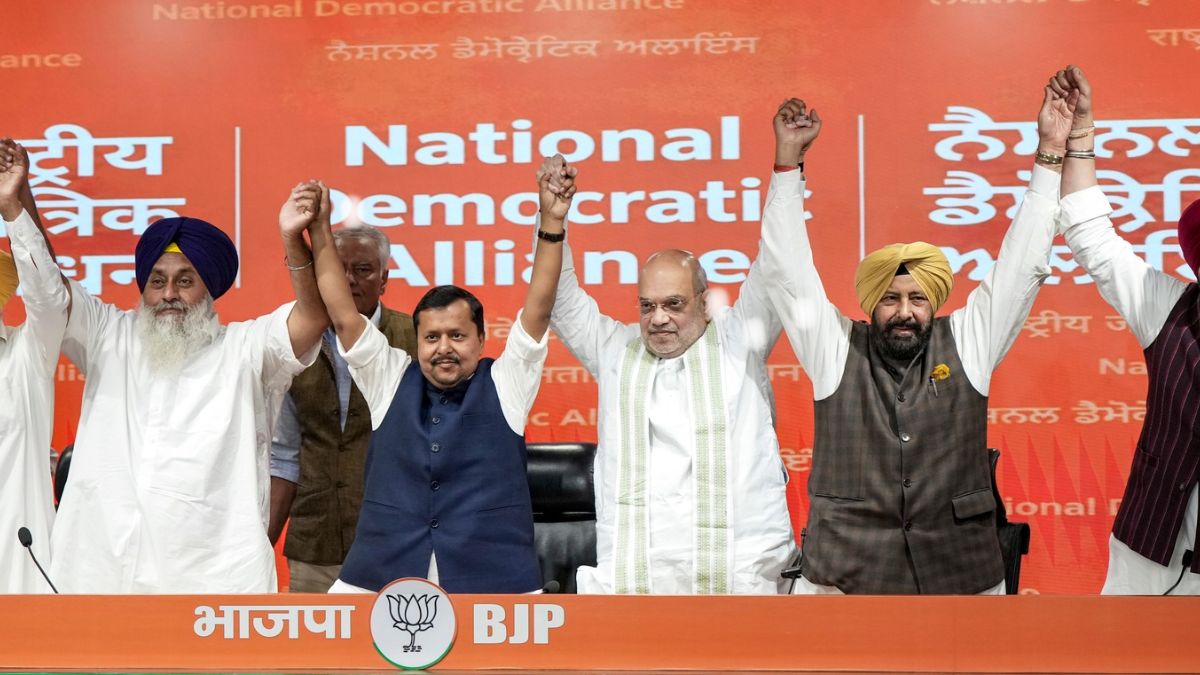
As Punjab braces for upcoming Assembly elections, the Shiromani Akali Dal (SAD) and the BJP have renewed their alliance, six years after they snapped their ties over the now-scrapped three farm laws.
There were already reports that the parties were planning to get back together after Prime Minister Narendra Modi met with Akali Dal President Sukhbir Singh Badal and BJP's Punjab election in-charge C.R. Patil.
Capping all speculations, Union Home Minister Amit Shah, Bharatiya Janata Party national president Nitin Nabin, and SAD president Sukhbir Singh Badal announced the alliance at an event held at the BJP headquarters in New Delhi on Tuesday.
"Under the leadership of our National President, we held a meeting which saw the participation of prominent leaders of both the SAD and the BJP. It was decided that the next Punjab Legislative Assembly election will be contested jointly by the BJP and the Akali Dal. From today, the Akali Dal will function in politics as an official partner of the NDA," Shah told reporters.
Shah said the two parties will fight on all 117 seats in Punjab and that the Shiromani Akali Dal (SAD) will get the post of Chief Minister. Shah said a detailed manifesto would be finalised soon by the two parties for the elections, but eradicating the drug menace from Punjab, working together for the welfare of farmers, and promoting Hindu-Sikh unity would be among the key focus areas.
Badal called the move not a political, but an emotional alliance. “This alliance is in the interests of Punjab, the country, and the Sikh community. You must have seen how long this alliance lasted and how many governments were formed during that time. Punjab is progressing. There has been peace in Punjab, and brotherhood has prevailed,” he said.
While the tie-up was expected, speculation is now on how the seats will be divided. Despite Shah acknowledging that SAD will play the role of the elder brother, reports hint that the BJP will ask for 48–55 of the seats in the 117-member Assembly. In the last elections where the parties contested together, the BJP had just 23 seats. However, this time around, it is likely that the BJP would want more seats, considering it has expanded its electoral standing and organisational base.
Sources within the SAD say the party is being cautious about ceding seats in its traditional areas of influence, and the two parties have reached an understanding that their electoral strategies should be tailored to each other's strong areas. The BJP will benefit from the Akali Dal's organisation in rural Punjab, while the Akali Dal may get support from the BJP's urban base and its political strength at the Centre.
During the last Lok Sabha elections, the BJP increased its vote share in Punjab, while the Akali Dal's performance remained weak. In the 2024 Lok Sabha elections, the BJP got about 18.6 per cent of the votes, and the Akali Dal got about 13.4 per cent. Fighting together will bring their vote share to 32 per cent.
That said, it is not necessary that the equation should come together as predicted. Other challenges include the SAD’s efforts to regain its lost acceptance in Panthic politics. For the BJP, the big challenge is to strengthen its grip in rural areas. Old political differences between local leaders and workers of both parties can also affect the election campaign.
