


 Add as a preferred source on Google

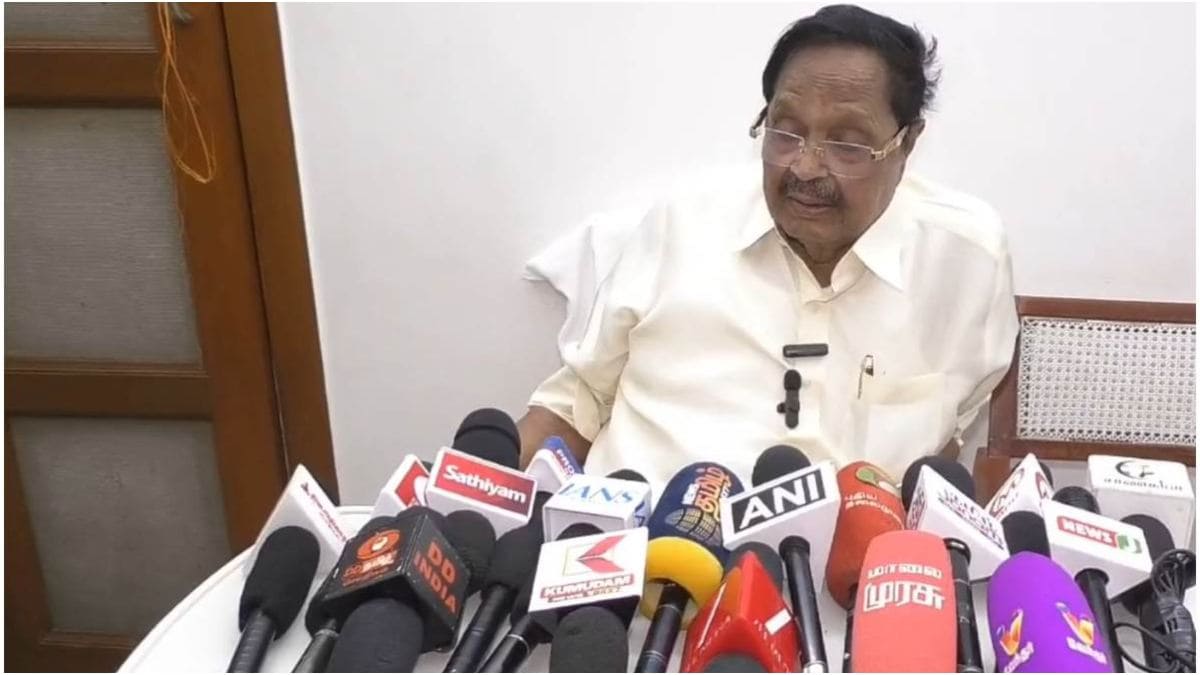
A month after acting against former school education minister Anbil Mahesh Poyyamozhi, the TVK government in Tamil Nadu has stepped up its anti-corruption drive, with the the Directorate of Vigilance and Anti-Corruption (DVAC) booking former water resources minister Duraimurugan in an alleged ₹1,427-crore sand mining scam. The FIR registered by DVAC reveals that Tamil Nadu’s riverbeds may hold the key to one of the state’s biggest alleged corruption cases.
The DVAC has registered a case against Duraimurugan, government officials and private contractors over alleged irregularities in river sand mining between 2021 and 2024. The estimated loss to the state exchequer from just four quarries is ₹1,427.34 crore. The FIR, registered on November 5, names Duraimurugan, 17 serving and retired public servants, private individuals and corporate entities. The investigation covers 28 quarry sites across Tamil Nadu. The allegations point to a suspected nexus between officials and contractors that allegedly enabled excessive extraction, manipulated contracts and illegal transportation of sand.
How did the alleged racket operate?
According to the DVAC, the accused allegedly circumvented transparent tender procedures by splitting contracts into smaller components and awarding them through limited tenders instead of open competitive bidding. This allegedly restricted competition and helped favoured contractors secure quarry-related work.
The second component involved extracting sand beyond the approved mining plans, including beyond authorised boundaries and depths. The FIR alleges that fabricated vouchers and transport permit slips were subsequently used to facilitate the movement of illegally extracted sand. The investigation is examining whether government records were manipulated to make excess extraction and transportation appear legitimate.
Where did the ₹1,427 crore figure come from?
The assessment of four of the 28 quarries — Echambadi, Kandaneri, Madhavaperumal Koil and Oruvanthoor — reportedly revealed the illegal excavation of 1,42,73,424 units of sand, equivalent to 4,03,93,790 cubic metres. The estimated wrongful gain and corresponding loss to the state from these four locations is ₹1,427.34 crore. The financial implications of the remaining 24 sites are yet to be quantified. This makes the current estimate potentially only part of the larger picture.
Who are the other accused?
Besides Duraimurugan, the FIR names retired engineers-in-chief A. Muthaiya and Ramamoorthi and several serving and retired water resources department engineers. Private individuals S. Ramachandran, P. Karikalan and K. Rethinam are among those identified by the agency as allegedly associated with the contractors' network. Companies named include MRM Ramaiya Enterprises, R S Constructions and K-Infra.
How did the investigation begin?
The case has its origins in complaints to the Enforcement Directorate (ED), including those by anti-corruption NGO Arappor Iyakkam. The ED examined alleged illegal mining across 28 sites and forwarded documentary evidence to the state authorities. The Tamil Nadu government authorised a detailed inquiry in December 2025. The DVAC subsequently registered the FIR and conducted searches at 34 locations across Tamil Nadu and Puducherry, seizing 825 documents, 11 electronic devices and three bank locker keys.
Beyond the alleged financial loss, the case raises serious environmental concerns. The FIR refers to falling groundwater levels, drying wells and damage to aquatic habitats and riparian ecosystems. It also alleges violations of environmental concerns highlighted by the Madurai Bench of the Madras High Court in 2017.
The central question now is whether investigators can establish the complete chain linking tender awards, quarry operations, transport permits and financial beneficiaries. With 24 more sites awaiting financial assessment, the ₹1,427-crore figure may not represent the full scale of the alleged irregularities.
