



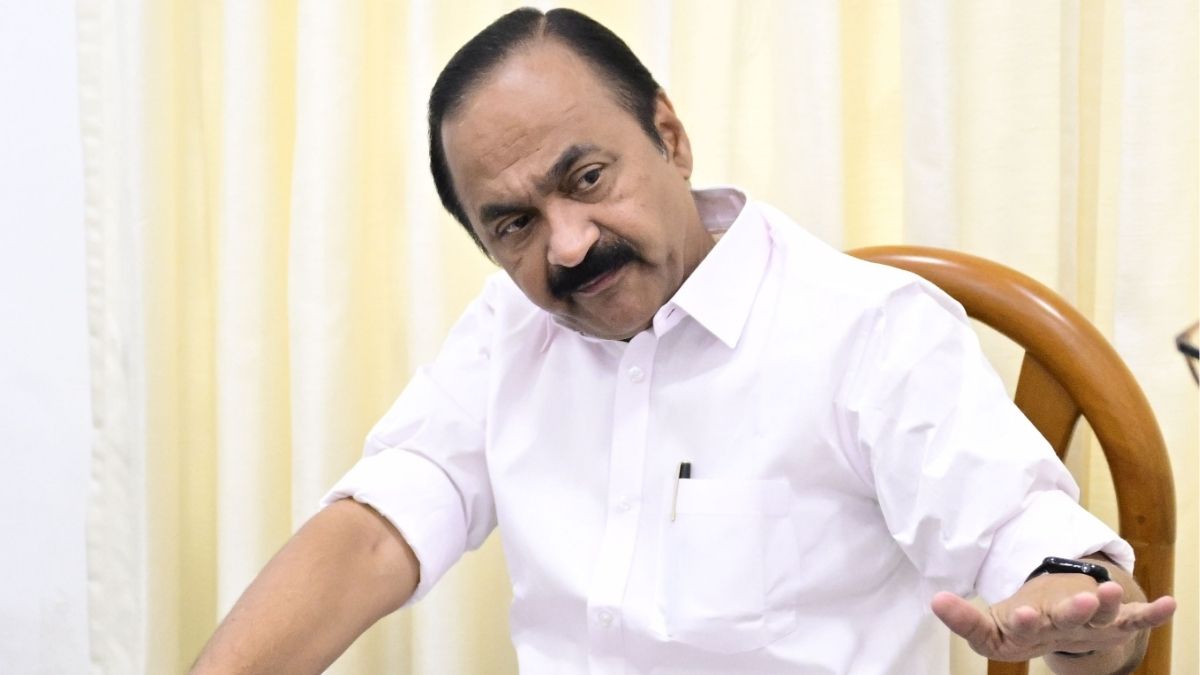
At the inaugural session of the conference of chairpersons of Public Accounts Committees (PACs) of Parliament and state legislatures, Kerala Chief Minister V.D. Satheesan attacked the methodologies followed in the audit and accountability framework.
Satheesan drew attention to instances where the Comptroller and Auditor General’s (CAG) audit methodology, in his view, appeared to go beyond its traditional mandate of examining financial regularity and procedural compliance.
“The C&AG’s audit approach sometimes shifts in a manner that defeats the very purpose of the audit. The question is how the Public Accounts Committee could approach such audit findings,” he said.
He cited the CAG’s 2010 report on 2G spectrum allocation and the audit of the Vizhinjam International Deepwater Multipurpose Seaport Project as examples.
On the 2G report, he noted that the widely reported figure of ₹1.76 lakh crore was a hypothetical presumptive loss, calculated by extrapolating later auction prices rather than reflecting actual market conditions in 2008. He argued that the audit had moved into questioning the merits of a government policy decision instead of confining itself to procedural and administrative lapses.
Regarding the Vizhinjam Port, Satheesan pointed out that a judicial commission had objected to the CAG treating the Public-Private Partnership (PPP) project as a conventional Public Sector undertaking. He said the audit applied generic public-sector principles to a venture with a fundamentally different commercial and risk-sharing structure. Furthermore, he noted that the audit failed to adjust for the reality that mega-infrastructure projects require heavy, state-backed Viability Gap Funding precisely because they are not financially viable on a standalone basis during their early lifecycles.
He urged the conference to discuss how PACs should handle audit findings that may fall outside the constitutional purview of audit due to such methodological approaches. In a related observation, Satheesan expressed concern over what he described as attempts to curtail the powers of the PAC through legislative majorities. He referred to a January 2021 resolution of the Kerala Legislative Assembly that rejected and expunged certain adverse observations in a CAG report on the Kerala Infrastructure Investment Fund Board (KIIFB), an extra-budgetary borrowing mechanism. The resolution effectively kept those findings outside the normal PAC scrutiny process.
Satheesan argued that once a CAG report is tabled in the House, it is automatically referred to the PAC under established parliamentary procedure. He questioned the legislative competence of any House to dismiss a CAG report based on its majority, stating that neither the Constitution nor the rules of procedure confer such a power. While acknowledging that a government with a majority can pass resolutions, he warned that such practices undermine the purpose of parliamentary institutions and the principle of financial accountability.
The conference, attended by PAC chairpersons from across the country, is expected to deliberate on strengthening the oversight role of the committees.
“A huge number of files are pending before the PACs across the country,” said the chief minister. “Even files that began 20 years ago are still pending. What is the relevance of the committee then? If we find somebody guilty of financial irregularities, what can we do? He may have retired, or he may be no more. What is the result? So we have to dispose of almost all the files. There should be a special drive to dispose of all the files. I am proud to say that when I was the chairperson of the committee, our PAC disposed of all the pending files. It was a success.”