



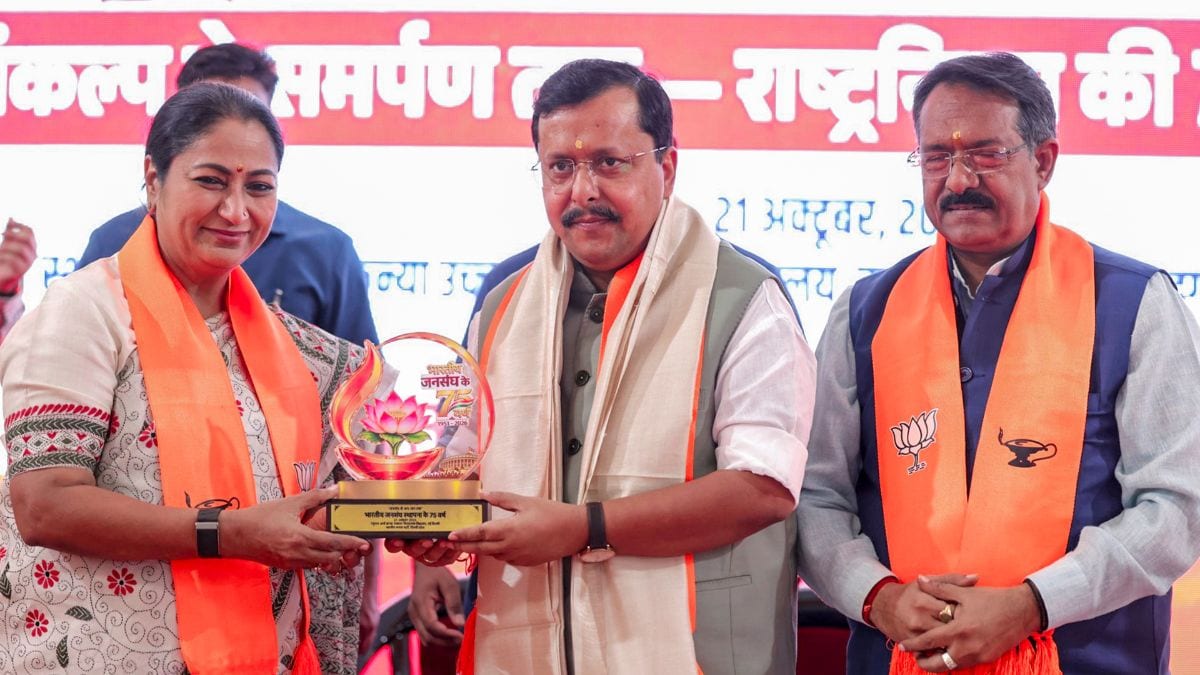
The Bharatiya Janata Party (BJP) on Wednesday marked 75 years of the Bharatiya Jana Sangh, its political predecessor, to highlight its ideological roots and connect them with Prime Minister Narendra Modi’s governance agenda.
Addressing a programme in New Delhi, BJP president Nitin Nabin said the Jana Sangh, founded on October 21, 1951, under Syama Prasad Mookerjee, had grown into the world’s largest political party. He said the BJP was continuing the Jana Sangh’s commitment to nationalism, cultural identity and development for the poor.
The Jana Sangh no longer exists as a separate political party, but its legacy remains central to the BJP’s identity. By marking its 75th anniversary, the BJP is presenting its rise to power as the outcome of an ideological journey that began with a small organisation and continued through decades of political struggle.
The Jana Sangh was founded with support from the Rashtriya Swayamsevak Sangh (RSS) as a political alternative to the Congress.
Mookerjee, a former Union minister in Jawaharlal Nehru’s government, resigned from the Cabinet in 1950 over differences with the government’s approach to Pakistan and issues affecting Hindus in East Pakistan. He subsequently founded the Jana Sangh, drawing on the RSS network to build the new party. Deendayal Upadhyaya became one of its key organisers.
The party began with a limited electoral base. In the 1951-52 general election—its first—it won three Lok Sabha seats. It sought to build support around Hindu cultural identity, nationalism and a stronger, more integrated Indian state. Its early campaigns included the demand for the full integration of Jammu and Kashmir with India.
Mookerjee was arrested in Kashmir in 1953 and died in custody that year. Upadhyaya subsequently played a central role in building the organisation and expanding its network of workers.
The Jana Sangh gradually expanded its presence, particularly in northern India. In the 1967 elections, it made significant gains and became part of a wider Opposition challenge to Congress's dominance.
It also joined coalition governments in several states with parties that did not share all its ideological positions. These alliances helped the Jana Sangh gain administrative experience and establish itself as a national Opposition force, even though it remained far from replacing the Congress at the Centre.
A major turning point came during the Emergency imposed by PM Indira Gandhi from 1975 to 1977. The Jana Sangh joined other Opposition parties in resisting the government. After the Emergency, it merged with several of them, including the Bharatiya Lok Dal, the Socialist Party and Congress (O), to form the Janata Party.
The alliance defeated the Congress in the 1977 general election, bringing the first non-Congress government to power at the Centre. Former Jana Sangh leader Atal Bihari Vajpayee became foreign minister.
The Janata Party government, however, was weakened by internal differences. A dispute over whether former Jana Sangh members could maintain their association with the RSS became a major point of conflict.
In 1980, former Jana Sangh leaders left the Janata Party and formed the BJP under Vajpayee’s leadership. The Jana Sangh had thus ceased to exist as a separate party, first through its merger into the Janata Party in 1977, before its former members established the BJP three years later.
Nabin’s speech sought to link this history with the BJP’s present political position. He said Mookerjee had resigned from the Union Cabinet because he believed the government had moved away from the objectives of Independence.
He accused the Congress government of being influenced by Western and Leftist ideas and said that the Jana Sangh was formed to defend national interests and nationalist thought.
He cited the Jana Sangh’s campaign for Goa’s integration with India in 1961 and its stand on Hindu-majority regions in West Bengal as examples of its efforts to promote national unity. He argued that the organisation had challenged the Congress when it believed the government was not doing enough to protect national interests.
Nabin also linked the Jana Sangh’s ideology to the Modi government’s welfare policies. He invoked Deendayal Upadhyaya’s concept of Antyodaya, which calls for development to reach the last person in society. He cited the Jan Dhan scheme as an example, saying it had brought people who previously lacked bank accounts into the banking system.
He also accused previous Congress governments of making promises on poverty alleviation without ensuring that welfare benefits reached those who needed them. The comparison was part of the BJP’s attempt to present its governance record as a continuation of the Jana Sangh’s founding principles.
Nabin said the principle of 'Nation First, Party Next, Self Last' remained central to the BJP’s working culture. He credited senior leaders such as Vajpayee, L.K. Advani and Upadhyaya, along with generations of party workers, for building the organisation despite limited resources.
The BJP chief urged younger party workers to learn from the struggles of their predecessors. He recalled that the Jana Sangh had started without adequate offices, funds or transport, but that its workers had continued to expand the organisation. He also noted that the present generation must show similar commitment while adapting to new technologies and changing times.
Nabin also linked the Jana Sangh’s legacy to the BJP’s current political arguments, accusing the Congress and the INDIA bloc of attempting to weaken democratic institutions and create disorder.
He said the BJP would continue to work towards Modi’s vision of Viksit Bharat while drawing on the ideas and sacrifices of the Jana Sangh’s founders.
