



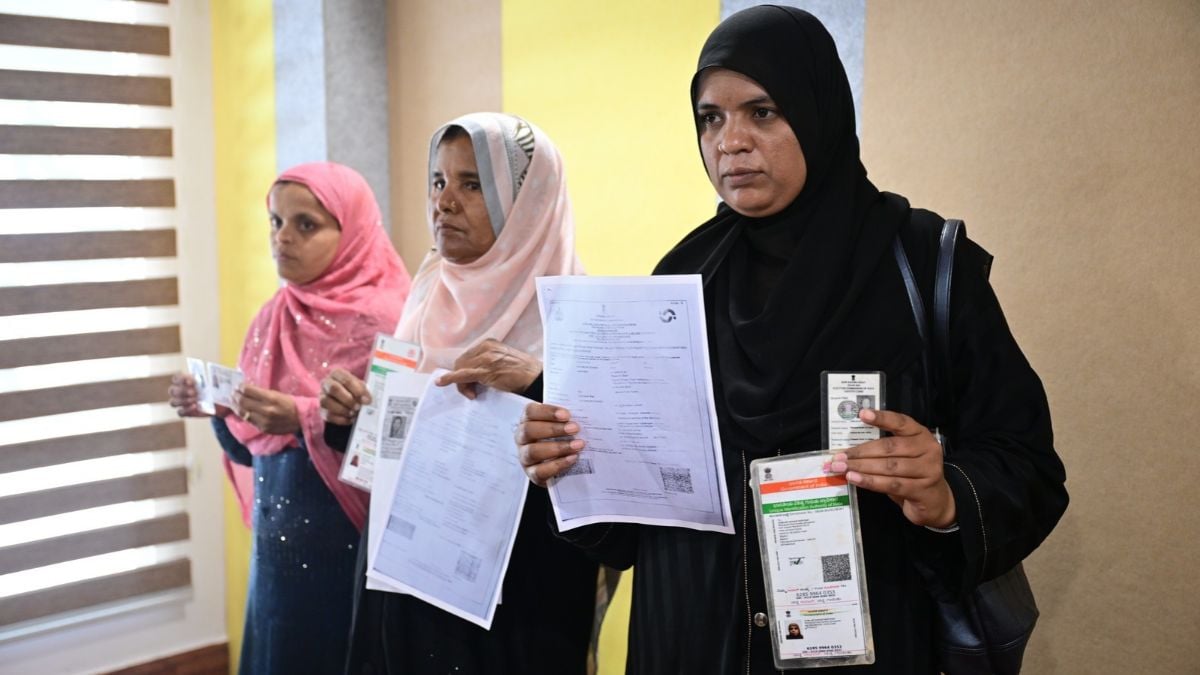
The controversy around the Special Intensive Revision (SIR) of electoral rolls in Karnataka is heating up by the day. Three women voters whose names were included in a list of 'dead' voters submitted by Vijayapura City MLA Basanagouda R Patil Yatnal have come forward to prove that they are alive, producing Aadhaar and other documents before the media and demanding action against those behind what they described as a conspiracy.
“I have been listed as dead. I am still alive. I had to come here and prove it to you,” said 35-year-old Mahabubi Peerazade Jahagirdar from Vijayapura City.
She said she was shocked to learn that her name had been listed as that of a dead person. “I was thoroughly shocked and am still processing the fact that my name was listed as dead,” she said.
Mahabubi was accompanied by two other women from the district who had the same grievance — 57-year-old Malanbi Jamadar and 35-year-old Raziya Shaikh. The three women were among 1,054 voters from Vijayapura City whose names were included in a list submitted by Yatnal for deletion from the electoral rolls during the SIR. Eight of the voters, including the three women who spoke to THE WEEK on Wednesday, were shown as dead based on death certificates.
On August 31, Yatnal, a former minister, wrote to the corporation commissioner and assistant electoral registration officers, raising objections to the names. The district commissioner subsequently directed the AERO to verify the documents, following which the ERO ordered a mahazar.
The verification also challenged Yatnal’s claim that the 1,054 voters on the list were dead and should therefore be deleted from the electoral rolls.
An inquiry found that the death certificates cited against at least eight voters had been wrongly attributed to them. The certificates either belonged to their namesakes or were allegedly fabricated.
Vijayapura Deputy Commissioner and District Electoral Officer Anandh K said Yatnal’s letter was not taken up for investigation under the Representation of the People Act, 1950, which governs the SIR process. False declarations under the Act can attract imprisonment of up to one year, a fine, or both.
Instead, the inquiry into Yatnal’s complaint was opened under the Registration of Births and Deaths Act, Anandh said. The commissioner also heads the birth and death registry and is duty-bound to verify complaints relating to suspected fake death certificates. Upon verification, Anandh said the death certificates were found to belong to namesakes of the voters.
Interestingly, in the case of all three women THE WEEK spoke to, their names and those of their spouses were correctly mentioned on the death certificates, but the addresses were different.
The Representation of the People Act was not invoked in relation to any of the 1,054 objections because no Form 7 applications had been submitted, Anandh revealed. What was submitted was only a list of names along with a complaint on the MLA’s letterhead.
Officials are still seeking legal opinion on how to proceed against those responsible for the complaint, while activists are demanding an FIR and criminal action against the former minister.
Dr Vasu HV of Jagrutha Karnataka, an organisation closely tracking the SIR process, said, “We demand criminal action against Yatnal.” He alleged that the exercise amounted to a targeted attempt against minority voters and questioned how the BJP MLA obtained detailed electoral data when opposition parties had been raising concerns about access to voter information. “How can a BJP MLA get the voter list with colour photographs?” he asked.
Yatnal’s letter had attached colour photographs of the eight voters along with their electoral details. This has also raised another question similar to the one Chief Minister D K Shivakumar raised last week: how are political workers getting pre-printed electoral data?
Of the eight voters for whom Yatnal furnished death certificates, two were men and six were women. One of the voters was a state government employee.
According to local activist Irfan Sheikh, the other 1,046 voters on Yatnal’s list were also found to be alive. The only exception, he said, was one voter who died after the claims and objections period.
