



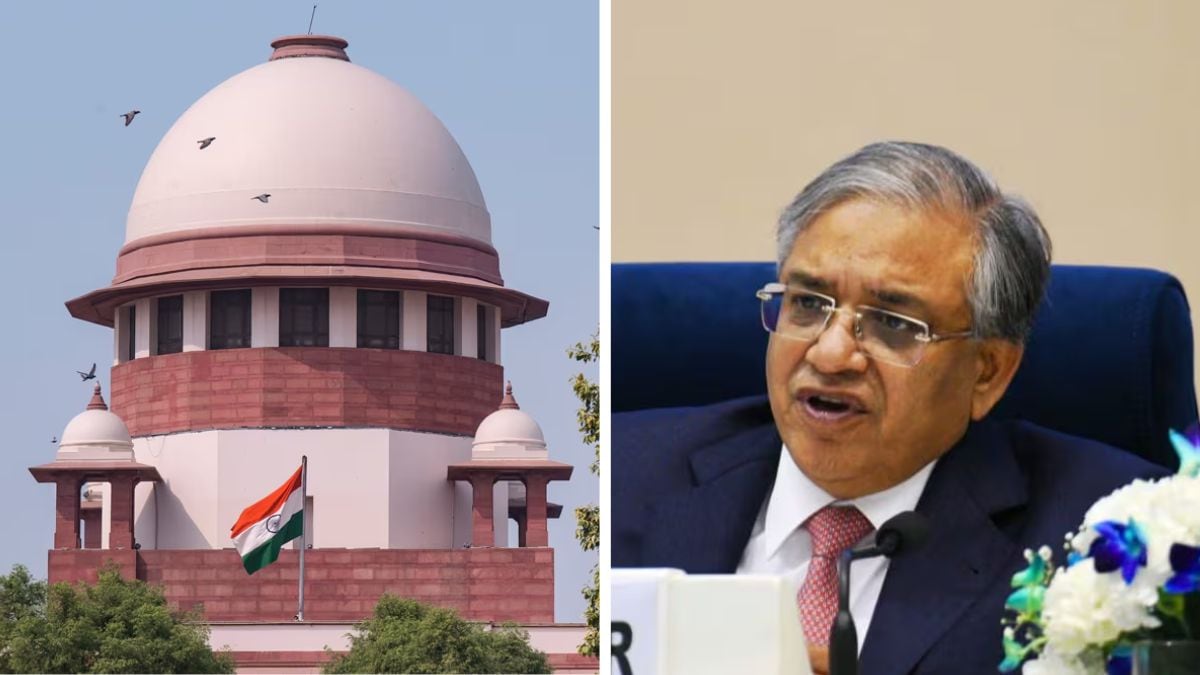
The Supreme Court on Monday said that if it emerges that decisions of the Election Commission of India (ECI) were taken neither unanimously nor by majority, the poll panel would have to explain how such decisions were arrived at, as it sought replies from the Centre, the ECI and Chief Election Commissioner Gyanesh Kumar on a plea alleging unilateral decision-making by the CEC.
“We have to issue notice. After notice, if they come and the reports show that an Election Commission decision was neither by majority nor by unanimity, they will have to explain those decisions,” a bench headed by Chief Justice of India Surya Kant and comprising Justices Joymalya Bagchi and V Mohana observed.
The Court also sought responses from Election Commissioners Sukhbir Singh Sandhu and Vivek Joshi, ECI Director General (IT) Seema Khanna and Senior Deputy Election Commissioner Maneesh Garg.
The plea seeks a writ of quo warranto requiring Kumar to explain under what authority he has acted, and continues to act, as though the collective decision-making powers vested under Article 324 of the Constitution in the Election Commission can be exercised by the CEC individually.
The ECI comprises the CEC and two Election Commissioners. While its business is expected to be transacted unanimously, where there is no unanimity, decisions are required to be taken by majority. The petition alleges that the procedure was not followed in several instances.
The petition, filed by Rakesh Kumar Singh, alleges progressive centralisation of power, absence or delay in circulation of agendas and minutes, changes to electoral-roll processes and filing of appeals without the knowledge or approval of the two Election Commissioners.
It relies on 14 objections allegedly recorded by Sandhu and Joshi between October 28, 2025 and August 14, 2026 against steps taken in the name of the ECI without their approval.
“If the power constitutionally vested in the Election Commission as a multi-member body can, in fact or in substance, be exercised by one office within it without the participation the Constitution and the 2023 Act require, then decisions that determine who is on the electoral roll, and therefore who may vote, raise a serious constitutional question as to whether such decisions are being taken by the constitutional authority the Constitution created for that purpose,” the plea said.
The petition further seeks a declaration that any exercise of collective authority by the CEC without a decision of the Commission in accordance with Section 18 of the Chief Election Commissioner and Other Election Commissioners Act, 2023, is invalid. It has also challenged the Special Intensive Revision (SIR) and sought to have all actions, decisions, directions and consequential measures undertaken pursuant to it declared void ab initio.
Senior Advocate Vikas Singh, appearing for the petitioner, also referred to Section 16 of the 2023 Act, which provides protection to the CEC even after demitting office.
“This was not there in the earlier Act. Section 16 makes it even more important because of the kind of authority that the statute has given to the Chief Election Commissioner,” Singh said.
When Singh pointed out that the provision uses the words is or was, CJI Kant said, “Protection while in office is always understood.”
Justice Bagchi observed that such protection was not available even to judges.
Singh, while clarifying that he was not challenging Section 16, sought an interim order either suspending Kumar or divesting him of his authority as CEC and allowing the other two Election Commissioners to function in his stead
“We are dealing with a very grave situation which can undermine the very basis of our democracy,’ Singh argued, urging the Court to restore the position contemplated in the Anoop Baranwal judgment by including the CJI in the selection committee.
The Court, however, declined to pass an immediate interim order.
“We have to have some authentic information before us. Let us wait for 10 days,” CJI Kant said.
The Court also indicated that decisions found to have been improperly taken could subsequently be annulled.
“If there is anything wrong with the decisions, we can always annul them,” the CJI observed, adding that the 1993 amendment and the 2023 Act provide for unanimity in the transaction of business and majority-based functioning where unanimity is absent.
The proceedings also drew on a recent newspaper report alleging that the ECI had taken several decisions relating to SIR despite written objections from Sandhu and Joshi.
Singh submitted that the ECI had not specifically addressed the report and had instead issued a press release in the vaguest possible language.
“The newspaper report may be 100 per cent correct, partially correct or partially incorrect. We cannot pass an order on that basis today. But we would definitely like to have a response,” CJI Kant said.
The earlier plea also alleged that between November 2025 and August 2026, the two Election Commissioners had recorded written dissents on at least 14 occasions against decisions allegedly taken unilaterally in the name of the Commission.
Senior Advocate Menaka Guruswamy, appearing for the petitioner in the related plea, then broadened the challenge, arguing that the allegations were not confined to any one State but raised a larger question about the functioning of the Election Commission as a constitutional institution.
She argued that voting rights were under threat and alleged that the CEC’s functioning was biased. Referring to the situation in Delhi and West Bengal, she said a significant section of the electorate had been affected, while around 16 lakh appeals were pending before appellate tribunals. Guruswamy maintained that the issue was a national one and questioned whether the alleged conduct could be treated as a valid discharge of official duty. She said she stood by all the prayers in the petition.
The plea further alleged that statutory Form 6, used for inclusion of names in electoral rolls, was altered to introduce a mandatory last SIR linkage or ancestral condition for first-time voters without amendment to the Registration of Electors Rules, 1960.
“Any modified Form 6 has not been approved by us. Let's be clear. When the record is produced, we would like to see who has modified it,” CJI Surya Kant said. The observation came amid allegations that additional requirements, including details relating to an applicant's or their parents' linkage with the previous SIR, had been introduced for first-time voters. The Court indicated that it would examine the records to determine who authorised the changes.
The petition has also raised allegations concerning more than 16.10 lakh appeals filed in West Bengal against orders restoring electors whose names had initially been excluded during SIR. It claims the appeals were filed without the knowledge or authorisation of the two Election Commissioners or the West Bengal Chief Electoral Officer.
Other allegations include centralisation of electoral-roll management under the ECI's IT division and the alleged failure to activate a rollback facility in the ECINet system in Goa, which, according to the plea, prevented the restoration of 97 eligible electors despite judicial directions.
