



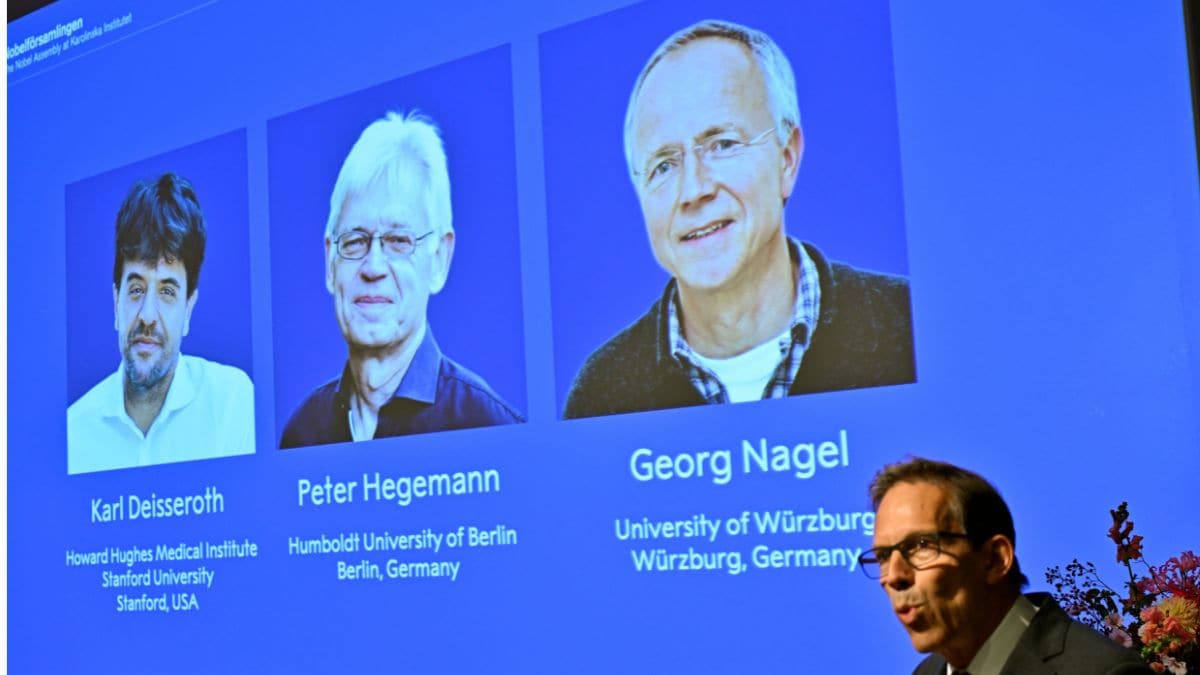
The Nobel Prize in Physiology or Medicine for 2026 has been given to three scientists, Karl Deisseroth, Peter Hegemann and Georg Nagel, the academy announced on Monday.
The trio won the award for their “discoveries concerning light-gated ion channels and optogenetics.”
The press release by the organisation said that the award was given for their discoveries leading to optogenetics, “which makes it possible to switch on, or off, the activity of individual nerve cells in a living brain”. “This method is now being used in laboratories around the world to reveal the brain’s mysteries,” the notice said.
Hegemann and Nagel discovered a protein called a channelrhodopsin in a single-celled alga, Chlamydomonas. Deisseroth meanwhile transformed the protein into a light-controlled switch for nerve cells.
They discovered that when the protein was illuminated by blue light, a channel opens through the protein. "They found that regardless of which cell they put the protein in, those cells became light sensitive," a press release read.
Deisseroth introduced the protein to nerve cells from rats. By illuminating the cells with blue light, he was able to trigger a nerve signal. The breakthrough was published in 2005. The method for controlling the nerve cells with light is called optogenetics.
Researchers have used optogenetics to reveal neural circuits governing specific memories, feelings and behaviours relevant for neurological and psychiatric disorders. Researchers are also using the method to restore sight in people with visual impairment.
Peter Hegemann is a Hertie Senior Professor of Neuroscience, Humboldt University of Berlin, Germany.
Georg Nagel meanwhile is a Professor of Molecular Plant Physiology at the Department for Molecular Plant Physiology and Biophysics - Botany I, University of Würzburg, Germany.
Karl Deisseroth is a professor of Bioengineering and of Psychiatry and Behavioral Sciences at the Howard Hughes Medical Institute and Stanford University, USA.
The laureates are selected by the Nobel Assembly of Sweden's Karolinska Institute medical university. They are set to receive a prize sum amounting to 12 million Swedish crowns, which is shared if there are multiple winners. The prizes will be presented to the winners in a ceremony in Stockholm, Sweden on December 10.
Last year the prize went to Mary Brunkow, Fred Rasdell and Shimun Sakaguci "for their discoveries concerning peripheral immune tolerance."
There are six Nobel prizes awarded every year in the fields of physiology or medicine, physics, chemistry, economic sciences, literature and peace work.
This year had a total of 287 candidates, 208 individuals and 79 organisations, according to the Nobel Committee. The rest of the prize winners will be announced each day from October 6 to 9 and October 12 between 5 am and 7 am Eastern Time or 2:30 to 4:30 pm IST. The announcements are made from Oslo and Stockholm and are livestreamed on the official pages of the Nobel Prize organisations.
