



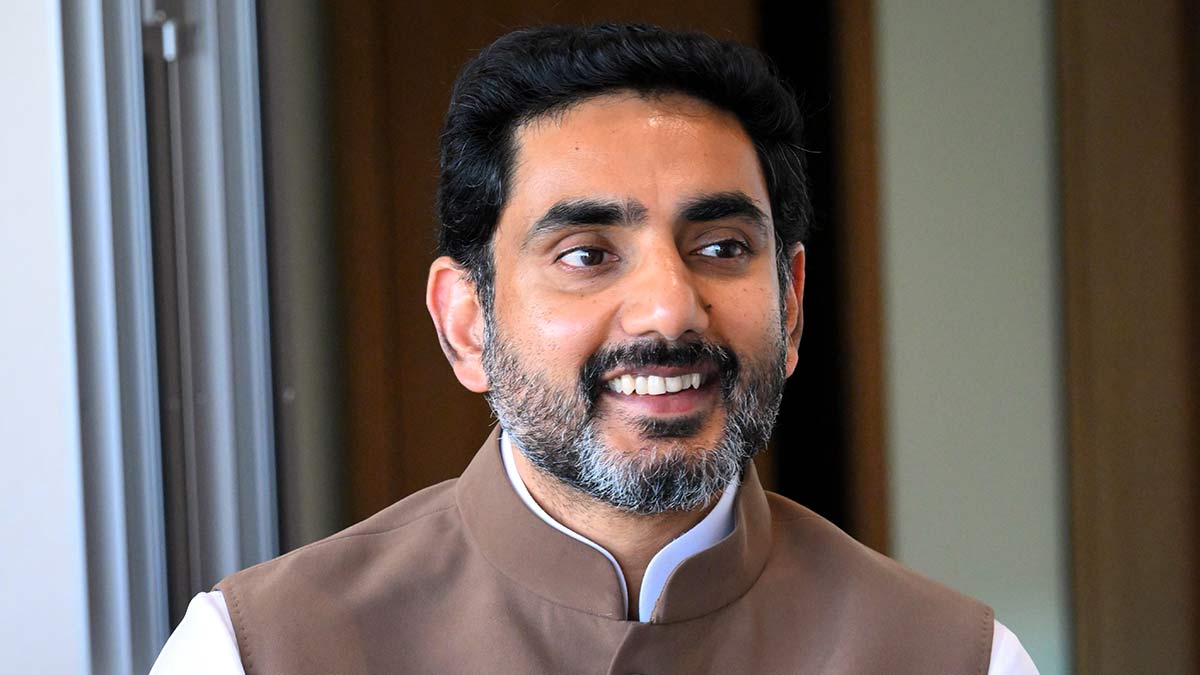
Andhra Pradesh wants to move beyond the conventional race for investments and position itself as a laboratory for the next generation of technology, industry, and research. Speaking to investors, researchers, policymakers, and members of the PanIIT community in Amaravati, IT and HRD Minister Nara Lokesh made a pitch for a development model built around speed, policy stability, and close government-industry collaboration.
He said the state government, under Chief Minister N. Chandrababu Naidu, does not want to merely attract companies to Andhra Pradesh but build ecosystems around them.
Outlining what he called the government’s 3S approach – speed, service, and stability – Lokesh said, “We are not in the business of simply setting up projects and forgetting them. We are in the business of grounding projects and ensuring that jobs are created.”
The pitch comes at a time when Andhra Pradesh is seeking to establish Amaravati not merely as a political capital but as a hub for technology, research, and advanced manufacturing. He also cited several projects that illustrate the state’s approach. Google’s proposed data-centre investment in Visakhapatnam, he said, involved coordination between the state and the Union government on issues ranging from regulations and taxation to infrastructure. The project, he claimed, moved from initial discussions to groundbreaking within 13 months. Green steel, space technology, defense, and quantum technology were among the other sectors highlighted.
But the larger ambition, Lokesh said, is to create 23 industrial clusters spanning sectors such as horticulture, aquaculture, medical devices, pharmaceuticals, chemicals, automobiles, electronics, solar energy, defence, manufacturing, data centres and renewable energy. The idea, he explained, aims to create vertical and horizontal integration within these clusters. A mobile-phone ecosystem, for instance, should include companies producing cameras, glass, batteries, casings, and accessories, rather than a single large manufacturer operating in isolation, which, he said, the government is aware of and extends support to. “The government also wants research institutions to become an integral part of this ecosystem.”
He asked the PanIIT community, which brings together alumni of 23 IITs and nearly five lakh alumni, to contribute to this effort. Lokesh also called for researchers from IITs and other institutions to work with the government on specific problems emerging from the proposed clusters.
“Research is equally important,” he said, urging the community to help create a deeper research ecosystem around the sectors Andhra Pradesh hopes to develop. Calling the government’s move as “from jugaad to institutions”, he said the state needed to develop systems and policies that could withstand legal, political, and technological changes rather than depend on individual interventions.
Describing Andhra Pradesh as an “amazing sandbox” for new ideas, he said, “Whatever we do here should become a model for the rest of India. That is the beauty of competitive federalism.” Calling Amaravati the physical expression of that ambition, Lokesh urged the IITians and entrepreneurs to visit the emerging capital region to see the new government complex, High Court, and other infrastructure taking shape. “Every 100 days, you will see something new,” he said.
The ultimate objective, according to him, however, goes beyond building a new capital. The government wants Andhra Pradesh to acquire “escape velocity”—the ability to create an ecosystem in which infrastructure, research, industry, talent, and investment reinforce each other.
The PanIIT summit, held in Vijayawada, was attended by IIT alumni, entrepreneurs, academics, and deep-tech innovators from across the globe.
