



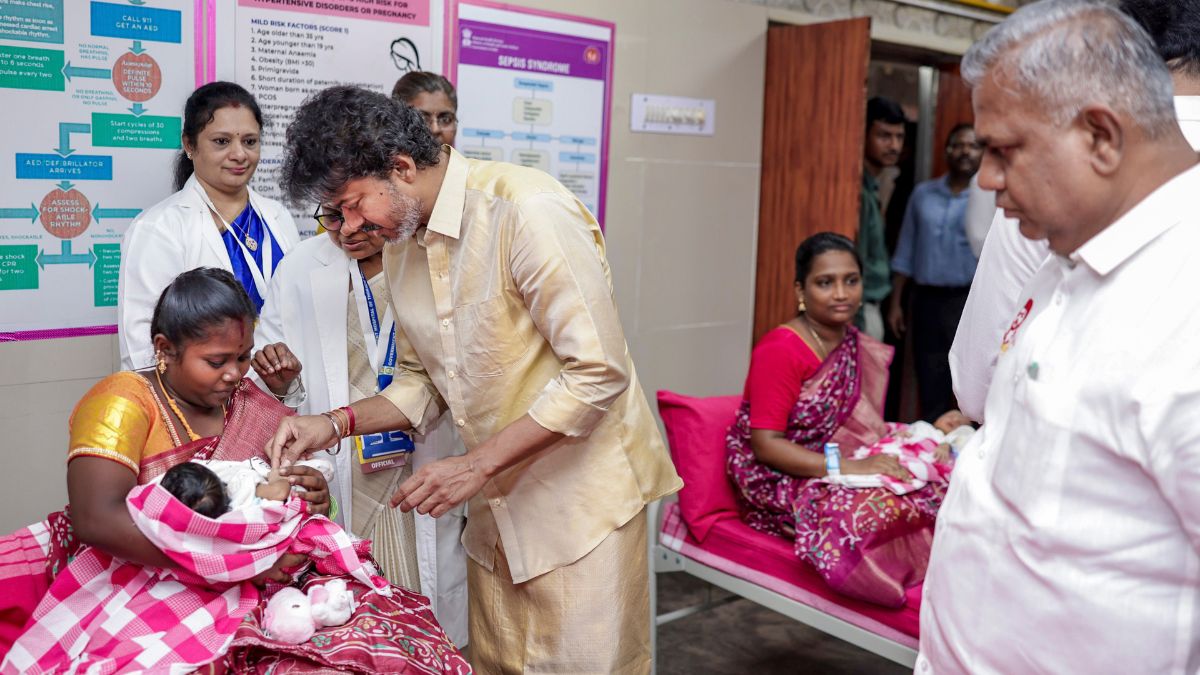
Tamil Nadu chief minister C. Joseph Vijay on Monday launched the 22-carat one-gram gold ring scheme for the newborns in Madurai, fulfilling one of the key electoral promises of the TVK launched with much fanfare.
Christened as the Thaaimaman Thanga Mothiram Thittam, the maternal uncle gold ring scheme combines an old Tamil custom with a distinctly new political message. With ₹753 crore earmarked annually, the scheme is meant to celebrate the birth of a child while encouraging women to choose government hospitals for delivery.
The launch was originally planned for September 15, coinciding with the birth anniversary of former chief minister C.N. Annadurai. It was postponed after Vijay travelled to the UK. The venue too changed. Incidentally, the choice of Madurai is significant. The launch was initially planned at Usilampatti government hospital but was later shifted to Goverment Rajaji Hospital amid security related considerations. During the launch of the scheme, Vijay presented rings to 25 newborns and visited the maternity ward. It is his first official engagement in Madurai since taking the office as chief minister.
Vijay also visited the Meenakshi Amman Temple and the renovated Gandhi Memorial Museum after launching the gold ring scheme. The symbolism of launching a scheme centred on childbirth in a major government hospital is hard to miss. The government is placing maternal welfare, public healthcare and the chief minister himself in the same frame.
Why gold and who gets it?
The government has consciously invoked the Tamil tradition of the thaai maaman—the maternal uncle who gives gifts to a newborn. Vijay announced the scheme in his Independence Day address, with the government subsequently setting September 28 as the launch date.
The welfare calculation in the scheme is straightforward. Tamil Nadu has about 7.8 lakh births every year. Around 4.2 lakh, roughly 53 per cent, take place in government hospitals. And of course the objective of the scheme is to increase confidence in public healthcare and encourage institutional deliveries. For women, particularly those from economically weaker families, the attraction is not merely the value of one gram of gold. Government hospitals already provide free delivery, emergency obstetric care and newborn services. The ring adds a tangible symbol of recognition to that transaction between the state and the mother.
“A maternal uncle is someone who is among the first to rush in when a child is born, sharing in his sister’s happiness as his own. He assures her that he will always stand by her and her child, offering love, support and a sense of security. Today, the Tamil Nadu government, under the leadership of our brother, Vijay, is embracing this sacred bond of the maternal uncle and, as a gesture of that affection, is set to provide a one gram gold ring to every child born in government hospitals,” Health Minister K.G. Arun Raj said. With this scheme, the government is effectively trying to turn a hospital discharge into a moment of celebration.
The benefit is available to babies born in government hospitals and government health institutions, subject to the eligibility conditions. The mother must be a permanent resident of Tamil Nadu and registered under PICME with a reproductive and child health ID. The scheme has been made retrospective covering eligible babies born from June 22, 2026, Vijay's birthday. That means the first phase is not confined to children born on launch day. About 1.28 lakh rings have already been procured. For babies born between June 22 and September 27, the government has created 107 distribution hubs to clear the backlog. From September 28, eligible babies will receive the ring before leaving the hospital.
The tender behind the ring
The scheme has also generated considerable interest because of the scale of the procurement. The Tamil Nadu Medical Services Corporation floated an open tender in July for a one-year rate contract covering 4,41,667 one-gram, 22-carat gold rings. The tender required bidders to have experience in manufacturing or selling gold jewellery and specified requirements relating to BIS hallmarking, 916 purity, HUID, packaging, insurance and transportation. Eleven companies eventually submitted bids. The figures recorded by the Madras High Court show just how unusual the bidding became. Joyalukkas quoted one paisa per ring for the charges over and above the cost of gold and emerged as L1. GRT Jewellers quoted ₹410.97, followed by Vummidi Bangaru Jewellers (₹822.97), Titan (₹832.24) and Malabar Gold and Diamonds (₹871.38). Other bidders included Emerald Jewel Industry, KTM Jewellery, Mohanlal Jewellers, Kalyan Jewellers, Zaveri and Company and Saravana Stores (Jewel) Super Ltd. The price of the gold itself was separate and payable according to the prevailing benchmark specified in the tender.
Under the tender conditions, other technically qualified bidders were given an opportunity to match the L1 rate. Kalyan Jewellers, which had originally quoted ₹978.50 for the additional charges, agreed to match Joyalukkas’s one-paisa rate. The government subsequently issued work orders to Joyalukkas and Kalyan Jewellers in a 70:30 ratio. The procurement later became the subject of a Madras High Court challenge. The court recorded the tender history, including the bids and the matching process, and declined to interfere with the award.
More than a ring
For Vijay's government, the challenge now moves from procurement to implementation. The annual financial provision is ₹755.83 crore, with nearly 4.42 lakh rings planned over the full year procurement period. The state has also put monitoring mechanisms in place, including district-level committees and systems for tracking inventory and distribution.
The scheme fulfils an electoral promise. It also gives the new government an unusually photogenic welfare programme - a chief minister, a mother, a newborn and a piece of gold. But its actual test will be less dramatic. For the government, the test will not simply be how many rings are distributed. It will be whether the scheme changes where women choose to give birth. And for Vijay, the scheme is therefore about more than gold.
Tamil Nadu's welfare politics has traditionally relied on schemes that put the state directly into people's everyday lives. Vijay's government is now attempting a similar proposition, but with a cultural symbol that is instantly recognisable.
