



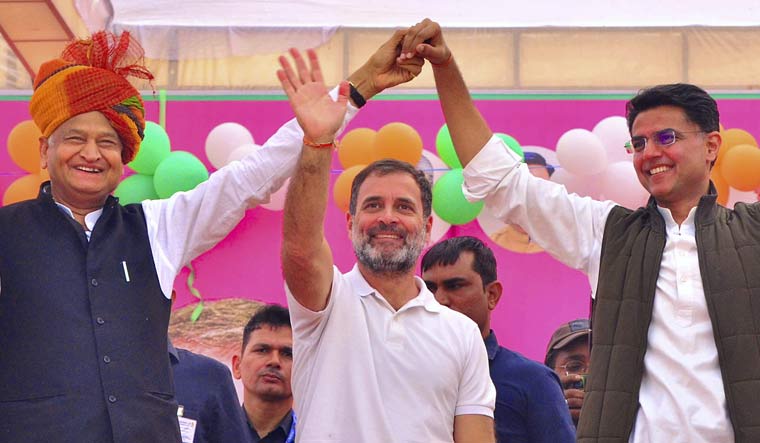
It has been nearly three years since former Rajasthan chief minister Ashok Gehlot failed to retain power for the Congress in the 2023 Assembly elections. Since then, he appears to have been kept at arm’s length by the party organisation, with no significant organisational responsibility coming his way.
His isolation has become more conspicuous with the latest elevation of his long-time rival in Rajasthan, Sachin Pilot. Pilot has been shifted from Chhattisgarh to faction-ridden Punjab, which goes to the polls next year. Notably, this is the first time Pilot will serve as an AICC general secretary in-charge of a poll-bound state.
Pilot’s appointment to Punjab, meanwhile, carries a different message: trust. He is being entrusted with a state facing organisational uncertainty and internal factionalism, with an election less than a year away.
Party insiders attribute Gehlot’s diminished national role partly to the events of 2022, when his refusal to step down as Rajasthan chief minister amid the leadership crisis created a serious rupture with the Congress leadership. He subsequently did not take up the possibility of a larger organisational role that had been in the party's pipeline at the time. The episode cast a shadow over the standing of a leader who had long been regarded as one of the Congress’s most dependable loyalists.
Pilot has already demonstrated his organisational and administrative abilities in Rajasthan. As state Congress president, he led the party into the 2018 Assembly elections, when the Congress defeated the BJP in a 200-seat-strong assembly and returned to power after five years.
Gehlot’s absence from the organisational structure is particularly striking because the party had repeatedly relied on him when he was out of power in Rajasthan. He had held important AICC responsibilities, including serving as general secretary in-charge of Gujarat from April 2017.
During the 2017 Gujarat Assembly elections, the Congress failed to dislodge the BJP but increased its tally from 61 to 77 seats. The results made the party the best performer in the state in more than three decades. Gehlot was widely credited with playing an important role in the campaign and candidate selection.
A year earlier, Gehlot had also chaired the Congress screening committee for the 2017 Punjab Assembly elections. The Congress won 77 of the state's 117 seats and formed a government under Amarinder Singh. His role in the candidate-selection process was considered significant by party observers at the time.
Pilot’s move to Punjab has also put to rest, at least for now, speculation that he could be brought back as Rajasthan Congress president as part of the ongoing organisational reshuffle. The Rajasthan election is still some distance away, and his appointment as state unit president after the Punjab elections is also not ruled out.
But much could depend on what Pilot delivers in Punjab. A strong performance there could significantly enhance his standing within the Congress and open up a larger space for him in the party.
Gehlot, meanwhile, continues to retain considerable influence in Rajasthan and has his own political base in the state—leverage he could rely on if his relationship with the central leadership becomes more strained.
For now, the contrast is difficult to miss. When Gehlot was close to the Gandhis, he confined Pilot's expansion in the state as well as nationally. But now, with Gehlot's decline in at least the national politics of the party, the Congress has relied upon Pilot as a manager of a critical state. “The Gandhis haven't met him for a long time,” a party insider said.
