



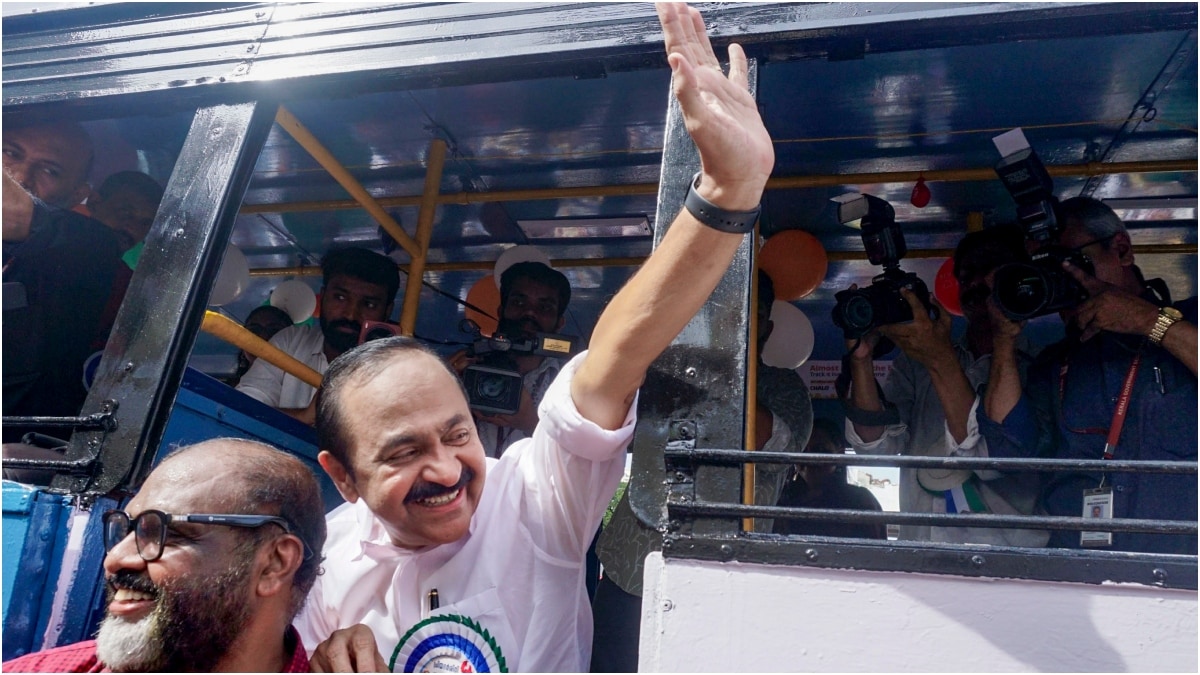
The V.D. Satheesan-led United Democratic Front (UDF) government in Kerala completes 100 days in office on Tuesday. In its first three months, the government has already had a glimpse of the challenges and opportunities that lie ahead. One of the starkest reality checks came from the weather-related destruction that ravaged the state. Kerala has been experiencing extreme weather events from time to time since the mega floods of 2018. The government’s lack of preparedness and experience came to the fore as flash floods once again battered Kerala, exposing gaps in the early warning system. The government will have to move forward with the realisation that Kerala has already become a weather-disaster hotspot, and devise a new proactive model to deal with climate change related weather events.
Human-wildlife conflict has emerged as another pressing and politically sensitive challenge for the V.D. Satheesan-led UDF government in its first 100 days. The issue is long-standing, but the Satheesan ministry has already faced pressure to address it with a long-term vision, as back-to-back fatalities have occurred across the state. In the revised 2026-27 Budget, ₹192.20 crore was specifically earmarked for mitigating human-wildlife conflict. The government has also promised technology-driven solutions, a scientific census of tigers and leopards, legally permissible relocation options and additional Rapid Response Teams. Despite these announcements, implementation gaps and structural issues persist. Over the next five years, the issue is likely to remain a key challenge for the government.
The government’s policy direction on governance and its political positioning have also become clearer in these three months. Notably, confrontation with the Centre or the Governor merely for political controversy does not appear to be the Satheesan government’s approach. Faced with the state’s precarious finances, it has shown a willingness to take pragmatic steps, at times appearing to dilute positions the UDF had taken while in Opposition. Chief Minister Satheesan has also frequently sought to blame previous administrations for the government’s current predicament. This was evident in both the PM SHRI and Waqf Board issues. However, this strategy of shifting the blame to previous governments may become less effective as the government’s honeymoon phase ends.
The Waqf debate centred on how the previous LDF government and the present UDF government interpreted and implemented the central legislation, particularly provisions relating to the composition of the Waqf Board. The PM SHRI issue, meanwhile, concerned whether the Kerala government should implement the Centre’s scheme in order to unlock other central funds. Like the previous government, the present government also formed a Cabinet subcommittee to study the continuation of the PM SHRI scheme. Incidentally, subsequent action by the subcommittee has been slow.
The government’s early achievements include the partial implementation of the Priyadarshini scheme, which provides free travel for women on KSRTC ordinary buses. The chief minister has promised to examine whether the scheme can be extended to all buses, based on financial and revenue-generation studies. Questions over its full implementation are likely to arise in the coming months.
Notably, the Satheesan government has also created an impression that the chief minister and his ministers are more accessible to people seeking to air their grievances than the previous administration.
Operation Toofan, spearheaded by Home Minister Ramesh Chennithala, which led to the arrest of around 10,000 people and targeted action against drug-trafficking networks, has emerged as one of the government’s more visible initiatives in its first 100 days.
The distribution of welfare pensions also continued without any major disruption. However, the government’s decision to bring all welfare pension payments under the Direct Benefit Transfer (DBT) system has drawn criticism from the LDF.
Supplyco also intervened effectively within the first three months to ensure the availability of essential commodities in the market during Onam, at lower prices.
The government has increased the remuneration of ASHA and Anganwadi workers. However, the Satheesan government has stopped short of granting the full increase demanded by protesting ASHA workers—a monthly honorarium of ₹21,000, which Satheesan had promised while he was Leader of the Opposition. Whether the government will fulfil the promise in its entirety could become a point of contention in the coming months.
Mission Samudra, the government’s most ambitious initiative to develop Kerala as a port-led economy by integrating its two international ports, container freight stations and 18 minor ports, was officially launched during its first 100 days. The government has also announced a slew of projects and concepts to be implemented under the mission.
Mission Samudra envisions transforming Kerala into a major maritime power within five years by treating the state’s 600-kilometre coastline as an integrated economic zone rather than a collection of isolated ports.
The government plans to connect Kerala’s two international seaports and non-major ports through an integrated network of roads, railways and inland waterways. These logistics corridors will be linked to greenfield cities and manufacturing clusters, creating a unified maritime economy.
However, its execution could present the government with several chicken-and-egg challenges. The state’s high population density, difficulties in land acquisition and fragile ecosystems could constrain its ambitions, particularly when it comes to expanding port-linked infrastructure.
Notably, the Satheesan government has shelved the previous LDF government’s ambitious Silver Line project, which would have required significant land acquisition.
The proposed Southern Kerala Economic Corridor, which seeks to integrate the natural-resource wealth of the state’s southern districts with industrial and technological development, is another major project announced by the government.
Notably, the Satheesan government’s opposition to the Mines and Minerals (Development and Regulation) Amendment Act is among the few instances in which it has taken a confrontational position against the Centre so far. The Kerala government argues that the Centre’s curbs on state levies and taxes on mineral-bearing lands violate federal principles, encroach on the state’s powers over land and result in significant revenue losses. The government’s decision to omit Vande Mataram from the official Independence Day celebrations also marked a rare point of divergence from the Centre’s position.
The government has not adopted an openly confrontational approach towards the governor either. However, it has expressed its displeasure over the governor’s decision to convene meetings with government officials and, more recently, to summon the DGP to Lok Bhavan without informing the government. The Satheesan government has maintained that such interventions encroach upon the elected government’s executive domain. Incidentally, the governor’s assertion that there is nothing wrong with summoning officials to Lok Bhavan could foreshadow tensions to come once the government moves beyond its honeymoon phase.
One visible shortcoming of the government includes the delay in implementing the Oommen Chandy health insurance scheme—a key poll promise of the UDF. The budget has announced only preliminary allocation (₹10 crore) for designing the scheme.
With the KPCC president and two acting presidents becoming ministers, the Congress party has so far failed to find replacements to lead the KPCC, creating difficulties in government-party coordination. The government has also not yet been able to appoint heads to various boards and corporations. Statements by some ministers, including K. Muraleedharan and C.P. John, triggered controversies. The appointment of Minister Sunny Joseph’s relative also became controversial.
As the government completes its first 100 days, it stands at a familiar yet critical crossroads for any new administration in Kerala: the gap between the high expectations generated by a decisive electoral mandate and the complex realities of governance. The early months have delivered a mixed ledger. They have also made it clear that structural challenges—fiscal stress, climate vulnerability, human-wildlife conflict, and land and ecological constraints on big-ticket projects—cannot be resolved through announcements or budgetary allocations alone.
The first 100 days have demonstrated intent and energy in select areas, along with a willingness to engage with some of the state’s hard realities. The next phase, however, will test whether the government can translate that intent into sustained institutional performance, moving beyond vision statements to executable projects.
