



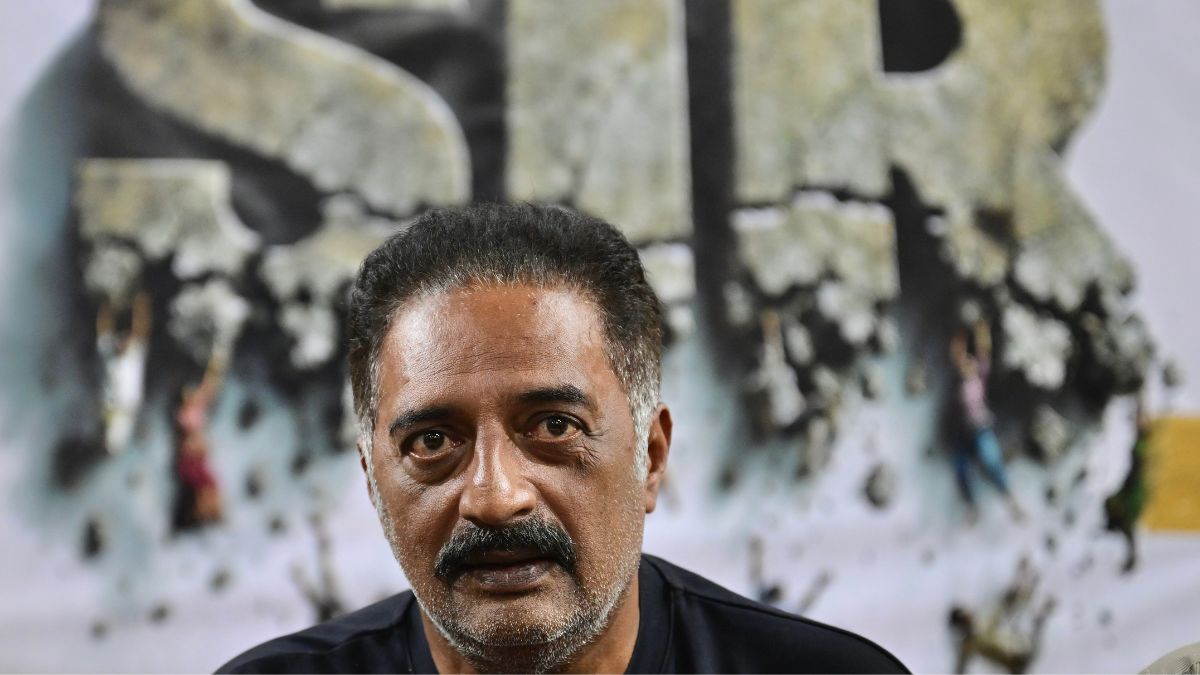
Actor and activist Prakash Raj on Friday questioned the need, pace, and manner of the Special Intensive Revision (SIR) of electoral rolls in Karnataka, saying that the exercise should not end up disenfranchising genuine voters.
Calling a press conference, he highlighted the issues he and many other residents of Bengaluru faced when their names were marked in the Absent, Shifted, Dead, Duplicate, and Others (ASDDO) list.
Speaking about the ongoing revision, Raj said there was a legitimate need to clean up electoral rolls by identifying deceased voters and duplicates and adding new eligible voters. However, he questioned whether it was practically possible to verify nearly 5.5 crore electors through house-to-house enumeration within the stipulated period.
“Yes, we need SIR,” Raj said, while questioning the manner in which it was being implemented. “Some are dead. We need those numbers. New people have to be added. But five crore voters are to be verified.”
He said the Election Commission’s (EC) decision to undertake house-to-house verification through Booth Level Officers (BLOs) had placed enormous pressure on both officials and citizens.
“Why are you torturing BLOs?” he asked, arguing that the officers were already responsible for completing an exercise of enormous scale within a very short period. Raj said the issue was not necessarily with Chief Electoral Officer V. Anbu Kumar or the BLOs, but with the system and the deadline imposed on them.
“Anbu Kumar is part of the bureaucracy and has to follow orders. How can you ask it to be done in one month?” he asked.
Raj also questioned the classification of voters as 'Absent' or 'Permanently Shifted'. He pointed out that a voter could be away from home when a BLO visited because of work, travel or other personal reasons.
“If someone is absent, is it a crime?” he asked. “You will delete their vote and remove their citizenship?”
He cited the movement of migrant workers as an example, saying people from areas around Bandipur could travel to Wayanad for work, while others from Karnataka could move temporarily to states such as Gujarat or Goa. Such movement, he said, should not automatically result in a person’s name being removed from the electoral roll.
He also dismissed allegations that he held multiple voter IDs, which surfaced around the time of his candidature in Karnataka. Raj said he had previously been a registered voter in Tamil Nadu, where he lived before moving to Karnataka in 2016.
“When I shifted to Karnataka, I filed Form 7 for deletion from Tamil Nadu,” Raj said, adding that the EC subsequently examined the matter and cleared his candidature.
He noted that he later obtained records of his communication with the ECI via an RTI application. According to him, the records included correspondences between Karnataka and Tamil Nadu election officials regarding the deletion of his earlier voter ID and any other duplicate or fake IDs associated with him.
He pointed out that a complaint alleging that he possessed multiple voter cards was filed in 2019, and had taken seven years to reach the district court.
Alleging that the summons in the case were sent to an incorrect address based on an affidavit published by a media organisation, he said he subsequently submitted documents showing his communication with the EC regarding the deletion of his Tamil Nadu voter ID.
“The allegations were proved false, and they cleared my candidature for the elections,” he said, speaking of how the SIR exercise in Karnataka saw his name initially categorised as 'Permanently Shifted' before being changed to 'Shifted'.
“I have only one voter ID. Ironically, that too is being snatched,” Raj said.
The actor-activist also raised concerns over the distinction between Form 6 and Form 8. While Form 6 is used for inclusion of a new elector, Form 8 is used for changes such as shifting residence. He questioned why existing voters who had merely changed their address should have to go through a process meant for new electors.
“If someone has shifted house, they are not wrongdoers,” he said.
He argued that the Election Commission should have announced the exercise much earlier and undertaken a sustained public-awareness campaign to explain the process. Political parties and public figures, he said, had traditionally appealed to citizens to vote and help them come to power, but the same citizens were now being forced to struggle to establish their voting rights.
“This is an assault on the dignity of the electorate,” Raj said, announcing that he would support a movement in Karnataka against what he described as an unnecessarily stressful process.
Raj stressed that electoral-roll revision was necessary but insisted that it should be conducted without traumatising voters or overburdening election officials.
“If one crore people lose their voting rights, what kind of democracy will it be?” he asked.
