



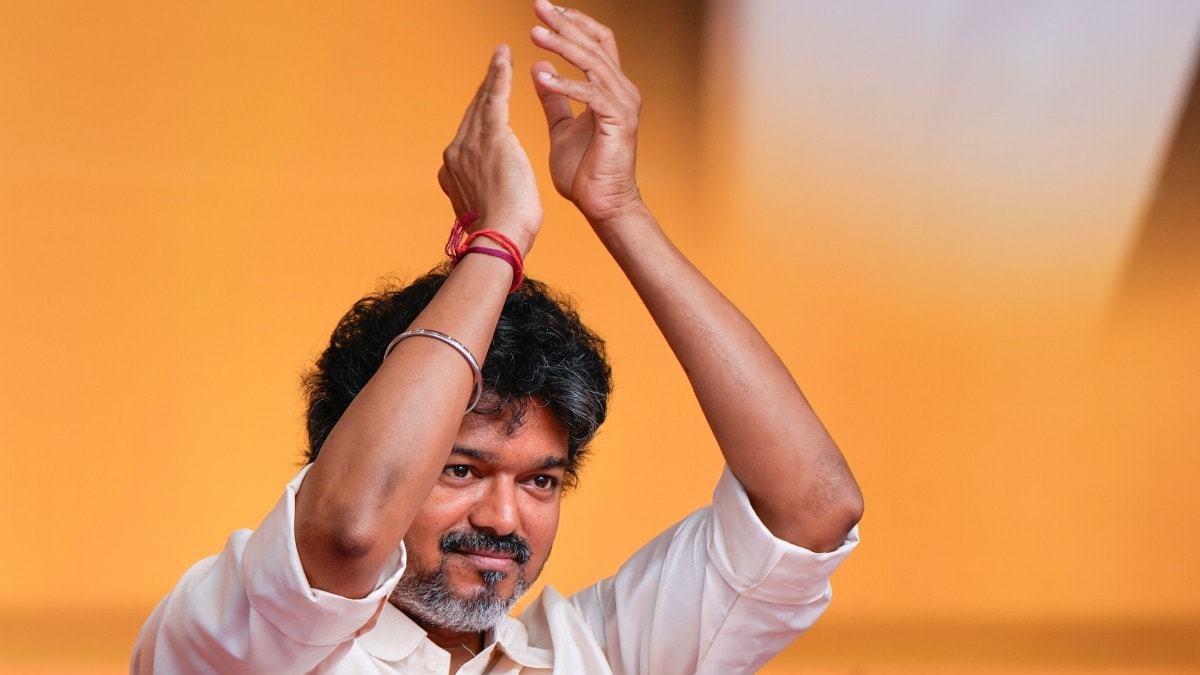
In a state where cinema and the Secretariat have always shared a revolving door, the maiden budget of the Tamilaga Vettri Kazhagam (TVK) government looks more like a manifesto. When Finance Minister N. Marie Wilson stood before the Assembly, the room was charged with more than just political rivalry. There was a profound, relatable curiosity: How would C. Joseph Vijay, an actor who built a career on high-octane heroism, tackle the leaden reality of a state grappling with a debt of nearly ₹11 lakh crore?
The stakes were framed by a grim white paper recently released by the Vijay administration, which revealed that Tamil Nadu's debt had effectively doubled over the last five years. For a policy analyst, the question was whether the TVK would pivot to austerity or double down on populism. The answer, as it turns out, is a high-wire act of "family-man" branding and a radical bet on administrative efficiency.
The 'family man' branding: Governance as kinship
The TVK budget codifies a strategic shift in Tamil political identity. For decades, the state's welfare politics were defined by parental figures—the "Amma" (mother) Jayalalithaa or "Kalaignar" (scholar/patriarch) Karunanidhi. Vijay has recalibrated this into a sibling-and-uncle dynamic that feels both modern and intimate.
By embedding familial titles directly into the administrative architecture, the government appears to be attempting to bypass the coldness of the state and create a direct emotional link with citizens. Throughout the budget speech, Finance Minister Wilson presented Vijay not simply as the Chief Minister but through familial identities—Annan (elder brother) for brides, Thai Maaman (maternal uncle) for newborns, and Vijay Mama (Uncle Vijay) for children. The welfare architecture mirrors the political persona that helped carry the actor-turned-politician to power.
This "Vijay Mama," or "Uncle Vijay," effect specifically targets women and children, transforming the state from a distant provider into a protective relative—a sociological shift intended to secure generational loyalty.
The gold standard: Welfare as a life-cycle event
While the approach may be described as pure populism, the TVK frames its major welfare schemes as investments in the dignity of life-cycle events. Two gold schemes stand out, representing a combined cost of over ₹1,370 crore to the exchequer.
The Thai Maaman Thanga Mothiram Thittam, with an allocation of ₹560 crore, is presented as a maternal uncle's gift of a one-gram gold ring for every child born in a government hospital to permanent residents of the state.
The other is the Annan Seer Thittam, with an allocation of ₹812 crore. It is presented as an elder brother's wedding gift consisting of an eight-gram gold coin and a silk saree for eligible brides.
These are not just handouts; they are culturally resonant symbols of wealth and security. In a state where gold is regarded as the ultimate hedge against poverty, these schemes provide a tangible and visible form of welfare that the TVK hopes will outshine the fiscal gloom.
Fighting the financial crunch through the Ahluwalia logic
The most counterintuitive aspect of the budget is the expansion of welfare despite a "financial crunch." The TVK's central proposition—and its greatest fiscal risk—is that the state does not need expenditure cuts if it can simply repair the machinery.
Minister Marie Wilson argued that previous regimes had allowed revenue departments to "bleed uncontrollably." To address this, the TVK government has appointed the Revenue Augmentation Committee, headed by former Planning Commission Deputy Chairman Montek Singh Ahluwalia.
The goal is to raise ₹16,000 crore annually through technology-driven governance, anti-middlemen reforms aimed at ending restrictive tender practices, opening public procurement to curb kickbacks, using high-tech monitoring to prevent the siphoning of public funds in the mining sector, and plugging leakages in liquor retail sales through government-run TASMAC shops.
A specific ₹1,000 crore is expected from an additional privilege fee on liquor manufacturers, separate from the broader ₹15,000 crore expected through plugging leakages.
The Gen Z playbook
Targeting Generation Z, the budget leans heavily into future technology. The administration has anchored its vision in the goal of reaching a $1.5-trillion economy by 2036.
Central to this vision is Arivagam, India's first dedicated AI and Innovation City, which will house an AI university and semiconductor testing labs. This is not just about infrastructure; it is about building a 50-year vision.
Key digital platforms such as SPEED, an AI-enabled single-window planning approval system, and the AI Economy Mission suggest that the government is attempting to outrun bureaucratic delays through technology.
Reviving and reimagining
Through its maiden budget, the TVK government seeks to blend traditional Dravidian welfare with new-age priorities.
This hybrid approach is best reflected in the revival of Jayalalithaa-era programmes, such as the free milch cow distribution scheme for 10,000 women, alongside the modern Vetri Laptop Scheme, for which Wilson allocated ₹2,000 crore.
Perhaps the most interesting detail is the Puthiya Payanam Puthiya Vegam scheme. It provides 5.32 lakh Class XI students with bicycles equipped not only with helmets but also with water-bottle holders—a small but significant nod to the lifestyle needs of modern students.
The Super Clean, Super Campus scheme, with an allocation of ₹129 crore, focuses on school sanitation. It reinforces the "Uncle Vijay" branding by projecting an image of modern, efficient and hygienic leadership.
The TVK government's debut budget, however, is a calculated bet that administrative transparency and technological optimisation can generate enough liquidity to fund a gold-plated social safety net. It is, in many ways, a "Puthiya Payanam"—a new journey—that rejects the traditional austerity playbook in favour of a reformist surge.
However, the ultimate question for the state's future remains: Can administrative efficiency truly withstand the crushing burden of an ₹11 lakh crore debt, or will the "Uncle Vijay" effect eventually collide with the hard mathematics of a state treasury that can no longer afford its own cinema-scale dreams?
