



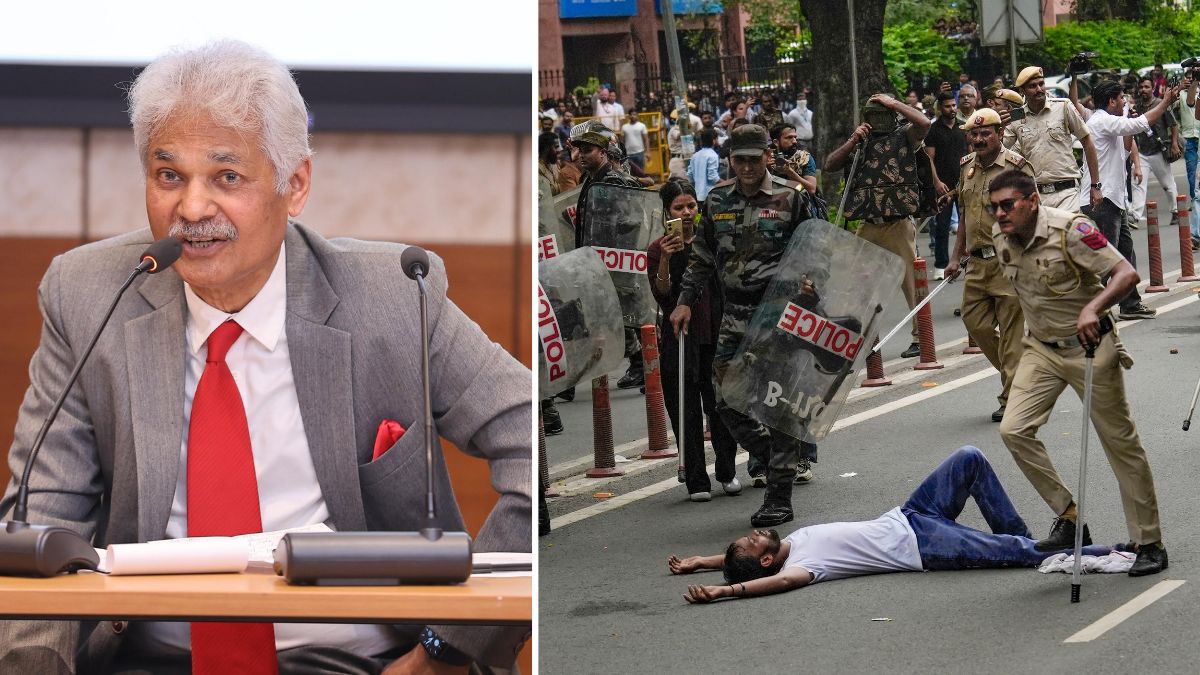
As the Supreme Court examines allegations of excessive police force during protests by students against the alleged NEET paper leak, one voice has emerged with unusual moral clarity: that of former IPS officer, Former Special Director, Intelligence Bureau and former Information Commissioner Yashovardhan Azad, the petitioner who has sought judicial intervention against the use of pellet guns for crowd control.
For Azad, the issue goes far beyond one protest. “I was deeply pained to see students being hit with pellet guns,” Azad told THE WEEK. “These are not terrorists or armed insurgents. They are students exercising their democratic right to protest. Crowd control cannot mean beating the crowd.”
His remarks came after the Supreme Court questioned the use of force against protesters and indicated that it was considering laying down national guidelines on handling demonstrations. The Court has also granted interim protection against coercive action to several protesters.
Azad argues that the deployment of pellet guns against students is both unnecessary and disproportionate.
“There are enough alternatives available,” he said. “Police have water cannons, lathi charge, chilli spray, tear smoke and rubber pellets. Why should pellet guns be used when less harmful methods exist?”
His principal concern is the weapon's lack of precision.
“Pellet guns are not aimed at one particular part of the body. Accuracy is the issue,” he said. “Hundreds of tiny pellets scatter after being fired. No one can predict where they will hit. They can strike the eyes, face, chest or any vulnerable part of the body.”
The human cost of that unpredictability has long haunted the country. Pellet guns were introduced in Jammu and Kashmir as a supposedly non-lethal method to disperse violent stone-pelting mobs. Over the years, however, the weapon became synonymous with horrific eye injuries, permanent blindness and lifelong disabilities suffered by many civilians.
Azad believes that history should have been reason enough not to deploy the same weapon against students protesting on university campuses and city streets.
“Pellet guns were introduced in Kashmir in a particular security context. Even there, they generated enormous concern. Using them against students is unacceptable,” he said.
According to Azad, the problem is compounded by the fact that security personnel continue to receive training in the use of pellet guns. The Ministry of Home Affairs, he said, still conducts three-day training programmes for personnel on handling and firing these weapons.
“The training continues, but the larger question is whether we should be using such weapons at all when better alternatives are available,” he said.
Instead of expanding their use, Azad wants India to rethink its crowd-control strategy altogether.
His petition urges the Supreme Court to prohibit pellet guns except in the rarest of circumstances where there is an immediate threat to life.
“They should only be considered in life-threatening situations where there is absolutely no other option,” he said. “Routine protests, student demonstrations or public gatherings do not fall into that category.”
For the former police officer, the debate is not about weakening law enforcement but about strengthening democratic policing.
“The objective of crowd control is to disperse a gathering safely, not to leave people permanently injured,” he said. “The police have to maintain law and order, but they must do so using the minimum force necessary.”
As the Supreme Court considers framing nationwide norms for handling protests, Azad hopes the moment becomes a turning point.
His appeal is ultimately a simple one: that governments distinguish between citizens raising their voices and enemies of the State.
“The solution to crowd control,” he said quietly, “is not to beat the crowd.”
