



In December 1973, the hostel mess of the Morbi Engineering College, Gujarat, saw the start of a protest against the high food bills. It is this protest that later snowballed enough to raise the slogan “Sampoorna Kranti ab nara hai, bhavi itihas hamara hai” (with total revolution as our motto, the future belongs to us).
By 1974, the student-led protest, which started over high food prices, soon saw participation from different sections of society against the high prices of food grains, cooking oil, and other essential commodities, as well as against corruption in government bodies. Soon the protest had its ripples felt across India.
The instance of a student-led protest capturing the imagination of national politics is no longer alien to Gen Z. On May 3, 2026, the allegations of a National Eligibility cum Entrance Test (NEET) question paper leak surfaced. Around 22 lakh candidates had appeared for the NEET-UG, and the students demanded an investigation.
While the investigation was being conducted under the Central Bureau of Investigation (CBI), the National Testing Agency (NTA) cancelled the exam and announced a nationwide re-examination on May 12.
If the students of 1973-74, organised under the banner of the Navnirman Samiti, with the support of the Akhil Bharatiya Vidyarthi Parishad (ABVP), the Bharatiya Jana Sangh (BJS), and the Congress (O), to conduct bandhs and strikes in the Congress ruled Gujarat, demanding the resignation of the then Chief Minister Chimanbhai Patel; the students of 2026 organised under the banner of the Cockroach Janata Party (CJP), a satirical online movement started against the controversial comments made by Chief Justice Surya Kant, with the support of the Students’ Federation of India (SFI), the All India Students’ Association (AISA), and the Krantikari Yuva Sangathan (KYS), demanded reforms in the whole examination system, accountability, and the resignation of the then education minister Dharmendra Pradhan.
On June 21, the NTA conducted the re-examination, but by then the news reports of multiple student suicides, who were NEET aspirants, became a major talking point in public spaces. If the Navnirman Movement of 1973-74 invited Jayaprakash Narayanan, an Indian freedom fighter and socialist leader, to join the protest, then in the 2026 CJP protest it was Sonam Wangchuk, an educational reformer, innovator, and engineer, who voluntarily joined the protest with an indefinite hunger strike.
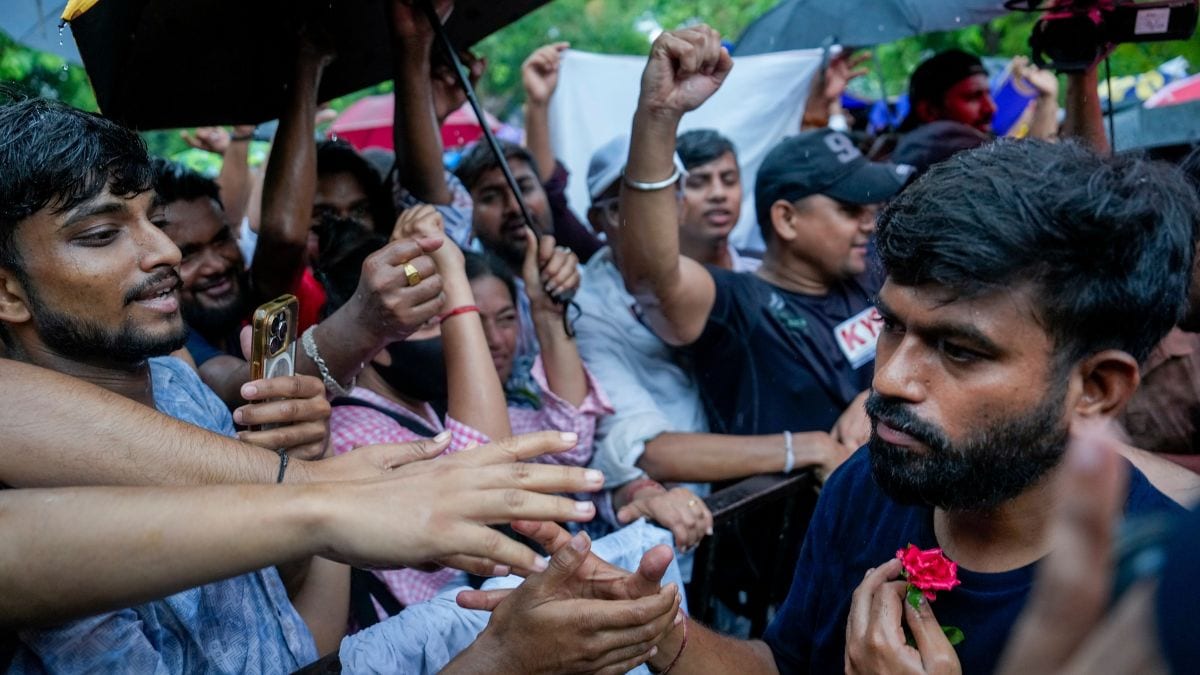
On July 18, Sonam Wangchuk was allegedly forcefully shifted from his protest site at Jantar Mantar by Delhi Police to the Safdarjung Hospital, New Delhi and then later to the Medanta Hospital. The CJP protest at Jantar Mantar decided to continue with the ‘Chalo Sansad' movement on July 20, where the students and the public marched to the Indian Parliament. This March was dealt with police brutality, including lathicharge, use of tear gas, and alleged misconduct by policemen at women protesters.
The morning after July 20, the Jantar Mantar, and the surrounding places around central Delhi saw continued protests from students and the public alike. The pressure was mounting on the Union Government regarding the demand for Education Minister Dharmendra Pradhan’s resignation, and on July 25, he submitted his resignation to Prime Minister Narendra Modi and took responsibility for the paper leaks. Similarly, in February 1974, the then Chief Minister of Gujarat, Chimanbhai Patel, resigned due to the mounting pressure from the Navnirman Movement, which by then had become a statewide protest.
The 1973-74 protest was spearheaded by the student leaders like Manishi Jani and Narhari Amin, who later moved into mainstream politics. Due to the support of the ABVP, a young Narendra Modi participated in the protest as an RSS pracharak and as an associate of the ABVP. Meanwhile, the CJP protest of 2026 was spearheaded by Abhijeet Dipke, a political communication strategist, and Saurav Das, an independent Investigative journalist. Due to the AISA and the SFI support, student leaders such as Neha Bora and Aishe Ghosh became active members of the protest.
Inspired by the Navnirman Movement, in 1974, students in Bihar organised protests against rising prices, food scarcity, unemployment and corruption. The organisers invited Jayaprakash Narayan to join the protest, who joined on the promise of not limiting the protest to Bihar. This protest later came to be known as the JP movement, which had rallied against the Indira Gandhi government of 1974. The movement also saw the rise of student leader Lalu Prasad Yadav, who served as the head of the Bihar Rajya Sangharsh Samiti.
If the JP movement of 1974 told the public “Sampoorna Kranti ab nara hai, bhavi itihas hamara hai” (With Total Revolution as our motto, the future belongs to us), the CJP protest of 2026 told the public “Inquilab Zindabad” (Long live the revolution) and asked “Dharmendra Pradhan Istifa do” (Dharmendra Pradhan must resign).
