



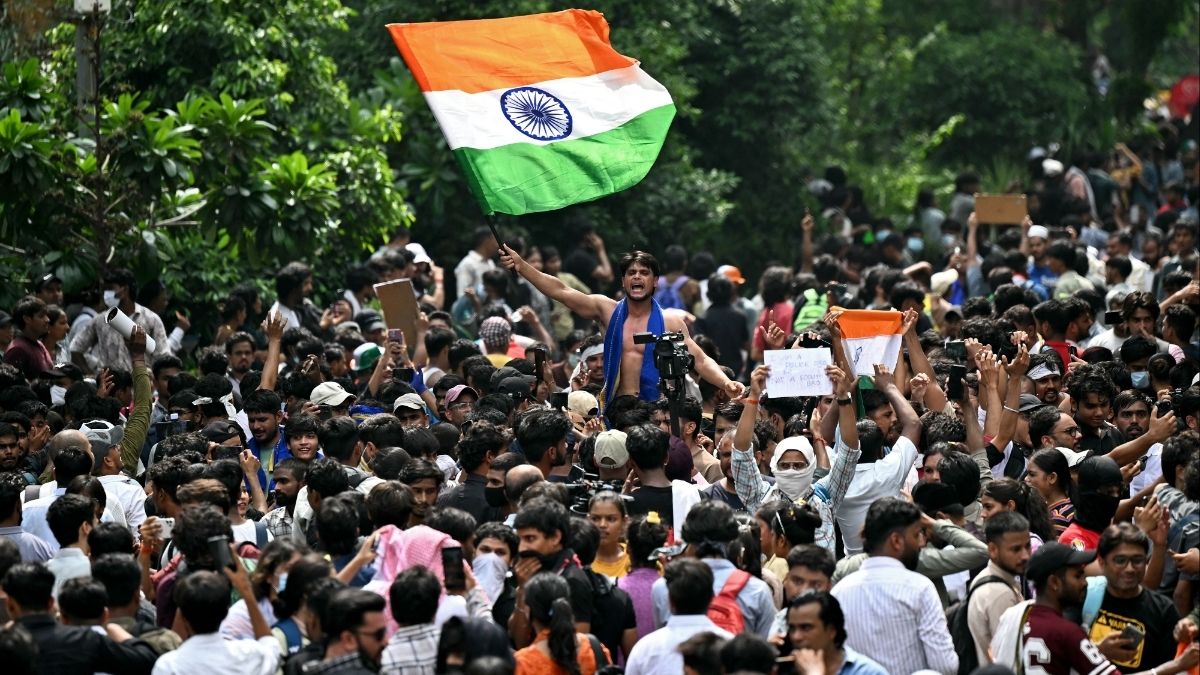
Peaceful protest is the heartbeat of democracy, but constitutional freedoms must coexist with the rule of law and the rights of every citizen.
In every vibrant democracy, protests are inevitable. They reflect public sentiment, provide a platform for dissent and remind those in power that governance is ultimately accountable to the people.
Whether the issue concerns employment, education, farmers' rights, environmental concerns or public policy, citizens have the constitutional right to express their views. However, every protest also raises an equally important question: When does the exercise of a fundamental right begin to infringe upon the rights of others?
The Indian Constitution protects the right to protest through Articles 19(1)(a) and 19(1)(b), which guarantee freedom of speech and expression and the right to assemble peacefully and without arms. These freedoms are not mere legal provisions; they are the essence of democratic participation. The Constitution does not expect citizens to remain silent spectators. It encourages debate, criticism and peaceful opposition as essential components of good governance.
At the same time, the Constitution does not treat these rights as absolute. Articles 19(2) and 19(3) expressly permit the State to impose reasonable restrictions in the interests of public order, sovereignty, security of the State and other legitimate constitutional objectives. Therefore, the legal position is clear: while the right to protest is protected, the manner in which that right is exercised remains subject to the rule of law.
The expression "public order" is often misunderstood. It is not synonymous with inconvenience. A protest may disrupt traffic, require diversion of police resources or cause temporary inconvenience to the public without necessarily threatening public order.
Public order is affected when a situation poses a real risk to public peace, safety or tranquillity. Violence, destruction of public property, obstruction of emergency services, prolonged occupation of public roads or acts that incite hostility and fear move beyond the protection of constitutional freedoms and attract legal consequences.
The responsibility of maintaining this balance rests primarily with the police. Contrary to popular perception, the role of the police during a protest is not limited to dispersing crowds or enforcing prohibitory orders. Their constitutional obligation is two-fold: to facilitate lawful and peaceful protests while simultaneously ensuring that public order is maintained. This is a difficult task that demands neutrality, restraint and sound judgment.
Professional policing requires planning long before a protest begins. Authorities must engage with organisers, assess the anticipated turnout, identify suitable venues, regulate traffic and ensure that emergency services remain unaffected. Dialogue is often more effective than confrontation. The objective should never be to suppress peaceful dissent but to ensure that competing rights are harmoniously balanced.
Equally important is the responsibility of protest organisers and participants. Constitutional rights carry corresponding duties. Those exercising the right to protest must ensure that demonstrations remain peaceful, comply with lawful directions issued by competent authorities and do not interfere with the rights of others.
A protest loses its constitutional protection the moment it becomes a vehicle for violence, intimidation, vandalism or coercion. Damage to public property, obstruction of critical infrastructure and attacks on law enforcement officers cannot be justified under the guise of democratic dissent.
Courts in India have consistently recognised this distinction. Judicial pronouncements have reaffirmed that peaceful protest is a constitutional right, but they have also clarified that public roads and public spaces cannot be occupied indefinitely in a manner that paralyses normal life. The judiciary has repeatedly emphasised that the exercise of one citizen's fundamental rights cannot extinguish the rights of countless others who are equally entitled to move freely, carry on their profession, access hospitals and educational institutions, and live without fear or disruption.
Recent years have demonstrated how quickly peaceful demonstrations can escalate. Social media, misinformation and provocative rhetoric often transform local grievances into large-scale law and order challenges. In such situations, the police must act with professionalism and proportionality.
Any use of force must remain lawful, necessary and proportionate to the threat posed. Excessive force not only invites judicial scrutiny but also erodes public confidence in law enforcement. Equally, failure to intervene when violence erupts undermines public safety and weakens the rule of law.
The law, therefore, does not compel the State to choose between liberty and order. It requires both to coexist. A democratic society cannot flourish if peaceful protests are suppressed through arbitrary restrictions. Equally, democracy cannot survive if public spaces become permanently inaccessible or if violence is tolerated in the name of dissent. The constitutional balance lies in protecting peaceful expression while ensuring that the rights of the larger community remain secure.
Ultimately, the strength of a democracy is measured not by the absence of protests but by the manner in which they are managed. Citizens must remain free to question, criticise and demand accountability from those in authority.
At the same time, protests must remain peaceful, lawful and respectful of the rights of others. The police, for their part, must discharge their duties with impartiality, professionalism and fidelity to the Constitution.
The law draws the line not at dissent itself, but at the point where the exercise of a fundamental right threatens public order, public safety or the constitutional rights of fellow citizens. Protecting that delicate balance is the hallmark of a mature democracy governed by the rule of law.
The author is advocate at the Delhi High Court.
The opinions expressed in this article are those of the author and do not purport to reflect the opinions or views of THE WEEK.
