



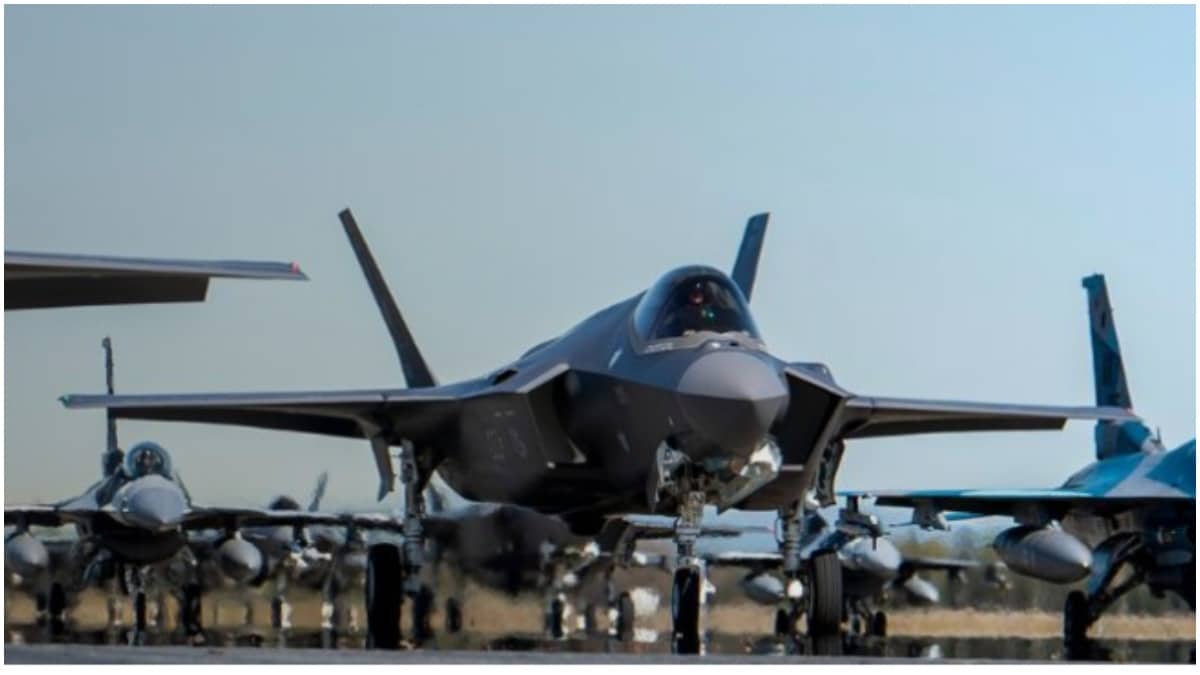
India's continued procurement of Russian-made S-400 Triumf air defence systems could be a possible reason why Indian Air Force (IAF) personnel were reportedly not allowed near American F-35 fifth-generation fighter jets during the recently-concluded multinational Tarang Shakti-2026 exercise.
The issue came into focus after IAF Chief Air Chief Marshal A.P. Singh revealed that Indian personnel were not even permitted near the American stealth fighters, which had arrived in India to participate in the exercise. Singh made the remark while responding to a question about reports that the US had offered to sell F-35 fighter jets to India.
Sitting alongside the commander of the US Air Force's Pacific Air Forces (PACAF), Singh had dismissed speculation about an official American offer and made a humorous observation about the restrictions surrounding the aircraft. "Your people don't even let us go near the aircraft, and you are talking about selling it to us," Singh said.
The IAF chief clarified that Washington had made no official offer to sell the fifth-generation fighters to India.
However, his remarks have raised questions about why Indian personnel were not allowed near the fifth-generation fighter during an exercise that brought together air forces from eight foreign nations.
According to media reports, India's continued acquisition of the Russian-made S-400 Triumf air defence system could possibly explain the restrictions surrounding the F-35.
In the past, there have been concerns raised about the security risks of operating the American stealth fighter in an environment where the Russian air defence system is also present.
It is to be noted that Turkey, a NATO member, was expelled from the F-35 programme after acquiring the S-400 system from Russia.
The US and NATO have maintained that the F-35 and S-400 are incompatible systems, arguing that operating them simultaneously could compromise the security of the American fighter.
The concern is that the Russian air defence system could gather valuable information about the F-35's stealth characteristics and operational capabilities.
However, no official explanation linking the reported restrictions on IAF personnel to India's S-400 procurement has been cited. The connection remains a possible explanation, as suggested in media reports.
Why does the US consider S-400 a threat to F-35?
American military officials and experts have previously warned that operating the F-35 near the S-400 could expose sensitive information about the stealth fighter.
General Tod Wolters, who previously headed the US European Command, had explained why Washington opposed operating the two systems in proximity. "You cannot operate an F-35 in the vicinity of an S-400. They won't talk to each other, and what the two systems will attempt to do, certainly the S-400 against the F-35, is attempt to exploit the F-35's capabilities," Wolters was quoted as saying.
He also made it clear that the US did not want Russia gaining access to sensitive information about the aircraft. "I can tell you that we aren't interested in sharing the F-35's capabilities from a radar perspective, from an operational perspective, with the Russians. We've made that very, very clear."
The main concern is that the S-400's radar systems could observe the F-35 during different flight conditions and potentially identify vulnerabilities in its stealth capabilities.
David Stupples, a professor of electronic and radio systems at City, University of London, had warned about the potential risks of exposing the F-35 to S-400 radar systems.
According to a 2019 article quoting him in Missile Defense Advocacy Alliance, S-400 radars could observe the F-35 across its flight profiles and potentially identify weaknesses in its stealth characteristics.
Experts have argued that operating the two systems in proximity, or connecting them through networks, could provide Moscow valuable intelligence that might help Russian forces counter F-35 aircraft operated by the United States and other countries.
The concern is not merely about whether the S-400 can detect the F-35, but also about the possibility of collecting information that could help identify and exploit vulnerabilities in the aircraft.
Former US Secretary of State Mike Pompeo had also expressed Washington's opposition to operating the two systems together. "It is not possible to both fly the F-35 in space where the S-400 is significantly operable," Pompeo told a Senate Foreign Relations Committee hearing in 2019.
