



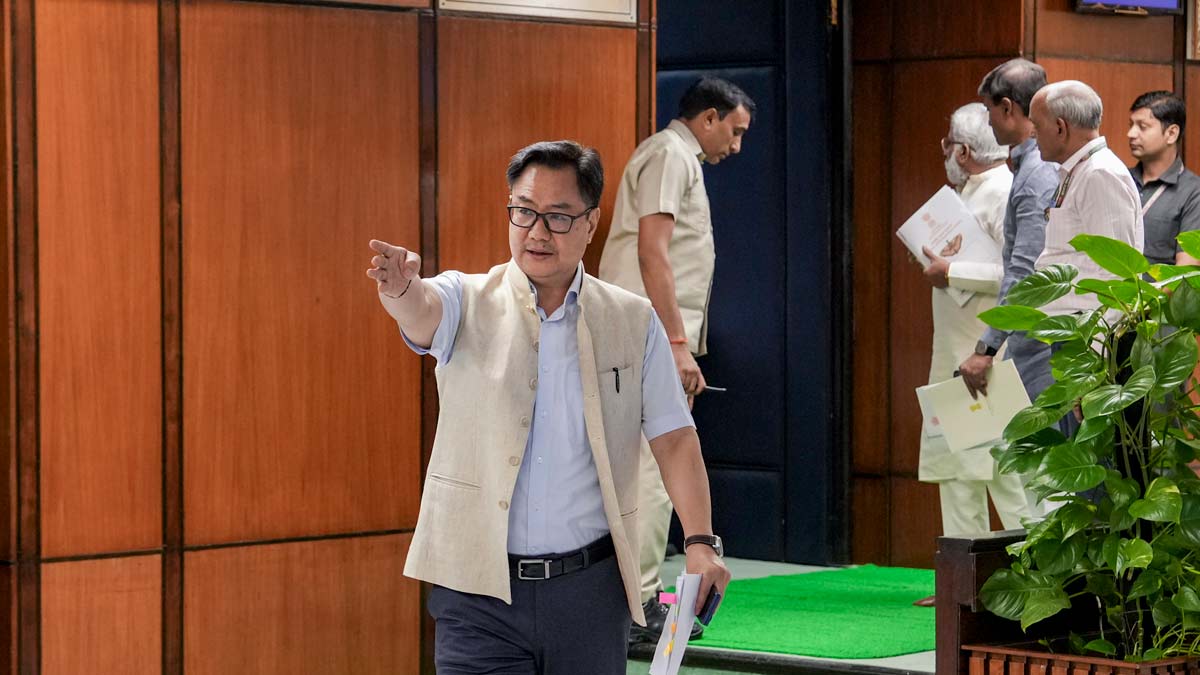
The government has drawn up an extensive legislative agenda for the Monsoon Session of Parliament, with eight key bills scheduled for discussion as the session begins on Monday. Parliamentary Affairs Minister Kiren Rijiju said that any additional legislative business would be taken up after following the required parliamentary procedures.
The session, which will run from July 20 to August 13, is expected to begin on a stormy note, with the Opposition preparing to corner the government over issues including the NEET examination controversy and the alleged theft of donations at the Ram Temple.
Among the most significant proposals is the Foreign Contribution (Regulation) Amendment Bill, 2026, which aims to ensure that foreign contributions received by NGOs are not used in a manner prejudicial to national interests. The bill also proposes to empower the government to take over the assets of NGOs that fail to comply with FCRA registration requirements.
Another key legislation is the Prevention of Insults to National Honour (Amendment) Bill, which seeks to grant the national song Vande Mataram the same statutory protection as the national anthem Jana Gana Mana. If passed, insulting or obstructing the singing of Vande Mataram would become a punishable offence.
The government has also listed the Registration of Births and Deaths (Amendment) Bill, 2026, which proposes to tighten provisions relating to delayed registration under the Registration of Births and Deaths Act, 1969 (as amended in 2023). Under the proposed changes, births and deaths reported more than two years after the event would be subject to a more stringent registration process.
Another major reform on the agenda is the Viksit Bharat Shiksha Adhishthan Bill, 2025, which proposes a sweeping overhaul of India's higher education regulatory framework. The bill seeks to replace the University Grants Commission (UGC), the All India Council for Technical Education (AICTE), and the National Council for Teacher Education (NCTE) with a single unified regulatory commission.
The Supreme Court (Number of Judges) Amendment Bill, 2026 is also slated for consideration. It seeks to replace an ordinance that increased the sanctioned strength of the Supreme Court from 34 to 38 judges, including the Chief Justice of India. As the change does not require a constitutional amendment, the bill can be passed with a simple majority.
The government will also table the Micro, Small and Medium Enterprises Development (Amendment) Bill, 2026, which aims to update the MSME Development Act, 2006, in line with the evolving business landscape. The proposed amendments are intended to promote ease of doing business and introduce a more trust-based regulatory framework for MSMEs.
Additionally, the Income-tax (Amendment) Bill is expected to replace an ordinance that exempts foreign investors from paying income tax on interest income and capital gains earned from investments in government securities (G-secs).
Responding to questions on whether the government plans to revive the previously rejected delimitation bill during the session, Rijiju said the matter would be discussed by the Business Advisory Committee.
"We have urged all political parties to support the passage of the various bills brought by the government after constructive discussions. If parties choose not to participate in debates and instead resort to sloganeering, they will have to bear the political consequences," Rijiju said.
