



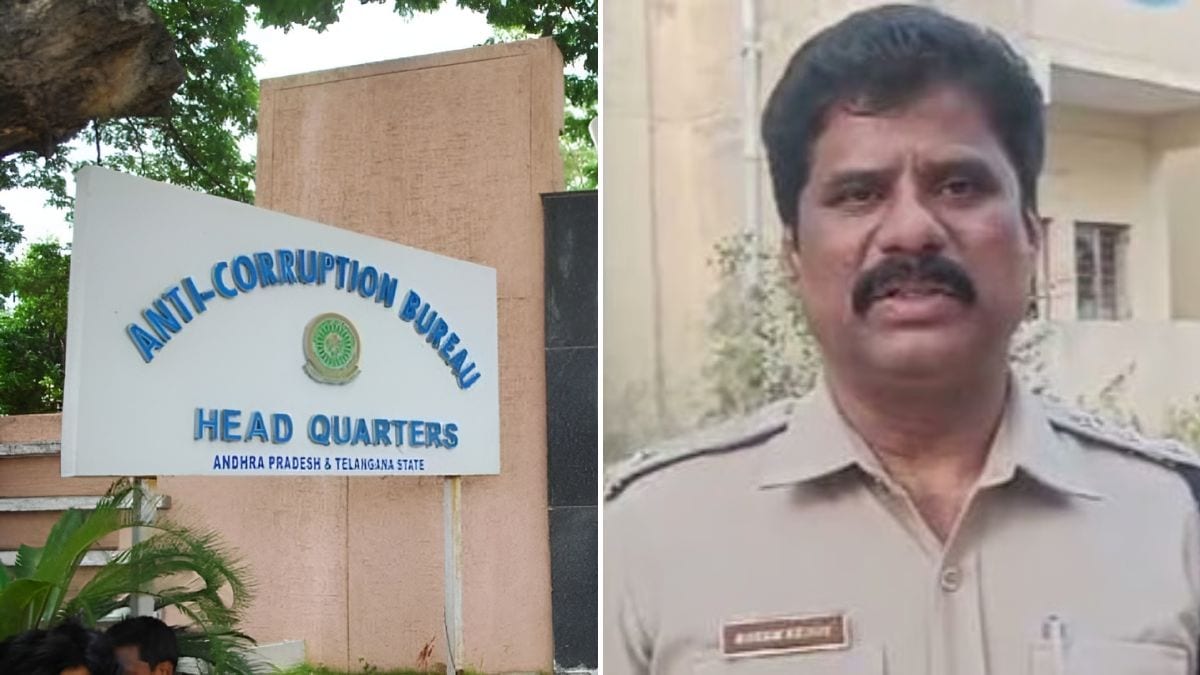
Media outlets in Telangana have been filled with news that the State Anti-Corruption Bureau has caught Deputy Superintendent of Police, S. Bheem Reddy, with disproportionate assets worth Rs 200 crore.
The Telangana ACB has intensified its crackdown in recent months, targeting government officials at higher levels.
Raids have unearthed properties ranging from luxury villas, apartments and agricultural land to large quantities of gold, cash and bank deposits. Despite the ACB’s commendable work, corruption will not come down in the state, even if the agency further intensifies its campaign.
The major reason for this is that government employees have figured out that ACB cases take at least 10-15 years to be decided, and they can, in the meantime, manage officials and politicians and weaken the cases.
Once the ACB files a case, it needs to secure government permission to prosecute the accused official, which never happens most of the time.
“The officials and government employees enjoy good relations with the ministers, and they know whom to involve, convincing the concerned minister and getting reinstated,” a former bureaucrat said.
Speaking to THE WEEK, Forum for Good Governance (FGG) president M. Padmanabha Reddy said that the ACB was not meant to eradicate corruption, as the cases have done little to deter corrupt staff.
As per the FGG's data on ACB cases, obtained via RTI, between July 2020 and July 2025, the bureau has booked 621 cases, completed investigations in 521 cases, and sent the files for government approval.
However, most of the files never got government permission and got shunted into departmental enquiry, where it could be managed through bribes again. Even if some cases crossed the “department enquiry” stage, the courts took 10-15 years to decide the case.
“Indeed, in the present case, the officer should go to jail besides facing punitive action of attachment of his assets and their eventual confiscation. But none of that happens,” Reddy pointed out.
Indeed, tokenism of the ACB is not confined to Telangana or any one state. The numerical strength of government employees is another of the reasons for government apathy towards corruption.
A serving official from the Andhra Pradesh government shared a story with THE WEEK about how a department head was reprimanded for preparing a list of officials caught by the ACB who continued to receive promotions.
“It was totally a horrible scene. The head who highlighted the issue with all good intentions got a serious warning from the higher-ups. The government has no guts to go against government employees, who have enough votes to change a government,” the official explained.
Dr Jayaprakash Narayan, president of Lok Satta, a think-tank that advocates governance reforms, said that the ACB’s efforts are not meant to succeed.
Even after the ACB completes the preliminary investigation, it needs to ask permission from the government.
Dr Narayan noted that the government makes decisions based on its discretion: the people appointed to decide the case again do the bidding of their political masters, and most of the cases won’t result in proper punishment. Even the judiciary doesn’t have a great record in punishing the corrupt, he claimed.
“In one corruption case, a trial court convicted an employee and the High Court upheld the judgement, but the Supreme Court exonerated him on technical grounds. Even after a judge was caught with crores of rupees in cash, we have seen what happened,” he remarked.
Dr Narayan concluded that there is no fear of punishment in India.
“People hardly get jail sentences in India, so they are not afraid of going to jail. If corruption happens, the corrupt should fear that they would lose everything, including their inheritance.”
He concluded his remarks with the story of Rod Blagojevich, former Illinois Governor, who lost everything and was sentenced to 15 years for selling a Senate seat to the highest bidder.
Blagojevich had been the Governor of Illinois in 2008. After Barack Obama vacated his Senate seat upon being elected President, the Governor, exercising his power to appoint an interim candidate, sold the seat.
The FBI exposed Blagojevich’s crime by securing federal warrants to wiretap his home, office, and campaign headquarters. These secret recordings caught him explicitly boasting that he wanted to sell the Senate seat to make money.
This led to his impeachment within six months, and a court sentence of 15 years.
Due to the two back-to-back federal trials, Rod Blagojevich was financially ruined. His personal savings and campaign funds were drained due to staggering legal costs. Following his felony convictions, the State of Illinois also stripped him of his lucrative government retirement pension. Eventually, his family was forced to sell their remaining assets.
