



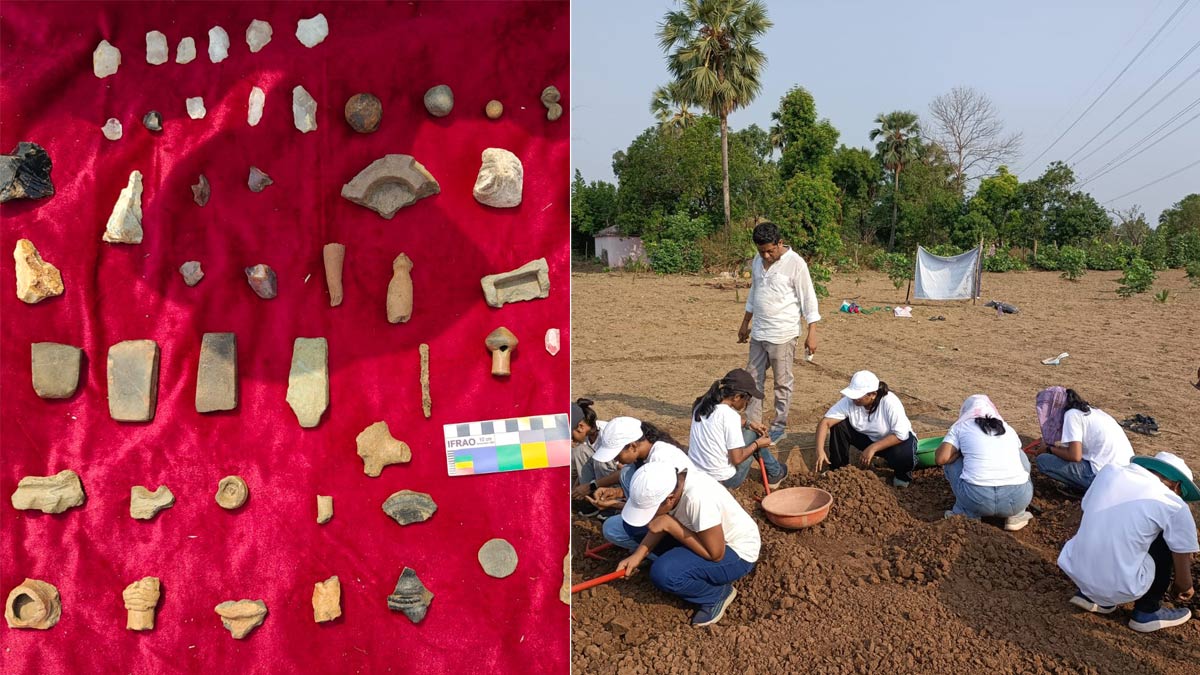
Recent archaeological excavations at Purunagarh in the Redhakhol subdivision of western Odisha's Sambalpur district have uncovered significant evidence of an ancient settlement long buried beneath the soil.
Conducted by the School of History at Gangadhar Meher University, Sambalpur, the excavation has emerged as one of the most significant archaeological investigations in western Odisha in recent years. Situated on the banks of the Kerandi River, a tributary of the Mahanadi, the site offers valuable insights into the region’s cultural, technological, and economic history.
Despite its rich archaeological potential, the region had received limited scholarly attention in the past. Earlier investigations, particularly in the 1990s, were largely confined to documenting a few rock art sites. However, recognising the area’s archaeological significance, the School of History, under Dr Atul Kumar Pradhan, initiated extensive field explorations across the subdivision. Over the past five years, the school has undertaken a systematic study of both the tangible and intangible cultural heritage of the Redhakhol subdivision.
According to Dr Pradhan, these explorations resulted in the documentation of numerous prehistoric sites, early historic settlements, temple remains, and several other archaeological localities. Among the most noteworthy discoveries were more than 20 traditional iron-smelting sites, which form an important part of the technological heritage of Odisha and India.
These sites provide crucial evidence for understanding indigenous knowledge systems and traditional metallurgical practices that flourished in the region for centuries. Based on the results of these explorations, Purunagarh was selected for systematic excavation due to its strategic geographical and archaeological significance.
The site is naturally protected by the Kerandi River, which encircles it on three sides, while a man-made moat safeguards the fourth side. Such defensive features are commonly associated with ancient fortified settlements and urban centres, highlighting the site’s potential importance for studying early urbanisation in western Odisha. Following detailed archaeological assessments, a proposal for excavation was submitted to the Archaeological Survey of India (ASI), which subsequently granted the necessary licence for scientific excavation.
The initial phase of excavation, carried out to a depth of approximately 75 centimetres, has yielded substantial archaeological evidence indicating continuous human occupation from prehistoric to early medieval times. Among the major discoveries were prehistoric stone tools that represent the earliest phase of habitation at the site. In addition, a variety of artefacts dating to the early medieval period have been recovered, reflecting the cultural and technological advancement of the settlement.

The excavated materials include celts, decorated beads, iron implements, copper rings, terracotta figurines, saddle querns, and potsherds belonging to different ceramic traditions. These artefacts provide important information on the daily life, craft production, trade activities, and technological capabilities of the ancient inhabitants.
According to Dr Pradhan, one of the most remarkable findings is the extensive presence of iron slag throughout the excavation area. Thousands of slag fragments indicate that Purunagarh was once a major centre of iron production, he said.
Archaeological evidence further suggests the existence of a large industrial complex or workshop associated with iron smelting and processing activities. The discovery of pottery kilns and buried storage vessels reinforces the interpretation of the site as an organised settlement with specialised craft production and industrial activity.
The cumulative evidence from the excavation strongly suggests that Purunagarh was not merely a rural habitation site but an important township and a significant centre of traditional iron-smelting technology. The findings contribute substantially to the understanding of settlement patterns, technological development, and socio-economic organisation in western Odisha, said Dr Pradhan, who had earlier worked in field archaeology in neighbouring Chhattisgarh during Raman Singh’s tenure as Chief Minister.
The Purunagarh excavation has generated considerable academic interest among historians, archaeologists, and heritage scholars. The site is expected to make a major contribution to the archaeological map of Odisha and eastern India, as the discoveries open new avenues for research into the processes of urbanisation, craft specialisation, and indigenous technological traditions in ancient India.
According to Dr Pradhan, the primary objective of the Purunagarh excavation is to establish the cultural sequence of the Redhakhol region, which was earlier a princely state and is now a subdivision of Sambalpur district. Sambalpur, the headquarters of western Odisha, holds significant political importance. The Hirakud Dam, built on the Mahanadi River shortly after Independence, is located near Sambalpur city.
Prof Byomakesh Tripathy, Vice Chancellor of Gangadhar Meher University, said the excavation at Purunagarh is expected to establish a comprehensive cultural sequence for the Redhakhol region.
