



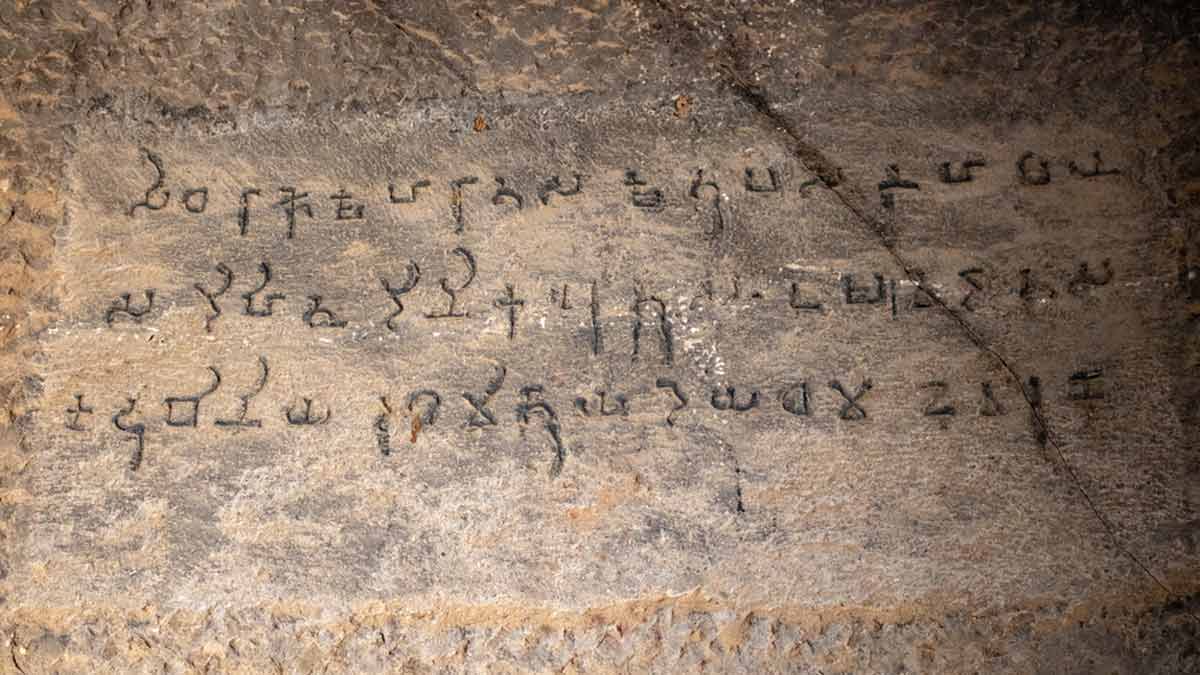
Brahmi, as understood in its literal translation, means divine. The earliest expression of humans in a language is traced to the ancient Indian language Brahmi, as evident from its name, which indicates divine intervention. It later became the mother of all languages in the evolution of languages found in the Asian subcontinent.
As a historian, it’s a unique internal thirst to keep learning new languages. With a new language, one gets empowered to trace an entire civilisation and its history. This thirst led me to attend an amazing workshop organised by the Indian Institute of Heritage in collaboration with the Indira Gandhi National Centre for the Arts, New Delhi. This workshop was organised on the Brahmi language, and as a participant, this workshop opened the ancient side of my historian brain, which was lying dormant. Brahmi is the language that is regarded as the motherboard of all languages of the world. Its decipherment, learning, and understanding open vistas of human existence in ancient times.
Brahmi, as a language, is one of our farthest historical languages for understanding, and its inscriptions are a witness to the rich and extremely vibrant past of Bharat. The Brahmi script is the earliest writing system developed in Bharat after the Indus Valley script. The Indus Valley script is yet to be deciphered; hence, Brahmi stands as a first-hand dialogue from our ancient past. There are stages of development attributed to the Brahmi script. However, the Ashokan Empire and the Mauryan Empire are the richest repositories of Brahmi inscriptions. The most rich and dynamic are the Ashokan Rock Edicts. The Ashokan inscriptions are found on carved rocks, stones, slabs, and on rock pillars. Brahmi inscriptions have also been found on seals and terracotta. However, the recent claim of pre-Ashokan Brahmi has been made on the basis of evidence found from Anuradhapura, Sri Lanka. The origin of the Brahmi script is a controversial issue in Indian Epigraphy. The decipherment of Brahmi by James Princep was followed by various scholars like Alexander Cunningham, who have come a long way. Scholars like G.H. Ojha and later R.B. Pandey and T.P. Verma suggested that Brahmi, of course, had an indigenous genesis. Some scholars also try to connect the Harappan script to Brahmi. However, the possibility of a close connection between the Indus Valley script and the Brahmi script cannot be validated unless any progress is made in the decipherment of the Harappan script or the Indus Valley script, as we commonly know it. The decipherment of the Indus Valley script will be a giant step in closing many gaps that followed language understanding, and it will open or close doors; one can only anticipate until its decipherment. Just as Napoleon found Egyptian civilisation after the discovery of the Rosetta Stone, one can only wait for the decipherment of the Indus Valley script that could reveal what the earliest humans who walked Bharat were.
Brahmi script has travelled more widely outside India and has its great presence in countries like Thailand, Myanmar, Vietnam, and, until recently, Sri Lanka discovery. Brahmi, as a language, has seen the progress and decline of our beautiful past. Brahmi was the voice of Ashokan Dhamma. It was a sail that anchored the ship of ancient civilisation that throws light on trade, religion, social dynamics, and the past that was engraved on stones, and no stone was left unturned to change this past. Buddhism and the social constitution approach of Ashoka were conveyed to the world through his edicts found all over the geography of his empire. The Hammurabi Code inscription from Mesopotamia opened the civic side of this civilisation. Hence, inscriptions and their decipherment are like a Google map to any civilisation. Thus, Brahmi is not only an ancient Indian language or script but a window or gateway to our rich past.
Brahmi is the voice of smriti, as prior to all dharma shastras, they were oral. The Brahmi script is undoubtedly the most important writing of humanity in this subcontinent and from the ancient past. It serves as the basis of all writing systems of all modern scripts. The characteristics of Brahmi as an inscriptive language are found in north Indian Devanagari and south Indian Tamil. Its impact is also found in South Asian scripts, including Thai and Khmer.
However, the exact origin of Brahmi is still highly debatable. The debate is between its indigenous evolution and some scholars arguing that it was derived from Aramaic or Semitic Scripts. The famous Ashokan edicts are the earliest and most fascinating and exhaustive evidence of Brahmi script. Ashokan edicts and Pillars across the subcontinent are canvases to Brahmi inscriptions. The number 256 that appears on an Ashokan edict signifies the number of nights he spent in his quest to spread the message of Dhamma.
The gap or denial towards the Brahmi script during the Middle Ages and medieval period in Indian history has led to certain losses in its important roots and antiquity. However, the tracing, translation, and decipherment by the British scholar James Princep in 1837 opened a new vista towards the study and debate of Brahmi inscriptions. Brahmi is believed to have travelled from the 3rd century BCE.
The striking necessity, with artificial intelligence taking over any further human analysis, is that the understanding of Brahmi would definitely cross over doubts and unexpected analogies about the language. There is strong emphasis on indigenous and regional languages in the New Education Policy of the government. There is an effort to revive, treasure, and save our rich past through savouring our heritage by protecting these languages. The government has introduced the Gyan Bharati Mission under the Ministry of Culture as a major initiative. This is a major project of the Indian government to preserve, catalogue, and digitise India’s rich manuscript heritage.
In the process of preserving the heritage of our rich past, there is an extreme necessity to have scholarly repositories, not only in government efforts, which is commendable. There is an extreme need for more youngsters to take up the study of our past heritage through its rich cultural repositories, which can be the language, the art, the scriptures, or the history of our rich past. As a historian, I feel that there is a need for youngsters to take up history as a career through spaces of archival study, archaeology, and also ancillary or auxiliary sciences that would help in rebuilding and tracing the rich heritage in a scientific manner.
Amid the chaos and panic of paper leaks, it would be a breath of fresh air if we had students taking up history as a subject, not just for employment but also to be an ambassador by adopting a trained career of our rich past by taking special training and knowledge of our classic language like Brahmi. We need more shifts of youngsters from parental pressure and forced engineers and doctors to even think of coming to learn and take up professions as experts on heritage, culture, and history. To build future strong bridges, it is extremely necessary to know how our ancestors built monuments that still stand without any technical tragedy.
Brahmi is not only our language of the past but it’s the bridge that induces us to think that we were somewhere given a wrong address and went astray, while our intellectual ancient past was waiting to be illuminated and reckoned.
The author is a historian at University of Delhi, a social analyst and a voice for gender equality. She was recently featured in 10 prominent Muslim Women Academics of India.
The opinions expressed in this article are those of the author and do not purport to reflect the opinions or views of THE WEEK.
