



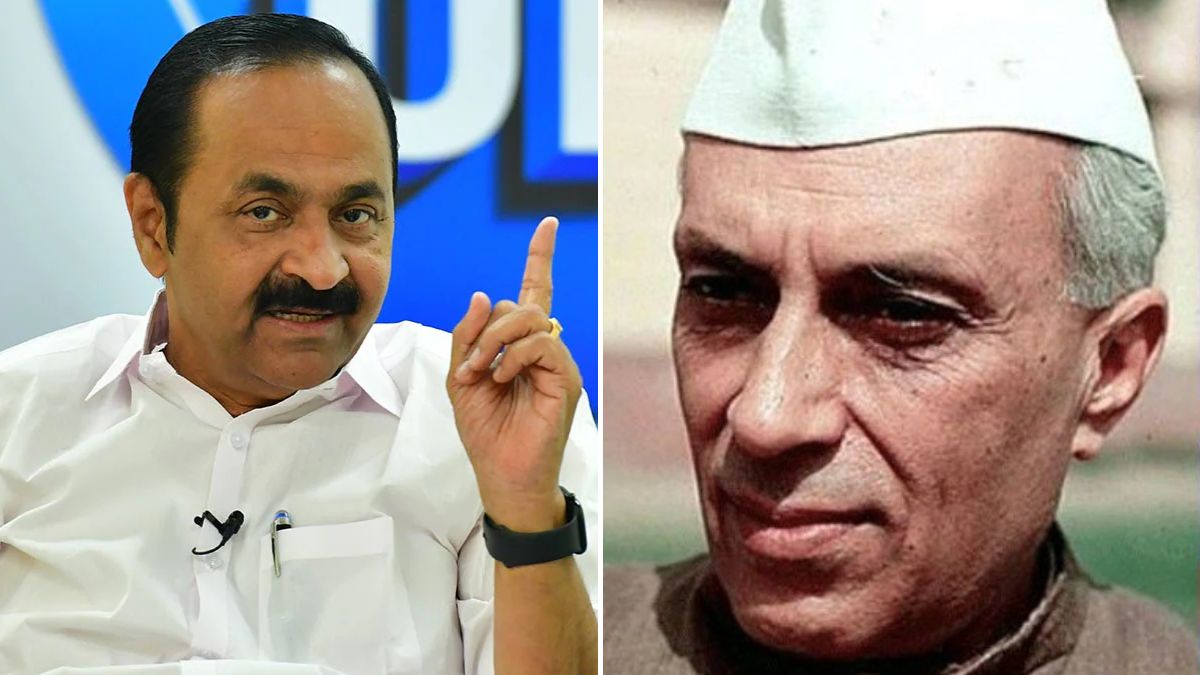
Kerala’s recent announcement that it will establish Nehru Centres of Scientific Temper across the state is more than an educational initiative. As narratives get increasingly marked by the conflation of mythology with history, faith with evidence, and inherited belief with verified knowledge, the decision acquires a significance that extends well beyond Kerala’s borders. It invites us to revisit a foundational idea of the Indian republic: that the cultivation of scientific temper is not an optional cultural preference but a constitutional and civilisational necessity.
The proposal was unveiled by Chief Minister V. D. Satheesan during the reopening of schools for the new academic year. He described Nehru as the first Indian leader to emphasise the importance of scientific temper and announced that “dedicated centres bearing his name would be established to nurture scientific thinking among students.” It’s part of a broader vision that includes institutions modelled on global centres of excellence and a renewed emphasis on preparing young people for a rapidly changing technological age.
There is a certain historical appropriateness in associating such an initiative with Nehru. Few political leaders anywhere in the 20th century invested as much intellectual energy in reconciling the demands of modern science with the inheritance of an ancient civilisation. Nehru’s understanding of India was neither rooted in civilisational amnesia nor trapped within civilisational nostalgia. He saw India as a civilisation of remarkable antiquity, but one whose vitality depended on its capacity for self-renewal. His was not the modernism of repudiation; it was the modernism of adaptation.
In The Discovery of India, written during imprisonment in Ahmednagar Fort, Nehru reflected on India’s long intellectual journey with evident admiration. Yet, he consistently resisted the temptation to treat the achievements of the past as substitutes for inquiry in the present. He celebrated the intellectual accomplishments of ancient India precisely because they represented a tradition of questioning, experimentation and philosophical curiosity. For him, reverence for the past was meaningful only when accompanied by the courage to examine it critically.
This distinction has acquired renewed relevance today. Recent controversies surrounding interpretations of the so-called ‘Pashupati seal’ from the Indus Valley Civilisation illustrate the problem. Some commentators have sought to present the seal as definitive proof of specific religious continuities stretching uninterrupted across millennia. Such claims may be emotionally satisfying, but they exceed what available evidence permits. Archaeologists and historians continue to debate the meaning of the figure depicted on the seal. While some scholars have suggested possible proto-Shaivite associations, others have urged caution, emphasising the absence of deciphered texts and the speculative nature of such interpretations. The responsible scholarly position is one of informed uncertainty. Similarly, claims that ancient Indians possessed technologies equivalent to modern aircraft, stem-cell research, or advanced genetic engineering have periodically found attention without any credible historical evidence.
The issue is not whether ancient India deserves respect. It unquestionably does. The issue is whether respect should be confused with certainty. Civilisations do not become greater when evidence is bent to fit contemporary ideological needs. A civilisation confident in its achievements has no reason to fear scrutiny. Indeed, the greatness of India’s intellectual traditions lies precisely in their openness to debate. From the Upanishadic dialogues to the Buddhist councils, from the logical schools of Nyaya to the materialist provocations of the Charvakas, Indian civilisation has historically accommodated disagreement as a mode of inquiry rather than treated it as an act of disloyalty.
It is this deeper tradition that Nehru sought to revive through the language of scientific temper. His understanding of the concept extended far beyond laboratories and technological innovation. Scientific temper, as he repeatedly explained, represented “a habit of mind.” It meant the willingness to test propositions against evidence, to revise conclusions when facts changed, and to privilege reason over prejudice. It was, in effect, a democratic virtue. Citizens capable of critical thought are less vulnerable to manipulation, whether by political demagogues, sectarian entrepreneurs or purveyors of misinformation.
India remains perhaps the only country in the world whose Constitution explicitly identifies the development of scientific temper as a civic duty. Article 51A(h), inserted through the Forty-Second Amendment, calls upon every citizen “to develop the scientific temper, humanism and the spirit of inquiry and reform.” The placement of scientific temper alongside humanism and inquiry is revealing. The framers of the amendment understood that scientific reasoning was not merely a technical skill but an ethical orientation toward truth.
Kerala’s initiative thus resonates with a constitutional obligation as much as a Nehruvian legacy. For decades, Kerala has nurtured a vibrant ecosystem of public engagement with science. Yet the challenge confronting scientific temper today differs from the challenges of previous generations. The problem is no longer simply access to information. It is the ability to distinguish information from misinformation. Digital technologies have democratised communication, but they have also amplified falsehood at unprecedented speed. Artificial intelligence can generate convincing fabrications. Social media algorithms reward emotional certainty over intellectual nuance. Conspiracy theories travel faster than corrections. In such an environment, scientific temper becomes not just desirable but indispensable.
The proposal should therefore aspire to become much more than commemorative institutions. Their success will depend on whether they cultivate habits of inquiry rather than merely celebrate scientific achievements. If they become venues for lectures and ceremonial observances alone, they will have missed their purpose. If, however, they encourage students to interrogate claims, analyse evidence, understand probability, evaluate sources and appreciate the distinction between assertion and proof, they could make a transformative contribution.
This requires a conception of science that is both rigorous and accessible. Scientific temper cannot be confined to laboratories or classrooms. It must inform discussions about public health, environmental policy, economic development and social justice. Knowledge becomes socially powerful only when it is democratised.
Equally important is the need to avoid a false dichotomy between scientific inquiry and cultural identity. One of the most damaging misconceptions propagated in recent years by the right-wing is that rational scrutiny somehow diminishes civilisational pride. Genuine confidence in one’s civilisation derives from the knowledge that its achievements can withstand examination. Ancient India’s contributions to mathematics, astronomy, medicine, linguistics and philosophy require neither exaggeration nor embellishment. They are impressive enough on their own terms. To attribute modern scientific discoveries retrospectively to ancient texts without evidence is not cultural affirmation, but an admission of intellectual insecurity.
Nehru understood this instinctively. He recognised that India’s future would be secured not by retreating into an imagined past but by drawing strength from a real one. His vision combined reverence for civilisational inheritance with commitment to scientific progress. It was this synthesis that led to institutions ranging from the IIT to national laboratories, scientific research establishments and centres of higher learning. The objective was not imitation of the West but the construction of a confident, modern India engaging the world on equal terms.
That project remains unfinished. Indeed, it may be more urgent today than at any point since Independence. The 21st century will be shaped by scientific and technological transformations of extraordinary scale. Nations that cultivate critical thinking, innovation and evidence-based policymaking will prosper, while those allowing ideology to substitute for inquiry will fall behind. The significance of Kerala’s proposed Nehru Centres lies precisely here.
At a time when historical claims are often weaponised, when myths are frequently presented as facts and when public debate is increasingly polarised between unquestioning reverence and dismissive scepticism, the state has chosen to reaffirm a principle at the heart of the Republic. Scientific temper is not hostility to tradition. It is the means by which traditions remain intellectually alive. It is not a rejection of civilisation, but its highest expression.
In that sense, the most fitting tribute to Nehru is the revival of the intellectual ethic he championed: an India secure enough in its past to question it, confident enough in its identity to examine evidence honestly, and ambitious enough in its future to place reason at the centre.
The writer is an author, political analyst and columnist. His research and commentary regularly appear in scholarly and popular publications. He posts on ‘X’ at @ens_socialis
