



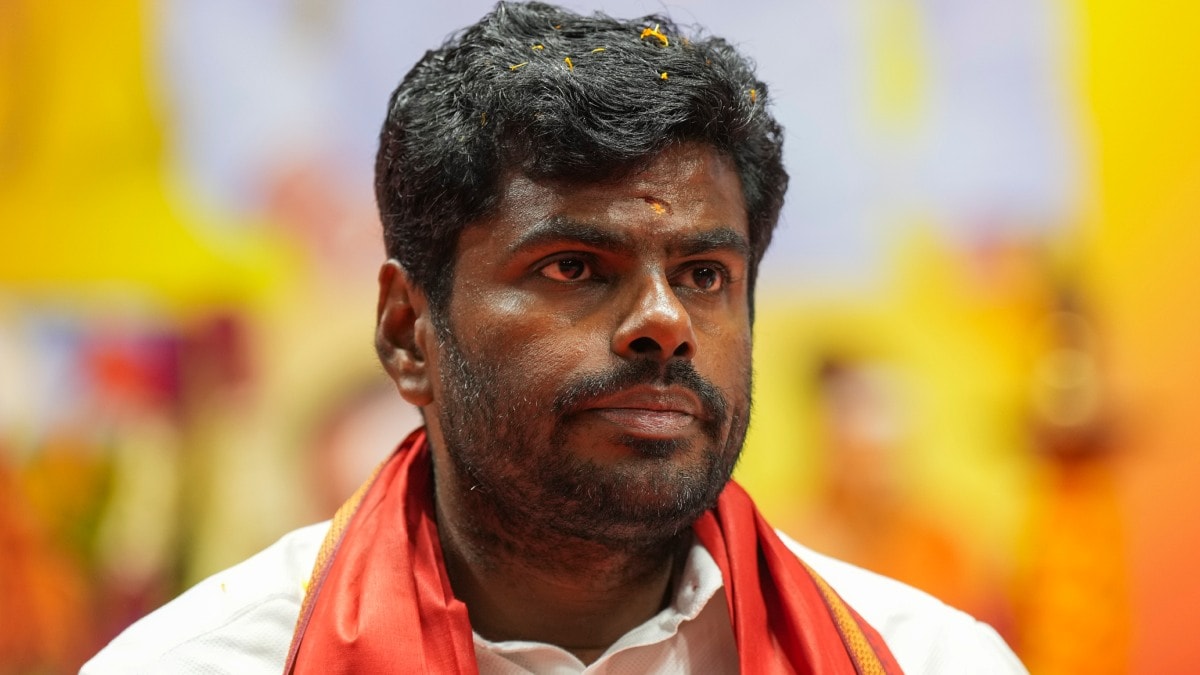
K. Annamalai, former Tamil Nadu BJP president and one of the most popular faces of the saffron party in South India, on Friday announced his decision to quit the BJP and launch a new movement that would eventually contest the 2031 assembly elections.
In his lengthy online address through his social media handles, Annamalai recalled his days as a straightforward IPS officer, along with his life story, political experiences and roadmap for the future. Annamalai's departure from the BJP, however, signals a significant churn in South Indian politics, marking the transition from a national party framework to a localised, people-centric movement. The former IPS officer, who has been articulate and vocal on issues of clean governance and corruption, appears to have chosen a path long dominated by the Dravidian majors — the DMK and the AIADMK — in the state.
While the public announcement marks a clean break from his current political role, the strategic foundation for this decision appears to have been laid 18 months earlier. Annamalai had internally conveyed his decision to the BJP leadership as early as December 4, 2024. This timeline reflects a carefully planned strategy, allowing him to fulfil national electoral obligations before executing a calculated solo entry into the Tamil Nadu political landscape.
Annamalai's departure, characterised by his respect and regard for Prime Minister Narendra Modi, appears to be a sophisticated tactical choice rather than an emotional one. This posture preserves his national credibility—essential for his pro-India branding—while simultaneously creating the independence needed to champion long-standing state-specific issues such as the Mekedatu dam, water rights and language policy. By framing the exit as a sacrifice of high office for the protection of Tamil interests, Annamalai appears to be positioning himself at the intersection of national integration and regional aspirations. This move is aimed at ensuring that he retains his nationalist image while positioning himself as a defender of Tamil Nadu's interests. This calculated exit serves as the foundation for an ideological movement that seeks to redefine the mechanics of political engagement in the state.
By relaunching his 'We The Leaders Foundation,' Annamalai is adopting a movement-first approach, prioritising institutional foundations over immediate electoral optics. By utilising 'We The Leaders Foundation'—an organisation with roots dating back to 2020—as his primary vehicle, he avoids the pitfalls of a rushed party launch. This phased transition allows for the consolidation of an ideological core and the mobilisation of a professional cadre before the movement formally evolves into a political party.
His celebrity status and ability to communicate effectively in three South Indian languages and English could help him gain political traction not only in Tamil Nadu but across South India. Sources close to him and the BJP say that he could position himself as a counterweight to Vijay, seeking to challenge the latter's growing popularity. More importantly, central to his plans is the A.P.J. Abdul Kalam Centre for Ethics and Politics in Coimbatore. The centre functions as more than a mere training ground and is being projected as a strategic differentiator designed to dismantle the personality cult and hereditary political models that have dominated Tamil Nadu for decades.
The centre's focus on ethics is grounded in Annamalai's personal political history—specifically his 2020 refusal of an invitation from Rajinikanth because he had already given his word to BJP national general secretary B.L. Santhosh. This anecdote provides moral weight to his movement's narrative. In fact, the Kalam Centre is not merely a branding exercise but an institutionalisation of the personal integrity he claims could distinguish him from the transactional nature of the established political order.
Annamalai's movement will also embrace technocrats and middle-class professionals with the aim of professionalising politics, turning it into a meritocratic service rather than a hereditary right or a post-cinema retirement option. This organisational rigour is the structural manifestation of a new, dual-layered ideological framework.
Annamalai appears to be attempting a paradigm shift in Tamil Nadu's political discourse by synthesising regional pride with national belonging. This "common man politics", as he describes it, is a direct challenge to the state's entrenched "cult politics", aiming to mobilise a demographic that feels alienated by the star-driven and family-oriented nature of politics in the state.
The core pillars of his movement include reclaiming the narrative on issues such as land, water rights, including the Mekedatu dispute, and cultural heritage from traditional regional parties; maintaining a vision of Tamil Nadu as a leading state within the broader Indian framework; dismantling personality-driven political structures; appealing to the middle class and the global Tamil diaspora; and transitioning from the BJP's cadre-based model to a broad-based mass movement capable of securing a popular mandate.
This approach signals to the electorate that 'We The Leaders' will operate as a functional governance platform rather than a vehicle for celebrity-driven politics or a dynastic wealth accumulation style of politics. However, his 2031 target reflects a commitment to strategic patience, acknowledging that a transformation of this scale cannot be achieved in a single election cycle. The five-year building phase between 2026 and 2031, however, introduces significant vulnerabilities in a state where political cycles move at the speed of the film industry.
Annamalai's challenges include a visibility gap against a leader like Chief Minister C. Joseph Vijay, who currently commands the state's cinematic and political spotlight; resource constraints; and the risk of political obsolescence. Despite these challenges, Annamalai's repeated appeal for "patience, patience, patience" suggests a belief that voters may eventually tire of the cult model, creating a vacuum that only a professionalised movement can fill.
Annamalai's move in Tamil Nadu is being viewed as more than just a party launch. It is an attempt to fundamentally rewire the political DNA of the state. By integrating an inclusive mass-movement agenda with a rigorous focus on ethics and technocratic participation, 'We The Leaders' seeks not only to challenge the dominance of hereditary politicians and cinema-star leaders but also to consolidate support among sections of the OBC community.
The recent election saw a significant shift in the minority and Dalit vote towards the TVK. This vote bank, which had largely remained with the DMK for the past 15 years, appears to have fragmented or shifted significantly in several constituencies. Vijay's governance model, though only 25 days old, is widely perceived as inclusive of Dalits and minorities. Over time, some observers believe this could create unease among sections of the Hindu OBC electorate.
Annamalai, who belongs to the influential Gounder community of western Tamil Nadu and is widely regarded as a staunch Hindutva supporter, could potentially benefit from such sentiments at the grassroots level.
More than anything else, the movement's success will depend on whether voters in the state are ready to trade the familiar comfort of personality-driven politics for a meritocratic, common-man alternative.
"Certainly, all of us together will create a great transformation and revolution. Our only goal is to make Tamil Nadu the leading state within Bharat, within India... We must come out of this cult politics. We must promote common man politics," Annamalai said in his online address.
