



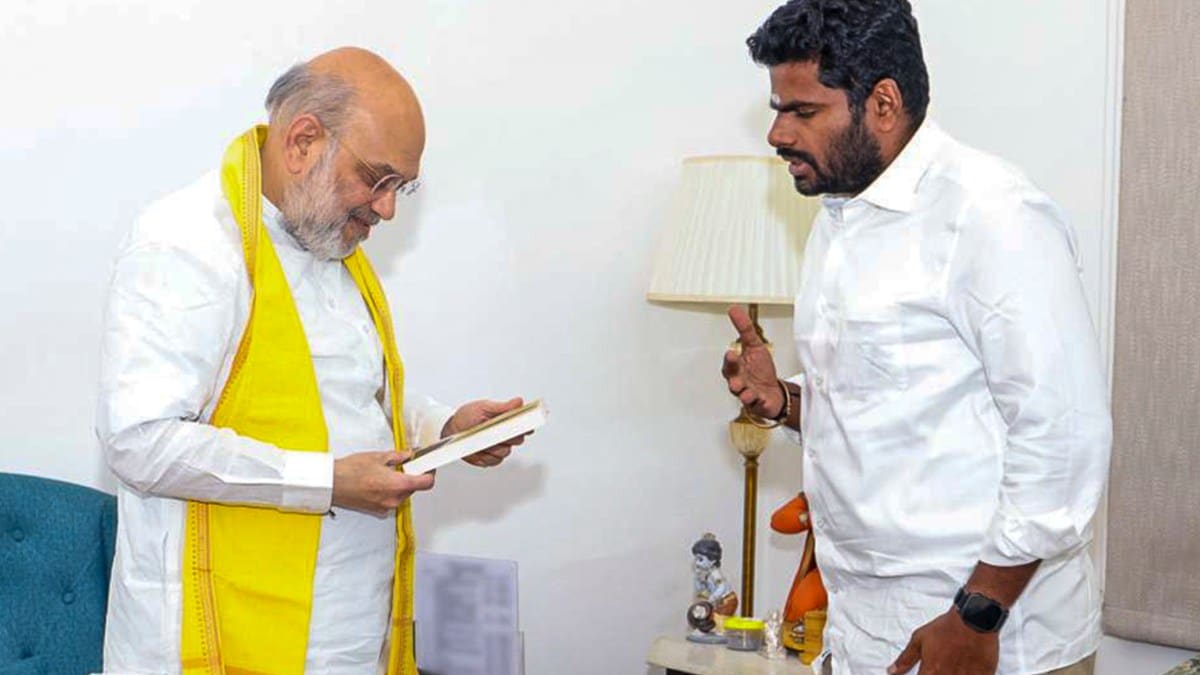
K. Annamalai, the most popular face of the BJP in Tamil Nadu, has categorically stated his decision to quit the party. The former 2011-batch Karnataka cadre IPS officer has reportedly submitted his resignation to the party high command in Delhi.
The party leadership is said to have sought more time to discuss and deliberate on his decision, and Annamalai is expected to stay back in Delhi until Wednesday to hear from the high command. However, Annamalai’s decision is no good news for the saffron party in Tamil Nadu, which is battling hard to come out of the election drubbing. The party apparently saw its graph shoot up during his tenure as the president of the state unit.
In 2019, the entry of Annamalai into the political arena of Tamil Nadu represented a deliberate, high-stakes attempt by the BJP to disrupt the long-standing Dravidian hegemony. Unlike traditional politicians who rise through party cadres, Annamalai’s brand was built on the foundation of administrative authority and a meticulously crafted aura of integrity. His transition from law enforcement to the legislative battlefield was not merely a career change but a strategic manoeuvre to offer a non-Dravidian alternative to a state weary of established political dynamics, leveraging his background as a member of the electorally powerful Gounder community from Karur in Western Tamil Nadu’s Kongu region.
As a former IPS officer, Annamalai’s profile is constructed around elite credentials. An alumnus of PSG College of Technology and IIM Lucknow, he entered the 2011-batch Indian Police Service (IPS), serving in the Karnataka cadre. His branding awareness began early. When in Class X, he renamed himself Annamalai, as his given name—Siva Senthil Kumar—was too long. He chose a name representing an angry incarnation of Lord Shiva. His tenure in Udupi and Bengaluru was marked by an aggressive policing style that earned him the moniker “Singam,” specifically modelled after the fictional, short-tempered, and incorruptible DSP Duraisingam character played by actor Suriya in the movie Singam. This reputation provided him with a unique political aura and also the image of an outsider ready to eliminate systemic corruption.
His resignation from the force in 2019 was framed as a spiritual and ethical pivot rather than a pursuit of raw power. In his farewell letter to his friends and well-wishers, Annamalai cited specific emotional incidents that led to his decision to quit service. “Madhukar Shetty sir’s death in a way made me re-examine my own life. ... A visit to Kailash Mansarovar the year before made me see my priorities in life better,” he had once said.
After he resigned from the service, Annamalai maintained a calculated distance from established parties, focusing on his NGO, the ‘We The Leader Foundation’. Strategic hesitation defined his entry. He initially waited for Superstar Rajinikanth to announce a political outfit, only to join the BJP three months after the actor’s plans faltered in 2020. He justified this choice by citing an alignment with the party’s nationalist vision and merit-based platform.
Incidentally, in Indian politics, former civil servants carry an added value of perceived efficiency. Annamalai leveraged this by speaking with the confidence of a professional administrator. This background allowed him to bypass traditional political hierarchies, presenting himself as a leader capable of achieving objectives faster than the bureaucracy he left behind. His background as an IPS officer served as a launchpad, transitioning him from a celebrated officer to a disruptive force poised to challenge the regional status quo dominated by the Dravidian giants.
Of course, Annamalai’s was a different style of politics. His strategic importance lay in his refusal to rely on the blunt religious polarisation typical of the BJP’s national strategy. Recognising that Tamil Nadu’s identity is deeply rooted in Dravidian values, he sought to create a synthesis between Hindutva and Tamil aspirations. He was more interested in expanding political territory than defending ideological boundaries. He focused on a platform appealing to the urbanising, aspirational youth through four core pillars of administration, anti-corruption, political reform and Tamil identity.
His most provocative move was reframing J. Jayalalithaa as a far superior Hindutva leader. This was a calculated effort to reinterpret a Dravidian icon through a BJP lens to inherit her legacy. However, this triggered intense backlash from the AIADMK and Jayalalithaa’s close aide V.K. Sasikala, who viewed it as a fundamental misunderstanding of the Dravidian tradition.
Incidentally, his style of politics was adapting national goals into a local dialect, often diverging from the party’s traditional north Indian template. If the BJP’s national focus was religion and Hindutva, he insisted on governance, administration and fight against corruption; if the centre insisted on Hindi-centric cultural motifs, he insisted on the use of distinctly Tamil political vocabulary, and he expanded political territory by defending ideology. Also, at a time when the BJP’s national leadership insisted on a double-engine growth model, Annamalai emphasised challenging the family-run enterprises.
The BJP’s launch of Annamalai in 2021, as the state president, soon after the election, was a rapid elevation designed to break the Dravidian duopoly. By promoting a 37-year-old non-traditional leader to state presidency, the BJP believed that he would bring more victories to the party. While Annamalai raised the BJP's profile, his visibility did not translate into personal electoral wins - he contested from Aravakuruchi in the 2021 assembly election and from Coimbatore in the 2024 Lok Sabha election. Crucially, by the April 2026 polls, the BJP won only one seat in the 234-member house, creating a strategic vacuum that justified his eventual sidelining.
In fact, the party insiders say that Annamalai faced friction from the old guard, a powerful Brahmin group in the party. Sources also say that the RSS viewed his aggressive, individualistic style with deep suspicion. His rivalry with the AIADMK grew stronger due to a personal friction with Edappadi K. Palaniswami (EPS), which led to the September 2023 NDA breakup. But the 2026 election drubbing for the BJP has proved that the saffron party did not act on Annamalai’s advice and sidelining him had cost huge for the party heavily. In fact, his signs of dissent were obvious in the run-up to the 2026 elections.
But now the emergence of actor C. Joseph Vijay upended Annamalai's strategy. While Annamalai was a master of reels and digital visibility, Vijay was a cultural phenomenon with a fan base first strategy. Vijay captured the anti-establishment space before Annamalai could consolidate it, leading to Annamalai’s resignation in June 2026.
Vijay possessed a stronger cultural reach, providing a far broader electoral acceptance that narrowed Annamalai's path as a non-Dravidian alternative.
Annamalai’s resignation at this juncture marks the end of a six-year experiment but signals the birth of a new multi-polar era. His meeting with Nitin Nabin was cordial, but the intent was clear—Annamalai plans a people’s movement first and a party later. He is expected to use his ‘We The Leaders’ foundation as his stepping stone to potentially challenge the existing political order by contesting the upcoming Assembly by-elections. This will help him assess his individual strength.
For the BJP, losing Annamalai could underscore the party's inability to accommodate strong regional leaders, potentially allowing Vijay to emerge as the primary beneficiary of the anti-establishment vote. Annamalai, however, remains a politician caught between institutions and ambitions. His next chapter will determine whether the “Singam” persona can survive without a national engine, potentially defining the next era of Tamil Nadu’s political landscape.
