



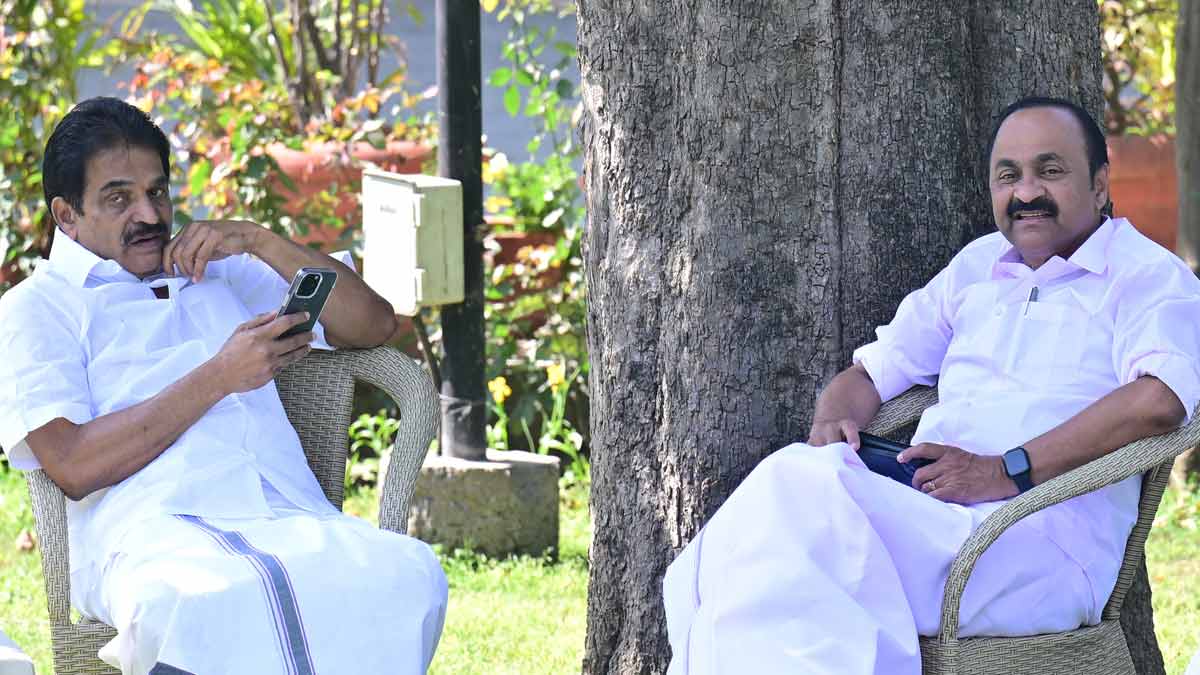
Volleyball has long been a favourite sport of AICC general secretary K.C. Venugopal. In his youth, he played as a spiker—the player entrusted with delivering the decisive smash over the net, often on the third touch, to finish the point with force and precision.
But, in the 2026 Assembly elections that redrew Kerala’s political map, with the Congress-led UDF sweeping to a stunning 102-seat victory, Venugopal appeared to occupy a very different role on the political court: that of the setter. In volleyball, the setter is often regarded as the game’s most demanding position, requiring split-second judgement, strategic vision and technical precision. The setter may not score the point, but he dictates the rhythm of the game, places the ball exactly where it needs to be, and makes the attack possible.
That, many within the Congress privately concede, was the role Venugopal played in the UDF’s victory—mobilising resources, managing dissidence, negotiating alliances and maintaining organisational control across constituencies.
Yet public sentiment—and, to a considerable extent, the mood within the UDF itself—cast V.D. Satheesan as the spiker: the visible face of the opposition campaign and the leader who transformed anti-incumbency into political momentum. For many supporters, that made Satheesan the natural claimant to the chief minister’s post. Venugopal, however, possessed something equally decisive in politics: numbers within the Congress Legislature Party. Ramesh Chennithala, the senior-most among the contenders and a former Leader of the Opposition, also staked his claim, invoking both seniority and administrative experience.
But when the final moment arrived—after ten days of intense deliberations and multiple rounds of consultations—the Congress high command ultimately chose to place public sentiment and the scale of the UDF mandate above organisational arithmetic, electing Satheesan as Kerala’s chief minister.
Delay and dilemma
Back in April, award-winning documentary filmmaker Vinod Mankara was handed a politically sensitive assignment: to chronicle the life and public journey of K. C. Venugopal as he completed 50 years in politics and the Congress movement. The plan was ambitious. The documentary was scheduled for release on May 1, leaving barely a month for production.
Mankara had completed shooting across Kannur and Alappuzha—the two regions most closely intertwined with Venugopal’s political evolution. But by the time the project entered the editing stage, Kerala’s rapidly shifting political climate had begun to disrupt the documentary’s original timeline.
Officially, those associated with the project maintained that additional material was still being collected. But in political circles, the slowdown was immediately linked to the uncertainty surrounding the KC camp itself in the days leading up to the counting: would Venugopal ultimately emerge as chief minister?
The first clear signs of a possible power struggle had surfaced months earlier, during the Kerala Pradesh Congress Committee’s Lakshya camp in Wayanad in January. As the party began mapping its Assembly election strategy, it also became evident that a UDF victory could reopen unresolved questions of leadership.
In private conversations after the camp, several leaders reiterated that the final decision on the chief minister would depend on the numbers within the Congress Legislature Party—an early indication that multiple aspirants were already positioning themselves for the role. Alongside Satheesan and Chennithala, both firmly rooted in state politics, Venugopal increasingly emerged in speculation as a serious contender.
The high command, however, eventually decided that no MPs—including Venugopal—should contest the Assembly elections. The decision was reportedly shaped by the firm positions taken by Satheesan and Chennithala during seat-sharing and candidate selection. Throughout the campaign, Venugopal repeatedly maintained in public that he was not in the race for the chief minister’s post.
Yet the political equations shifted sharply after the results. Armed with the support of a significant bloc of MLAs, Venugopal mounted a strong claim. But the high command hesitated to immediately endorse him, sensing growing unease within Kerala over the possibility of elevating a leader whom the party had earlier kept away from the electoral contest.
There was also a larger political concern: appointing Venugopal as chief minister would have appeared to contradict the very logic behind the earlier decision barring MPs from entering the Assembly fray.
Political observer A. Jayashankar argues that the confusion within the Congress—from the high command down to the grassroots, and extending even to UDF allies—stemmed from a deeper structural issue: the absence of an undisputed leader in Kerala Congress politics, unlike in previous decades.
“From the time K. Karunakaran emerged as the Congress party’s unquestioned leader in 1967 until 1995, there was never any ambiguity about who led the party in Kerala,” Jayashankar said. “That phase was followed by the era of A. K. Antony from 1995 to 2004, and then Oommen Chandy from 2004 to 2016.”
According to him, the roots of the present crisis lie in the Congress defeat in the 2016 Assembly elections. “After the defeat, Oommen Chandy was unwilling to continue as Leader of the Opposition, and Ramesh Chennithala naturally stepped into the role. But even then, there were effectively two centres of leadership within the Assembly—Chandy and Chennithala.”
Jayashankar argues that the fault lines widened ahead of the 2021 Assembly elections after the Congress performed poorly in the local body polls. “Doubts began surfacing within the party over whether Congress could realistically return to power under Chennithala’s leadership. Since there was no alternative senior leader available, the party attempted to bring back Oommen Chandy despite his deteriorating health.”
The deeper issue, he says, was that Chennithala never acquired the unquestioned legitimacy once enjoyed by Karunakaran, Antony or Chandy. “Leadership within the Kerala Congress gradually became fragmented. Later, Satheesan emerged as Opposition leader, but even he had not fully evolved into an undisputed party leader before the polls. That unresolved leadership vacuum is the root of the turmoil the Congress witnessed after the election,” he said.
Yet a significant section within the UDF and among the wider public believed Satheesan had, in fact, earned that legitimacy through the UDF’s extraordinary mandate of more than 100 seats.
Eighty-seven-year-old Muslim League historian and author M. C. Vadakara told THE WEEK that he had not witnessed such political cohesion between the Congress and the Muslim League since the days of the Liberation Struggle that led to the fall of Kerala’s first Communist government in 1959.
According to Vadakara, Satheesan was the architect of “Team UDF”—a campaign framework in which the Congress, the Indian Union Muslim League and other allies campaigned for one another with unusual enthusiasm and coordination. The model transformed latent rivalries into a collective political machine, significantly boosting the alliance’s strike rate.
“There wasn’t even the slightest discord anywhere. Congress and League workers functioned almost like a single party,” Vadakara said. “And V. D. Satheesan was at the centre of all this. He was the face of the alliance, the leader projected before the people. There was no second option.”
Jayashankar argues that the scale of the UDF victory elevated Satheesan into a rare category of mass leaders in Kerala politics. “In a way, Satheesan has acquired a mass appeal similar to what V. S. Achuthanandan once enjoyed. But while V.S. was largely admired within Left circles, Satheesan’s appeal cuts across communities and political sections,” he said.
At the same time, Jayashankar contends, Venugopal was quietly consolidating organisational influence within the Congress. “During the election period, Venugopal gave opportunities to many candidates who otherwise had little backing. He also financially supported several contestants. Many MLA-elects who benefited from that support now feel politically indebted to him. That is the real source of his strength.”
In contrast, he says, Satheesan never built a comparable organisational bloc within the party. “Only a small number of MLAs are firmly aligned with him. Others do not feel personally obligated to him in the same way. Inside the party, he lacks organisational backing. But outside the party, he commands enormous support across the state and across communities.”
As indications emerged that the Congress high command might sideline Satheesan, anger began surfacing even against the Gandhi siblings on social media and within Congress support groups—an unusual phenomenon in Kerala politics. In several places, Congress MLAs reportedly faced heckling from voters for not openly backing Satheesan.
Even though the KC camp attempted to portray the backlash as an orchestrated PR campaign by Satheesan supporters, the high command eventually concluded that ignoring the public mood—and the sentiments of key allies—could come at a long-term political cost.
Vadakara argues that had the high command chosen Venugopal over Satheesan, it might not have immediately fractured “Team UDF,” but it would have inflicted deep psychological damage on the alliance.
“There would have been emotional damage. Outwardly, nothing dramatic might have happened immediately, but internally the resentment would have continued to burn,” he said. “History would eventually have shown that denying Satheesan was a serious political mistake.”
