



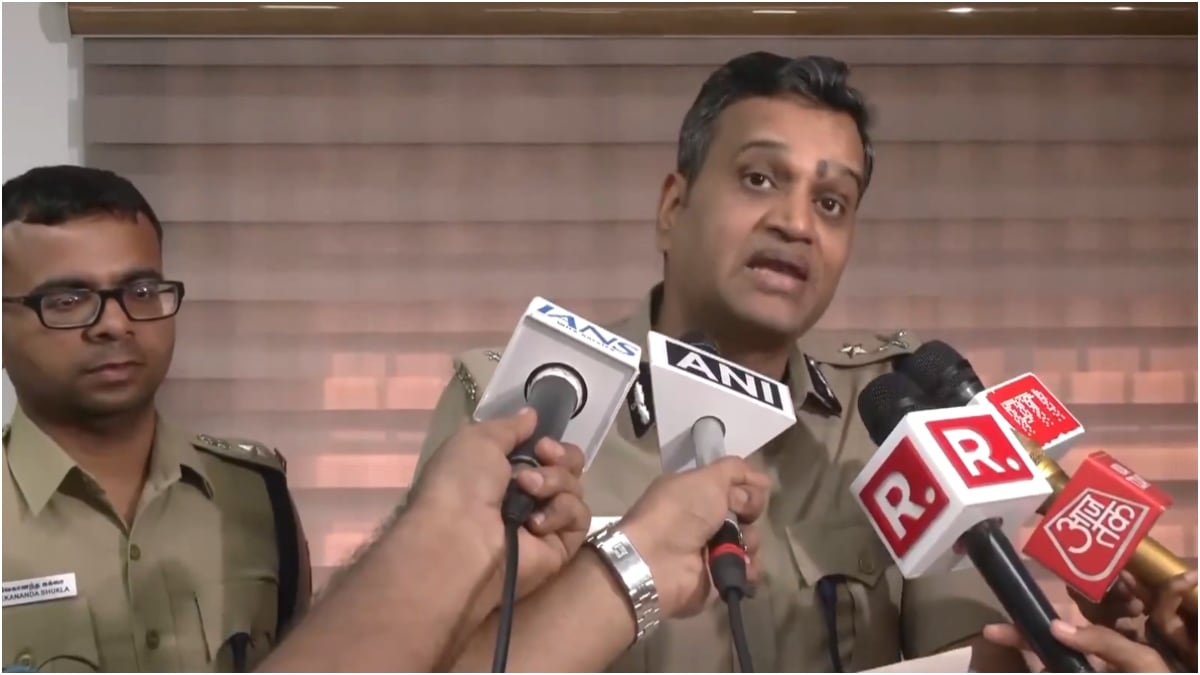
Senior IPS officer and Inspector General of Police (IGP), North Zone, Asra Garg has been transferred and posted as IGP, Intelligence, Chennai. The 2004-batch officer of the Indian Police Service (IPS) will replace Avinash Kumar.
Bureaucratic transfers have been in full swing since the change of government in Tamil Nadu. The new set of officers within the Chief Minister's Office (CMO) and the Finance Department has brought much confidence to the corridors of power and across administrative circles.
The elevation of Asra Garg to Inspector General of Police (Intelligence) signifies a calculated move by the State Government to reinforce institutional credibility. Garg will be assuming office at a critical juncture, succeeding Avinash Kumar—who was posted by the Election Commission of India (ECI) following the removal of the previous IG, K. A. Senthil Velan. Garg’s appointment is not merely a routine transfer but a signal of the government’s reliance on an officer whose career is defined by operational neutrality and the mitigation of systemic friction.
The appointment of Garg as IG, Intelligence, assumes significance in the current post-election landscape. A neutral yet tactically aggressive officer like Garg reflects the requirement for sophisticated threat assessment and political-administrative equilibrium. His transition from the North Zone to this central intelligence role reflects increasing trust from the state’s highest executive offices, moving him from field-level enforcement to the apex of strategic security management.
A native of Patiala, Punjab, and the son of educators, Garg holds a degree in electrical engineering from Thapar University. Perhaps his most significant strategic asset, however, is his absolute mastery of the Tamil language. For an officer of Punjabi origins, this linguistic proficiency is more than a communication skill; it is a bridge-building tool that has allowed him to navigate the linguistically sensitive landscape of the state with the nuance of a local—a trait that is invaluable in his current capacity as Intelligence Chief.
Garg’s early career milestones as Superintendent of Police (SP) in Tirunelveli Rural and Tirupattur established his reputation for "people policing" that challenged traditional bureaucratic inertia. In Tirunelveli, his aggressive dismantling of usury rings and criminal gangs garnered significant institutional commendation. Known to be an officer who proactively encouraged victims of exploitative money-lending to come forward, Garg handled several high-profile sensitive cases. In one notable instance, he ordered the release of a woman who had killed her husband in self-defence to prevent the assault of their daughter—a move that prioritised justice over rigid administrative optics. He was an officer capable of handling the socially volatile districts of the South.
Garg’s tenure as SP of Madurai, starting in 2010, stands as a benchmark for strategic social intervention and the dismantling of systemic civil rights violations. In Uthapuram, Garg was the primary architect of a peace agreement in a long-standing conflict between Dalit and non-Dalit communities. He moved beyond mere policing to actively dismantle the "two-tumbler system"—a discriminatory practice that had persisted for decades. His effectiveness in brokering peace was placed on record and validated by the Madras High Court as a landmark approach to social reform.
This success was mirrored in Dharmapuri, where Garg led operations to bust organ-trafficking rings and secured the first-ever conviction in a land-grabbing case in Tamil Nadu. By addressing these complex criminal networks, he bolstered public confidence in the rule of law as a shield for the vulnerable. These achievements in social mediation and legal enforcement transitioned his career into the realm of specialised, high-profile investigations and zone-wide responsibilities. Asra Garg’s career has been punctuated by assignments that demand both investigative rigour and the ability to maintain public confidence amidst tragedy.
Garg was appointed as the head of the Special Investigation Team (SIT), constituted by the Madras High Court following the 2025 Karur stampede—a tragedy that claimed 41 lives during Vijay’s political rally. The SIT lasted only ten days before the Supreme Court stayed its formation and transferred the probe to the Central Bureau of Investigation (CBI). Despite this, Garg’s expertise remained central, and he was included in the CBI monitoring panel supervised by retired judge Ajay Rastogi.
Garg was also the investigative officer who led the high-profile Ryan International School murder case in Gurgaon. His career also includes critical urban leadership roles as Additional Commissioner of Police for Greater Chennai and Additional Commissioner, Law and Order, Chennai North. He was instrumental in the dismantling of organised crime networks in the North Zone and took stringent action against drug peddlers.
