



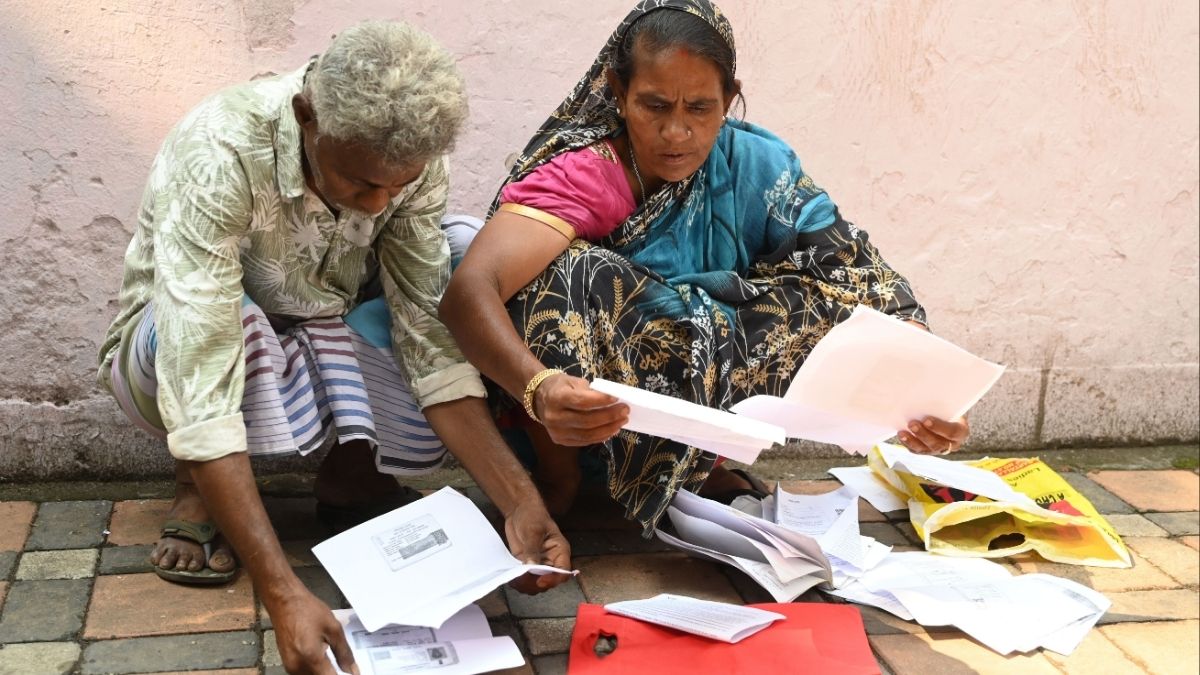
For Shabina Yasmin, voting has been a routine affair for the past three decades. She had walked to the polling booth in Entally assembly constituency in West Bengal, stood in line with her neighbours, and cast her vote without fuss. It was a routine she never thought would break. This year, it did. Her name was not on the voter list.
When she first heard about it, she did not panic. “There must be some mistake,” she told her son, holding on to the belief that systems correct themselves. She filed her appeal, gathered her documents, and waited for the electoral tribunal to hear her case. Every passing day, she held on to a small hope, that her name would be restored in time; that she would still be able to walk to the booth with her family on polling day. That hope never materialised.
Shabina was one among 12,86,148 people in West Bengal who did not get the chance to vote this election.
They are voters who existed on the rolls for years, who participated in elections, and who now find themselves excluded not by a final verdict, but by a process that did not move fast enough.
“I have voted in every election since I was married,” Shabina told THE WEEK. “This is the first time I sat at home. What changed? I am still the same person.”
What changed was the system around her. The Special Intensive Revision (SIR), introduced as a clean-up exercise for electoral rolls, was meant to remove ineligible names and strengthen the integrity of the process. But, on the ground, it has done something very different. It has created a system where inclusion depends not just on eligibility, but on the ability to prove that eligibility within a narrow window of time. For many, that window never opened.
The process began with mass exclusions. Names were pushed into the under-adjudication category for reasons that often had little to do with actual eligibility, minor spelling differences, gaps in documentation, inconsistencies in records that are common in a country where paperwork has never been perfect. Once a name entered that category, the burden shifted entirely onto the voter.
“They asked for documents from years ago,” said Wasim Aslam, a daily wage worker from a nearby district. “I don’t even have papers from last year properly. How will I show papers from 30 years ago?”
The tribunals were meant to address exactly this problem. They were set up as fast-track bodies to hear appeals, verify documents, and restore genuine voters before polling day. In theory, they were the safety valve of the system. In practice, they became its weakest link.
Out of 12,87,622 voters marked as under adjudication, only 1,486 were cleared before polling.
The numbers, when placed side by side, are startling. In the cases that were actually reviewed, more than 99.5 per cent resulted in inclusion. “It tells you one thing very clearly,” said Raghunath Chakraborty, a lawyer who appeared before one of the tribunals. “The initial exclusions were not done carefully. If almost everyone you review turns out to be eligible, then the problem is not with the voters, it is with the process that removed them in the first place.”
Yet, for the overwhelming majority, the tribunal never got around to hearing their case. Their inclusion rate is not low – it is zero. The difference between those two groups is not eligibility. It is the timing.
“The court said if your appeal is decided before the deadline, you can vote,” the lawyer explained. “But what if the system doesn’t decide your appeal at all? Then what happens to your right?” That question hung heavily over this election.
Even in constituencies where tribunals functioned, access was uneven. Of the 1,468 voters restored, 1,388 were from wholly urban areas. Only 42 came from mostly rural constituencies.
The gap is not difficult to understand. Urban voters have better access to transport, to lawyers, to information. They can reach tribunal offices, follow up on cases, and navigate paperwork. Rural voters often cannot.
“You lose a day’s wage just to go and stand there,” Mohd Raja said. “Then they tell you to come again next week. How many times can we go?”
All of this has come at a cost, not just to voters who are left running from pillar to post, but to the public exchequer that is funding a system with limited returns. Setting up and running these tribunals is not a small administrative exercise. Each one requires a presiding officer, usually drawn from the judicial or quasi-judicial pool, along with clerical staff, data entry operators, and support personnel. There are costs for renting or designating office space, arranging basic infrastructure like computers, printers, internet connectivity, record storage, and ensuring security and crowd management on hearing days.
Then come the recurring expenses, salaries, daily allowances, travel reimbursements, electricity, stationery, and the logistical costs of summoning records or coordinating with local election officials. Even if one takes a conservative view, a single tribunal can easily run into several lakh rupees over a few months of operation. When multiplied across dozens of tribunals functioning simultaneously in different districts, the figure quickly climbs into tens of crores.
What makes this spending harder to justify is the output. Despite the scale of investment, the number of voters who actually got their names restored remained relatively modest. In many cases, people either missed deadlines, struggled with documentation, or simply lost faith in the process midway.
Former Election Commissioner S.Y. Qureshi said the problem is not just financial but structural. “Public money is being spent, no doubt about that, and in significant amounts. But the real question is, what are we getting in return? If a tribunal is costing several lakh rupees to run, and only a small fraction of applicants are getting relief, then the cost per corrected entry becomes very high.”
He added that the design of the system itself limited its effectiveness. “These tribunals are being set up as a corrective mechanism, almost like a last resort. But, by the time a voter reaches this stage, the process has already become complicated and intimidating. Many people, especially in rural areas or among poorer sections, are not able to navigate it. So, you end up spending crores on a system that, in practice, helps far fewer people than it is meant to.”
In his view, the better approach would have been to invest more at the initial stage of verification itself. “If the revision process is done carefully and transparently in the first place, you don’t need such an elaborate and expensive correction mechanism later. Right now, we are putting money into fixing a problem that could have been prevented at a much lower cost,” he said.
The result is a system where the financial burden keeps growing, but the gap between those excluded and those successfully reinstated remains wide.
Shabina does not speak in terms of systems or statistics. For her, the experience is simpler, and harsher. “They say I can vote next time if everything is cleared,” she said. “But what about this time? This was also my right.” Her son said they went together to vote every time, until this year.
The quiet separation within families, within communities, was one of the least visible consequences of the process.
For over 12 lakh people, the moment to participate in this cycle of democracy was lost.
In the end, the failure of the SIR process and the tribunal system is not just about numbers or efficiency. It is about what happens when a system designed to include ends up excluding, when a mechanism meant to correct errors creates new ones, and when the right to vote becomes dependent on how quickly the machinery of the state can move.
