



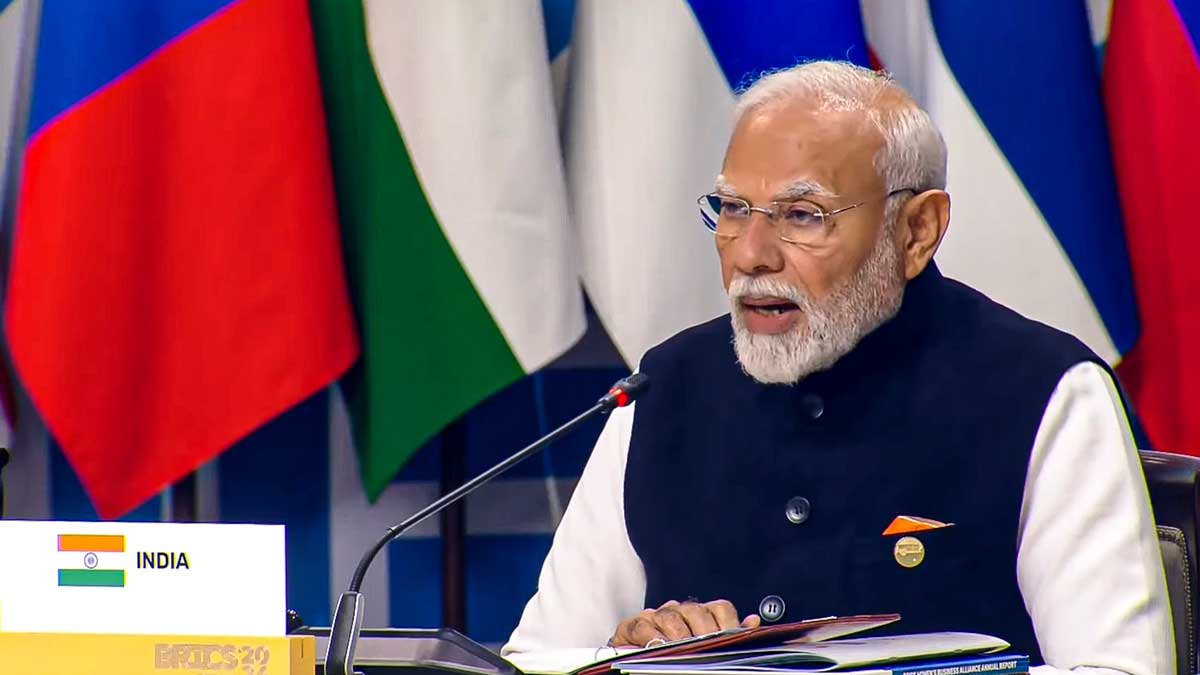
India is holding the chair of BRICS in 2026. The chair could not have come India’s way at a worse time. In the forthcoming meetings of the BRICS—foreign ministers are slated to meet in mid-May, while the heads of state will meet in a September summit—New Delhi may be cornered to take a position on the raging conflict between Iran and the US-Israel combine, a clear-cut position on which New Delhi has managed to evade till now.
The BRICS is not a homogeneous platform guided by a common political position. But widely, it has been looked at as an anti-US platform as it has avowed multilateralism while eschewing unilateralism.
Brazil, Russia, India and China together founded the organisation in 2009, while South Africa joined in 2010. At present, its 11 members include the UAE, Saudi Arabia and Iran.
The US-backed UAE and Saudi Arabia are facing Iran in a military conflict that is threatening to put the global order into turmoil, along with an impending scenario of a global economic slowdown. Iran, on the other hand, has the tacit backing of Russia and China.
India’s dilemma is evident. Besides strong historical links, it is close to Iran because of its massive energy needs. And to Israel and the US because of close military ties and collaboration.
The pressure on India is obvious. On March 21, Iran’s President Masoud Pezeshkian told Prime Minister Narendra Modi in a telephonic call that Tehran expects BRICS to play an independent role in halting aggression against Iran.
Prof Kumar Sanjay Singh, a strategic affairs commentator who teaches history in a Delhi University college, told THE WEEK: “Till date India has carefully hedged its bets. It is yet to make its position clear on the US-Israeli attack on Iran. It has been dragging its feet on demands to issue a statement from BRICS on the West Asian crisis.”
“Yet, time is running out on this strategic ambivalence. With the meeting of the foreign ministers of BRICS members slightly over a month away and the meeting of BRICS scheduled in the first half of September, India will be faced with the task of handling the rival claims of Iran and the UAE. What complicates the matter even more is that important BRICS member countries—Russia, China and Brazil—have unequivocally criticised the US-Israeli attack on Iran.”
Nor can India hedge it anymore because doing so would erode its credibility to be a leading voice of the Global South—an ambition that India has been nursing for long and is an adjunct to its policy of strategic autonomy.
By now, the Indian establishment has become fairly used to the vicissitudes of the rocking boat of strategic policy in a world full of turbulence, be it on balancing its proximate ties to the US and Russia, handling the conflict between Russia and Ukraine, or maintaining the trapeze act after the ambush terror attack by Hamas in Gaza on October 7, 2023.4
But, come May and September, Indian diplomacy may face a major challenge to its stated policy of prioritising national interest above everything else.
