



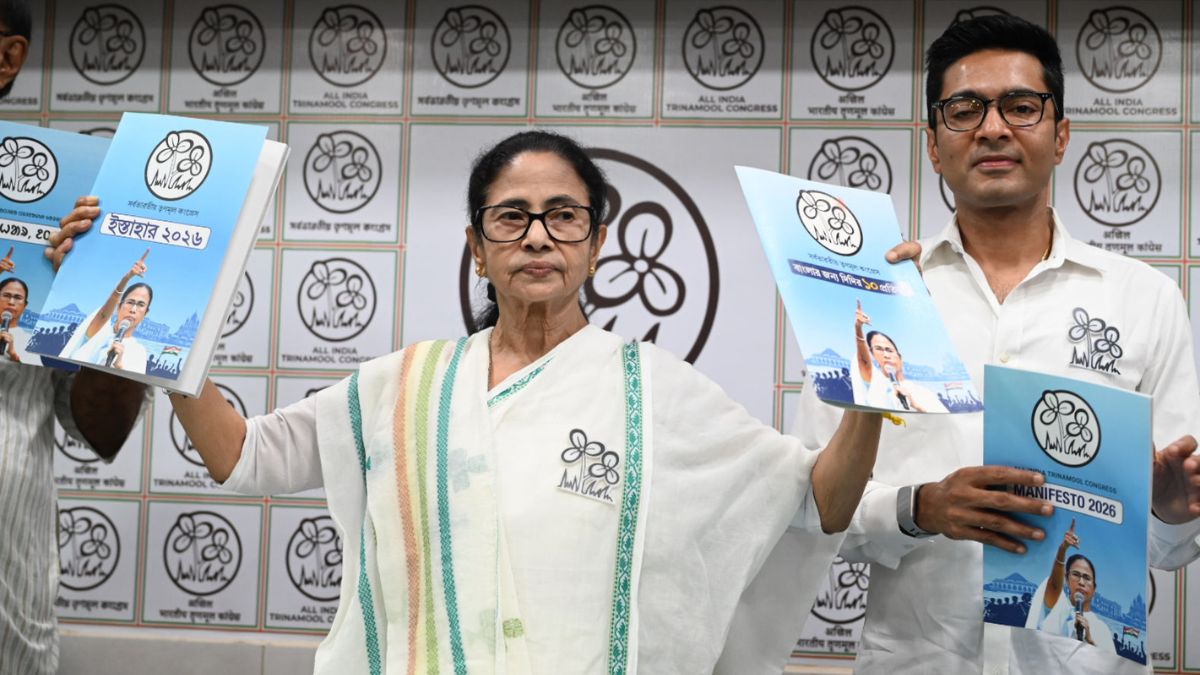
West Bengal Chief Minister Mamata Banerjee on Friday emphasised that her party, the Trinamool Congress (TMC), has consistently delivered on its promises over the last 15 years. Confident in securing a fourth term in office, Mamata stressed that the party’s manifesto highlights its commitment to the development and welfare of the state, countering the BJP’s claim that Bengal has seen little progress.
“We deliver what we promise. We don’t think anything is left for Bengal’s development,” said Mamata Banerjee as she unveiled the TMC’s manifesto, accompanied by her nephew Abhishek Banerjee.
The TMC’s manifesto outlines an ambitious vision for West Bengal, aiming to make the state the third-largest economy in India within the next decade and reach a target of a Rs 40 lakh crore economy in the next five years. A major focus is positioning the state as a power supply hub, a trade centre in Eastern India, and a thriving hub for MSMEs. The TMC wants to portray that they are not just focused on welfare schemes for the under-privileged, but also look to develop the state as a business hub, which has been a tough task to bring in key business players. After the Tata Motors exit from Singur in 2008, a move triggered by anti-land acquisition protests that propelled Mamata to power in 2011, the party aims to change the narrative and attract key business players.
Education is another key area of focus in the manifesto, with plans for 430 model schools across the state, equipped with modern technology and e-learning facilities. There are also plans for creating 25 new towns and seven new districts, expanding beyond the current 23 districts to foster growth and development.
The TMC also pledges to continue successful welfare schemes, including Lakshmir Bhandar, which provides financial support to women in rural households, and introduces a new monetary scheme for senior citizens. The government claims it has lifted 1.72 crore people out of poverty and reduced the unemployment rate for those aged 15 and above by 45.65 per cent over the last six years.
For the TMC, the battle is not only about retaining power but about demonstrating that their people-centric approach makes them the only party committed to West Bengal’s continuous development. The manifesto aims to showcase the party’s efforts across all sectors, proving that there is no viable alternative to their governance model.
