



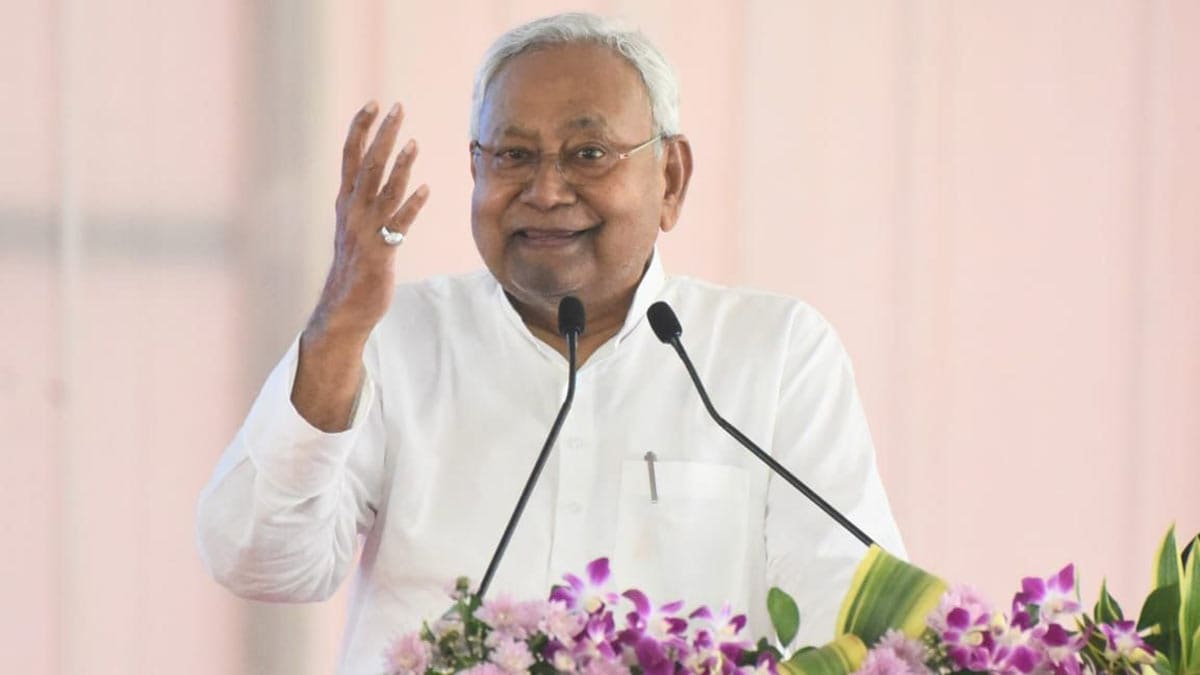
Four days after his 75th birthday, Nitish Kumar announced what Bihar had anticipated since before the Assembly elections, but few said aloud: his time as Chief Minister was over. After a record 10 oaths and nearly two decades shaping the politics of one of India’s most consequential states, Nitish is headed to the Rajya Sabha, a move many see as a quiet retirement for the last major socialist-era leader in active office.
The announcement triggers a cascade of political realignments. Kumar’s son, Nishant Kumar, 49, an engineer by training whose entry into politics had long been blocked by his father to avoid charges of dynastic politics, is set to make his political debut.
Meanwhile, Samrat Choudhary, the BJP’s Deputy Chief Minister and a long-groomed contender, has emerged as the frontrunner for the chief minister’s post, unless the BJP again springs a surprise choice. The BJP’s broader strategy in the state has also become visible through the elevation of Bihar minister Nitin Nabin as the party’s national president and his likely entry into the Rajya Sabha. At 45, Nabin represents the generational shift the party has been attempting to engineer, positioning younger leaders to dominate the next phase of politics in Bihar.
For nearly two decades, Nitish Kumar’s resistance to dynastic succession was one of his defining political positions. His contemporaries from the socialist movement — Lalu Prasad Yadav, Mulayam Singh Yadav, Sharad Yadav and Ram Vilas Paswan — all built parties that also launched their family members into politics. The Yadav surname became synonymous with the RJD; the Paswan name with the LJP. Nitish stood apart, and voters rewarded him for it. That reputation made him unusually difficult to replace.
Nitish Kumar began his political career in the anti-corruption movement led by Jayaprakash Narayan. His first major administrative role came in the Atal Bihari Vajpayee government, where he served as Railway Minister. He assumed Bihar’s top office in November 2005.
It was during this period that Kumar sought to reshape Bihar’s governance model. His government focused on restoring law and order and expanding infrastructure while introducing welfare schemes aimed at altering the state’s social coalition. Among the most visible initiatives were the bicycle scheme for schoolgirls and policies that strengthened the political base of extremely backward castes. Women voters and EBC communities became two pillars of his electoral support.
His prohibition policy, though controversial, also helped consolidate support among women voters.
Bihar is now entering a period of political fluidity. Even though the BJP will have its own Chief Minister, the opposition space is opening up. Leaders such as Tejashwi Yadav and Prashant Kishor may sense an opportunity in a political landscape no longer dominated by Nitish Kumar. The question also remains as to how Union Minister Chirag Paswan would conduct his politics, as he had also nurtured an ambition to become the state CM.
The BJP itself still depends on alliances to retain power in the state, where it has struggled to secure a majority on its own despite emerging as the single largest party in recent elections. At the same time, the party has used the coalition period to expand its social base beyond the upper castes and position itself as a broader political force. Separately, the BJP has also rewarded its general secretary Vinod Tawde, who was in charge of Bihar, by nominating him to the Rajya Sabha from Maharashtra.
How Bihar navigates the post-Nitish transition will shape its politics for years to come. His departure marks the end of a political era and the beginning of a contest among a younger generation seeking to define the state’s next phase.
