



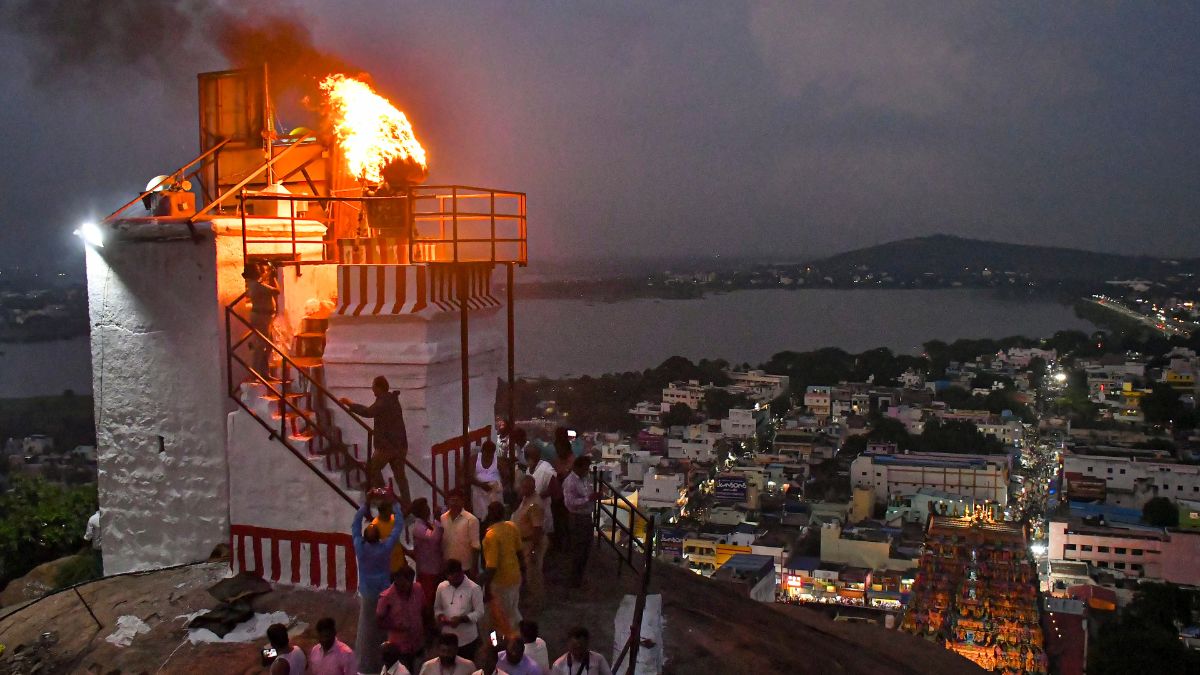
The Madurai bench of the Madras High Court on Tuesday upheld the single judge order directing the temple authorities to light the lamp on the stone pillar atop the Thiruparankundram hill, near the Dargah.
Dismissing a batch of appeal petitions filed by the state government, the Hindu Religious and Charitable Endowments (HR&CE) department and representatives of the Sikandar Badusha Dargah, a division bench of the Madurai bench of the Madras High court comprising of Justices G. Jayachandran and K.K. Ramakrishnan said the earlier judgment by Justice G.R. Swaminathan did not create a new religious practice. “It merely enabled the exercise of an existing right on temple-owned land.” A batch of appeal petitions were filed by the state government, HR and CE and the Dargah against the judgement of G.R.Swaminathan on December 1.
While upholding the single judge order, which permitted the lighting of the Karthigai Deepam on the deepathoon, the court said the act formed part of the Subramaniya swamy temple’s religious freedom and that it cannot be blocked by executive prohibitory orders or administrative objections.
The bench also said that the appellants, including the state authorities, Dargah and the HR and CE failed to produce formidable evidence to show that the agama sastra prevented lighting the lamp. “Lighting of the Karthigai Deepam is an essential religious practice of the temple. The state has no authority to interdict such practice by invoking prohibitory orders, when the land on which the practice is sought to be performed does not belong to the objector.”
Stating that the apprehension of law and order was “an imaginary ghost” created by the state authorities for their convenience to put one community against the other under suspicion, the court said that the district administration should have taken the issue as an opportunity to bridge the gap between the communities through mediation. “Public order is not a talisman to defeat constitutional guarantees. The executive orders under Section 163 of the Bharatiya Nagarik Suraksha Sanhita cannot override a judicial command, particularly when the apprehension is speculative and not founded on past disturbance attributable to the act itself”.
While the state argued that the devotees who moved the single judge seeking the lighting of the lamp at the Thirupparankundram hills cannot be claimed the same as legal right and Article 226 powers cannot be used to change a custom in existence for a long time, the bench held that the single judge had not mandated an exclusive or singular relocation of the deepam. “The impugned order does not prohibit lighting of the deepam at the Uchippillaiyar mandapam or other customary locations. It merely permits lighting of an additional lamp at a place found to be within the temple’s domain,” it added.
The bench also held that the collector’s prohibitory order was issued after the single judge’s directive and appeared to be designed to neutralise it. “The sequence of events gives rise to a reasonable inference that the prohibitory order was passed as a defensive measure to avoid compliance,” the bench said in its order.
The state government, however, chose to go on an appeal to the Supreme Court against the Division bench order. Tamil Nadu Law minister S. Raghupathy categorically denied lighting of the lamp on the hilltop. “There has been a customary practice. Why should we change it? There is no evidence to show that the practice of lighting lamp at a stone pillar near the dargah on the Thirupparankundram hill during Karthigai deepam had ever existed, at least in the last 100 years.” He said the court carried an “hidden agenda”. Stating that the stone pillar atop Thirupparankundram hill was not a deepathoon, he said the culture and traditions of the people of Tamil Nadu should be preserved.
The lamp lighting row
The ancient hill of Thiruparankundram has become the epicentre of a religious controversy. A legal battle over the act of lighting a lamp has challenged the tradition backed by centuries of complex and layered history. In Tamil Nadu, there are six abodes of Lord Muruga and the first of the six abodes is Thiruparankundram, a small town in Madurai. The others include Palani, Thiruthani, Thiruchendur, Swamimalai and Pazhamuthircholai. And Karthigai Deepam, is one of the auspicious festivals, which falls in November-December, celebrated with religious fervour in all the six abodes and the Lord Shiva shrines across Tamil Nadu. An oil lamp is usually lit in these abodes. But off all the six abodes, the Thiruparankundram temple assumes significance as it is the first abode of Lord Muruga where he is believed to have married his first wife Theivanai, the princess of heaven and the daughter of Lord Indra after slaying the demon king Soorapadhman. And the Murugan deity here is in a sitting posture with his consort Theivanai.
The current row over lighting the lamp came up after Rama Ravikumar, an Hindu activist, who is also running a party, moved the Madurai bench of the Madras High Court seeking direction to the government to make arrangements to light an oil lamp on a sacred pillar atop the hillock on the day of Karthigai Deepam festival. Justice G.R. Swaminathan of the Madurai bench of the Madras High Court passed an order allowing Ravikumar’s petition which led to the chaos and the confusion in the peacefully celebrated festival.
