



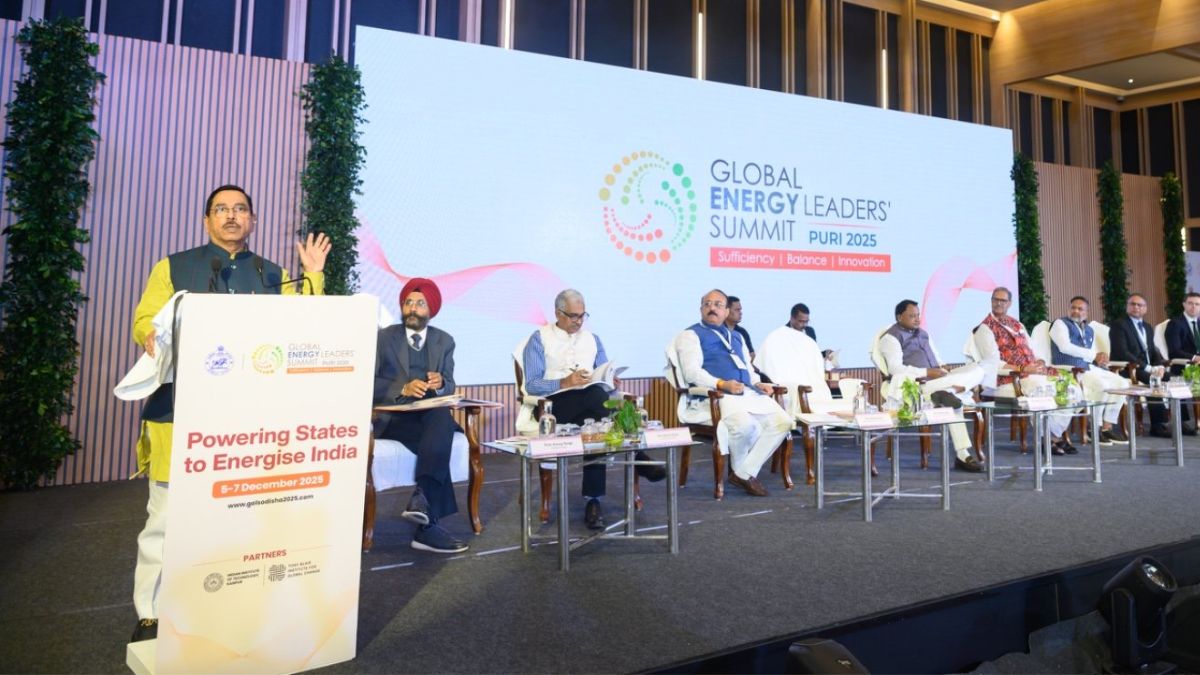
India’s solar energy journey has seen an extraordinary leap. “In just the last 11 years, the country’s solar capacity has grown from 2.8 GW to about 130 GW, a rise of more than 4,500%,” Union Minister Prahlad Joshi said at the Global Energy Leaders’ Summit (GELS) 2025, held at Taj Resorts in Puri.
The summit, organised by the Government of Odisha from 5–7 December, in collaboration with the Tony Blair Institute for Global Change and IIT-Kanpur, marks India’s first state-led global forum on clean energy. It convenes senior policymakers, industry leaders, and technology experts to shape the country’s clean energy path, culminating in the release of the Puri Declaration.
As global solar installations crossed the 2 terawatt (2000 GW) mark in 2024, Joshi highlighted the speed of this revolution: “The world needed almost 70 years to reach the first terawatt, but only two years to double it. That is how quickly solar power is accelerating.” He added that between 2022 and 2024, India became the third-largest contributor to global solar capacity, adding 46 GW during that period.
This momentum reflects strongly in the current fiscal year. As India recorded its highest-ever non-fossil capacity addition at 31.25 GW, including 24.28 GW of solar.
Joshi applauded Odisha’s green push.“I wholeheartedly congratulate Chief Minister Shri Mohan Charan Majhi ji, Deputy Chief Minister Shri Kanak Vardhan Singh Deo ji, and the proud people of Odisha. You are doing truly wonderful work.” He recalled positive experiences from his earlier visits as Coal and Mines Minister, noting Odisha’s cooperation in supporting coal production and resolving local issues.
India, he emphasised, holds the 5th largest coal reserves in the world (361.41 billion tonnes) and remains the second-largest consumer of coal. Yet, the country is deliberately balancing this strength with a rapid shift toward renewables. “Renewables are clean, decentralised, and empower people. They turn consumers into prosumers,” he said.
