



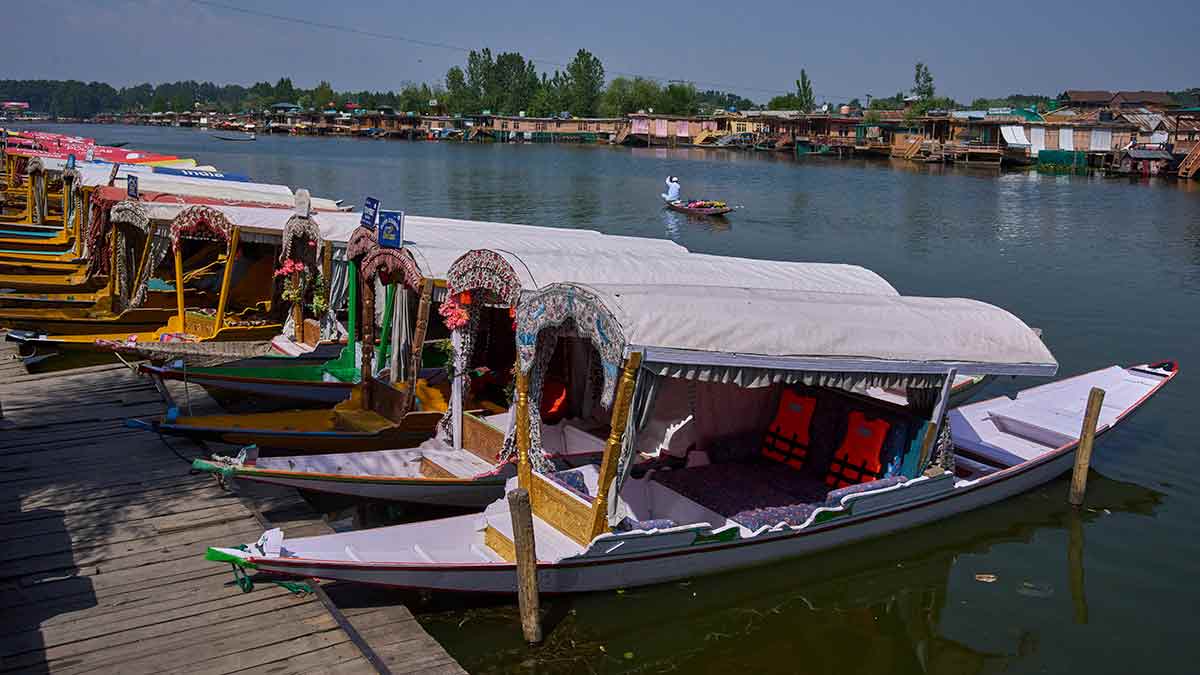
Six months after the deadly terror attack at Baisaran meadows in Pahalgam that claimed 26 lives, mostly tourists, Kashmir’s tourism industry continues to reel under its impact.
What was expected to be a record year for tourism has instead turned into financial distress for one of the most important sectors of Kashmir’s economy.
Soon after the attack, thousands of tourists fled Kashmir in panic. More than 15,000 flights to Srinagar were cancelled in the days following the attack, and around 13 lakh bookings scheduled for August were also withdrawn.
Since then there has been no recovery, despite efforts by the government and tour operators.
The figures tell the story clearly. In the first six months of 2025, Kashmir received 7,53,856 tourists, including 15,319 foreigners and 7,38,537 domestic visitors — a drop of nearly 52 per cent compared to the same period in 2024, when 15,65,851 tourists had visited the Valley, among them 25,995 foreigners. The slump becomes even more striking when compared with 2023, when the region recorded 13,63,980 tourists during the first half of the year. What had been a steady rise in arrivals between 2023 and 2024, with a 14.8 per cent increase overall, has now been abruptly reversed, leaving many stakeholders fearful about the future.
According to Gowhar Maqbool Mir, President of the Kashmir Hotels and Restaurant Owners Association (KHAROA), the situation continues to be grim for tourism-related businesses across Kashmir.
“KHAROA has around 1,200 members, including hoteliers and restaurant owners, all of us struggling to stay afloat,” he said. “There have been lots of job losses due to the huge decline in tourist arrivals after the Pahalgam incident.”
Farooq A. Kuthoo, President of the Travel Agents Association of Kashmir (TAAK), painted an even more depressing picture. “Despite all the efforts made by stakeholders, the response is very poor,” he said. “The Government of India must take an active part in getting Kashmir back as a tourism destination.”
He said that compared to last year, bookings and enquiries have dropped by more than 80 per cent. “For winter also, there is a massive drop in the number of enquiries compared to last year,” he added. “The industry is on a ventilator currently.”
According to him, this is happening at a time when Kashmir was bracing for record-breaking tourist footfall. “The Pahalgam incident has hit tourism in Kashmir really hard. The crisis was exacerbated by bad press,” he said.
“Tourist occupancy has reduced by 90 per cent, and there have been more than 70 per cent job losses across the sector. Those who have taken loans to invest in tourism-related businesses, like cab owners, are the worst hit.”
Manzoor Pakhtoon, Chairman of the Houseboat Owners Association (HBOA), said the investments people have made in tourism-linked businesses have become a huge liability. “Some years back, the bed capacity in Kashmir, including Srinagar, Gulmarg, Pahalgam and other destinations, was 62,000 rooms,” he said. “Currently, there are around 200,000 beds — and 95 per cent are empty.” Those who have taken loans are suffering as they struggle to pay their monthly instalments. He said the government’s efforts to woo back tourists have not succeeded. “Chief Minister Omar Abdullah travelled with us outside Kashmir, but the situation continues to remain grim,” he added.
Hotels without guests on the banks of the famed Dal Lake reflect the crippling impact of the Pahalgam attack on tourism in Kashmir.
An employee of Hotel Sunshine at Dal said they were offering rooms for Rs 1,500 due to zero occupancy. “The same room during good times would fetch Rs 8,000 and above,” he said. “First it was the Pahalgam attack, then Operation Sindoor, and now the disruption of traffic on the Srinagar–Jammu highway has scared potential tourists away.”
Nearby, a female official at Hotel Paradise Premium, a four-star property, said all their 30-plus rooms were without any guests.
“We used to receive requests for advance bookings, but currently, our hotel is empty,” she said. Another property adjacent to the hotel was offering rooms for less than Rs 2,000.
A similar situation exists at Hotel Shah Abbas, one of the attractions on the banks of Dal Lake. “The business has taken a hit,” said a staff member at the reception. “It started with the Pahalgam attack, followed by the floods and the shutting down of the Srinagar–Jammu national highway.”
The downturn has also affected those working behind the scenes — guides, handicraft sellers, pony owners and small shopkeepers who rely on tourist spending.
Experts estimate that tourism contributes about 5 per cent to Jammu and Kashmir’s Gross State Domestic Product, roughly Rs 10,000 crore a year when multiplier effects are considered. With the hotel industry alone contributing about Rs 2,700 crore annually, the current slump could have wide-ranging effects on the overall economy.
The Union Territory’s GSDP had grown by more than 7 per cent in each of the last two financial years, and any prolonged slowdown in tourism could dampen that growth and discourage future investment in the hospitality sector.
There is a consensus among tourism-related businesses that unless the Prime Minister’s Office gets directly involved in encouraging tourists to visit Kashmir, the situation is unlikely to change.
